Is Intel About to Launch a Chip for the AI PC?
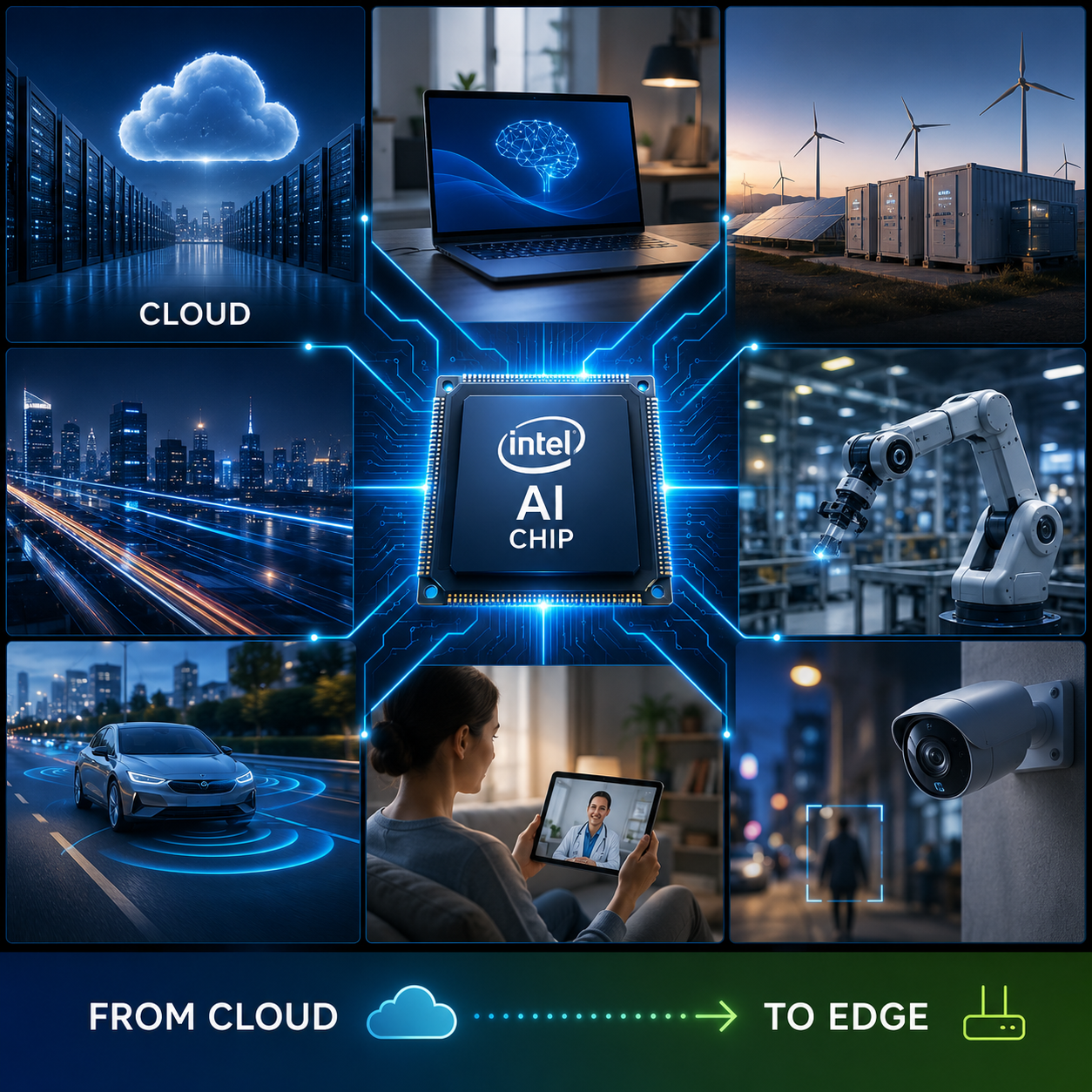
Why artificial intelligence may be moving closer to the user
For much of the past decade, artificial intelligence has become increasingly centralised. As AI models grew larger and more powerful, they also became more dependent upon massive data centres, cloud infrastructure and specialised computing hardware.
Today, most people associate AI with cloud-based services. Questions are sent to remote servers. Images are generated in distant data centres. Increasingly powerful models depend upon increasingly powerful infrastructure. Yet a different trend is beginning to emerge.
Intel, alongside other technology companies, is investing heavily in a new generation of processors designed specifically to run artificial intelligence directly on personal computers. The development raises an interesting question. Is the technology industry preparing for a future in which AI no longer lives primarily in the cloud, but increasingly operates on the device itself?
The Rise of the AI PC
The concept of an AI PC is relatively simple. Traditional computers rely primarily on central processing units (CPUs) and graphics processors (GPUs). Newer AI-focused systems add a third component: a Neural Processing Unit (NPU).
These specialised processors are designed to perform AI-related tasks more efficiently than conventional chips. Rather than sending every request to a remote server, some functions can be processed locally.
This allows computers to perform tasks such as:
- Real-time language translation
- Voice recognition
- Image enhancement
- Personal assistants
- Content generation
- Productivity tools
without requiring constant communication with the cloud.
For users, the change may appear subtle. For the technology industry, however, it could represent a significant architectural shift.
Why Now?
The timing is not accidental. Artificial intelligence is creating enormous demand for computing infrastructure. Technology companies are investing billions in data centres, electricity networks and specialised processors to support growing AI workloads.
At the same time, AI models are becoming more efficient. Not every task requires access to the largest and most powerful systems. Many everyday functions can now be performed by smaller models operating directly on a device.
This creates an opportunity. Rather than sending every interaction across networks to distant servers, some AI functions can move closer to the user.
The challenge is not merely technological. It is increasingly physical. Every AI request processed in a distant data centre consumes computing resources, electricity, cooling capacity and network bandwidth. As AI adoption grows, distributing some intelligence closer to the user becomes not only economically attractive, but potentially necessary.
The future of AI may be determined as much by physics and energy as by software.
The result is often faster responses, lower operating costs and reduced dependence on cloud infrastructure.
The Return of Edge Computing
The AI PC is also part of a broader shift towards what the technology industry calls edge computing: moving intelligence closer to where data is created and decisions are made.
For years, computing moved towards centralisation. Cloud platforms offered scale, flexibility and access to vast computing resources. Yet centralisation also created new dependencies.
Every request must travel across networks. Every interaction depends upon remote infrastructure. Every increase in demand requires additional data-centre capacity.
Edge computing offers a different model. Rather than concentrating all intelligence in a handful of facilities, some processing occurs directly on devices, industrial systems, vehicles or local networks.
The AI PC is not simply a new computer. It may be an early glimpse of a new computing architecture.
The AI PC may therefore represent one of the first mass-market examples of a broader movement towards distributed intelligence.
Intel’s Second Chance
For Intel, the emergence of the AI PC represents more than a product cycle. The company faces intense competition in the rapidly expanding market for data-centre AI accelerators. While competitors have become synonymous with large-scale AI infrastructure, Intel retains a different strategic asset: its position inside hundreds of millions of personal computers around the world.
If artificial intelligence increasingly moves towards the endpoint, that position may become extremely valuable. This helps explain Intel’s growing focus on dedicated AI capabilities within client processors and its efforts to encourage software developers to optimise applications for local AI execution.
The objective is not merely to build faster computers. It is to make artificial intelligence a native feature of everyday computing.
When AI Becomes an Application
Perhaps the most important aspect of the AI PC is not the hardware itself. It is what the hardware makes possible. Today, many people actively seek out AI services. They open a chatbot, access a platform or visit a specific application.
In the future, AI may become far less visible. Instead of existing as a separate destination, it may become integrated into ordinary software. Word processors could assist with writing automatically. Spreadsheets could analyse data in real time. Operating systems could organise information, search files and automate routine tasks without users consciously activating AI tools.
Future AI PCs may even host personal AI agents capable of interacting with local files, applications and workflows without continuously relying on cloud services. In this scenario, artificial intelligence becomes less like a product and more like a standard computing capability.
The most successful AI may eventually become the AI we no longer notice.
Much as internet connectivity eventually became an expected feature of every device, AI may become a standard layer embedded throughout digital systems.
Beyond Convenience
The implications extend beyond user experience. Running some AI workloads locally may reduce pressure on data centres, lower network traffic and improve privacy for certain applications.
Sensitive information may no longer need to leave a user’s device for every AI-assisted task. For businesses and governments alike, this could become increasingly important as concerns surrounding data security and digital sovereignty continue to grow.
Not all AI processing will move away from the cloud. Large models and computationally intensive workloads will continue to depend upon powerful infrastructure. Yet the future may not be entirely centralised or entirely local. Instead, computing could become increasingly hybrid.
Some tasks will remain in hyperscale data centres. Others will operate directly on personal devices. Intelligence may become distributed across multiple layers of infrastructure rather than concentrated in a single location.
From Cloud AI to Distributed Intelligence
The debate surrounding artificial intelligence often focuses on larger models and larger data centres. Yet the future may involve something different. Rather than concentrating intelligence in a handful of locations, computing may become increasingly distributed across clouds, devices, networks and specialised hardware.
The AI PC may therefore represent more than a new product category. It may offer an early glimpse of how the architecture of intelligence itself is evolving.
A New Computing Cycle?
The personal computer transformed digital life by bringing computing power to individuals. Cloud computing later shifted many capabilities back towards centralised infrastructure.
The AI PC may represent another stage in that evolution. Whether Intel ultimately dominates this market remains uncertain. Other technology companies are pursuing similar strategies, and the competitive landscape continues to evolve rapidly.
Yet the broader trend is becoming increasingly visible. The future of artificial intelligence may not depend solely on larger models and larger data centres. It may also depend on bringing intelligence closer to where people actually use it.
And that could make the AI PC one of the most important technology stories of the coming decade.

Credit
Visual: AI-generated illustration (OpenAI/DALL·E), concept and editorial direction by Altair Media.
Caption
From Cloud to Edge. The AI PC may be only the beginning. As specialised AI chips spread across devices, vehicles, factories and healthcare systems, the architecture of intelligence itself may become increasingly distributed.
