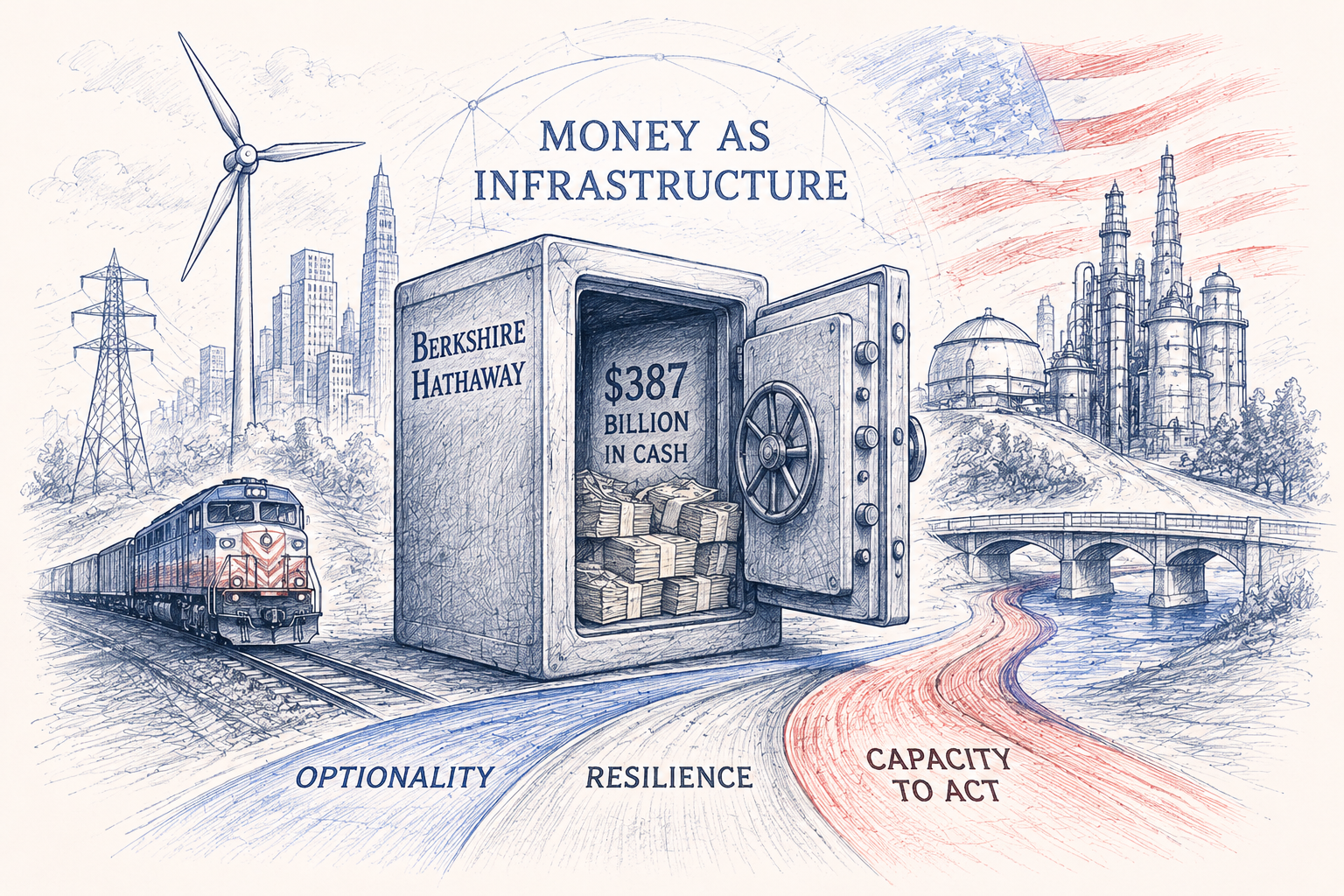
Berkshire Hathaway’s vast liquidity is often interpreted as caution. Yet in an age increasingly defined by uncertainty, cash may represent something more profound: reserve capacity, strategic optionality and the ability to act when resilience becomes more valuable than efficiency.
Macro
Economic forces and policy dynamics shaping interest rates, inflation, growth and the broader direction of markets.

America’s economy has never been larger or more financially sophisticated. Yet for many citizens, markets, debt and asset prices increasingly feel disconnected from everyday experience. This article explores how financial abstraction is reshaping the relationship between economic indicators and lived reality.

Money once carried physical weight, visible limits and emotional meaning. Today it increasingly moves invisibly through apps, algorithms and digital infrastructure. As finance becomes faster and more abstract, societies may also be losing their connection to value, trust and economic reality itself.

The Federal Reserve’s decision to hold rates steady signals more than caution. It reflects a system shaped by conflicting forces — persistent inflation, geopolitical shocks and uncertain growth — where monetary policy is no longer directional, but increasingly reactive to a shifting macro environment.
