The Meaning of Money
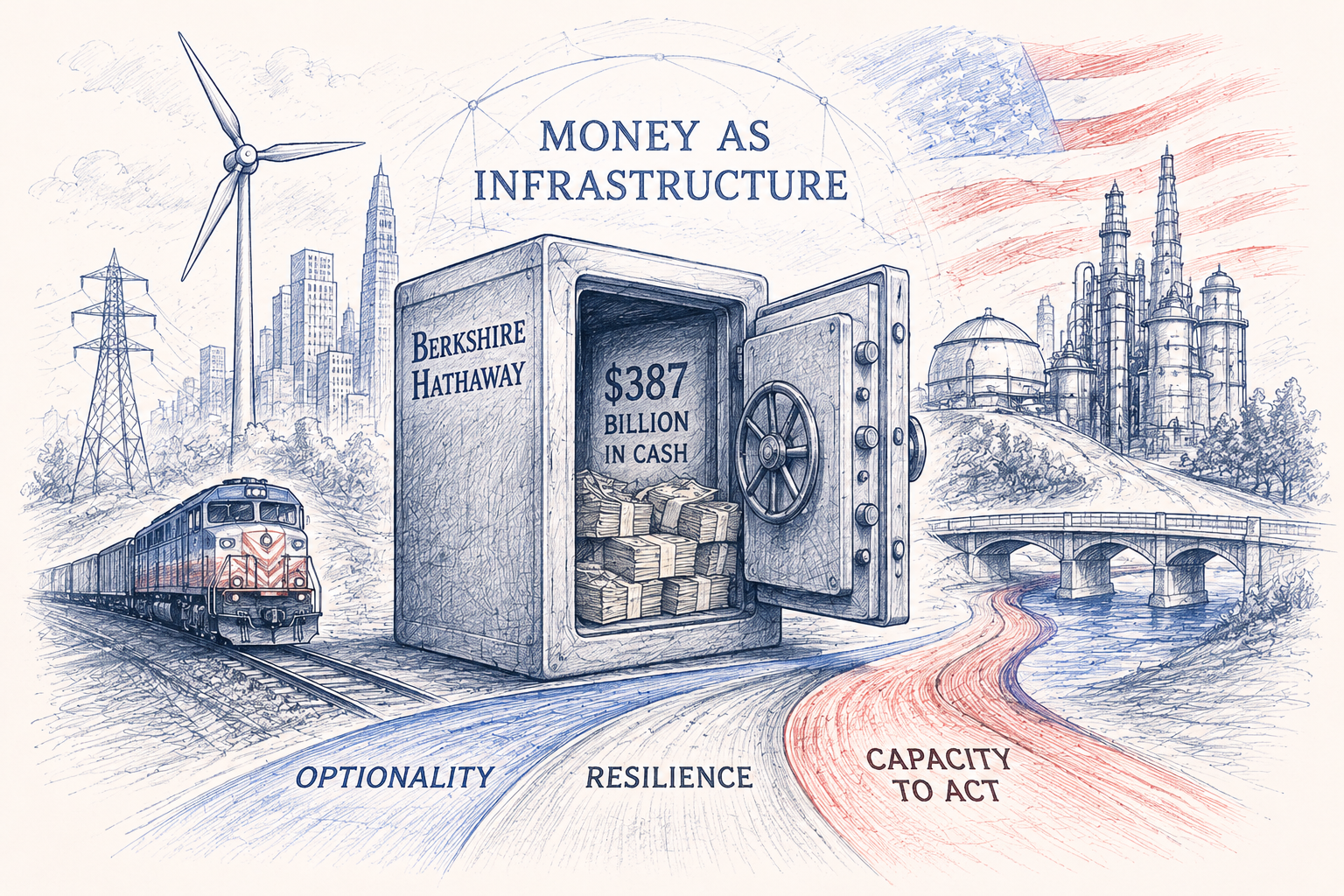
When Liquidity Becomes Infrastructure
Berkshire Hathaway currently holds nearly $400 billion in cash and short-term securities. For many investors, such a balance sheet signals caution. Some see an expectation of a market correction. Others interpret it as preparation for recession, geopolitical instability or financial turbulence. But perhaps these interpretations miss a more fundamental question.
What if Berkshire Hathaway’s growing liquidity tells us less about markets and more about the changing meaning of money itself?
For generations, money was understood primarily as a medium of exchange, a store of value and a source of investment capital. Cash was expected to be deployed, invested and optimised. Idle capital was considered inefficient.
Yet in an era increasingly defined by uncertainty, a different understanding may be emerging.
The Return of Buffers
For decades, economic systems were built around efficiency. Supply chains became lean. Inventories were reduced. Financial leverage expanded. Idle capacity was viewed as wasteful and reserves as inefficient. Today, however, societies increasingly appear to be moving in the opposite direction.
Governments are building strategic stockpiles of critical minerals. Energy systems maintain reserve capacity. Semiconductor supply chains are being redesigned for resilience rather than maximum efficiency. Nations are rediscovering industrial capabilities once considered expendable.
Buffers are returning. The same logic may increasingly apply to capital.
Berkshire Beyond Investing
Berkshire Hathaway is often portrayed as an investment vehicle, but it increasingly resembles something else: an infrastructure system.
For decades, Warren Buffett became synonymous with capital allocation itself. Yet under the operational stewardship of Greg Abel, Berkshire has quietly assembled a sprawling physical foundation of railroads, energy utilities, transmission networks, industrial businesses and insurance operations.
These assets do not simply generate profits. They provide continuity, reliability and long-term stability. Within that architecture, liquidity takes on a different role. Cash becomes less a question of yield and more a question of capability.
Capability to invest when markets seize up. Capability to support businesses during downturns. Capability to acquire assets when others are forced to sell. Capability to maintain strategic flexibility when uncertainty increases.
Money may increasingly function as infrastructure. Not because it produces the highest returns, but because it preserves the ability to act.
The Economics of Optionality
Seen through this lens, Berkshire’s balance sheet resembles less a portfolio and more a reserve system.
Electricity grids maintain spare capacity to ensure reliability. Governments hold strategic reserves for emergencies. Infrastructure networks are designed with redundancy because societies cannot function without them.
Perhaps liquidity serves a similar purpose. The twentieth century rewarded optimisation. The twenty-first century may reward resilience. The return of higher interest rates further alters this equation.
For much of the previous decade, holding large cash reserves imposed a significant opportunity cost. In a world of near-zero interest rates, liquidity earned little.
Today, however, substantial reserves can generate meaningful income while preserving strategic flexibility. Liquidity no longer necessarily represents idle capital. It increasingly resembles reserve capacity. Financial optionality with a yield.
Capital in an Age of Uncertainty
This shift extends far beyond Berkshire Hathaway.
Artificial intelligence requires enormous investments in energy systems, data centres and physical infrastructure. Industrial policy is returning. Supply chains are becoming regionalised. Energy transitions demand unprecedented levels of capital expenditure. Geopolitical fragmentation increases uncertainty about future market access and resource availability. Under such conditions, access to patient and available capital becomes a strategic asset.
In the twentieth century, money financed infrastructure.
In the twenty-first century, money itself may become infrastructure.
The Meaning of Money
The question, then, is not why Berkshire Hathaway maintains extraordinary levels of liquidity. The more interesting question is whether modern economies possess sufficient financial buffers to navigate an increasingly volatile world.
If energy is infrastructure and data is infrastructure, perhaps money itself is becoming infrastructure as well.
In that case, Berkshire Hathaway’s cash mountain tells a story that extends far beyond financial markets. It may offer a glimpse into the architecture of the next economic era.
An era in which the meaning of money is no longer defined solely by what it earns, but by what it allows societies, institutions and companies to do when conditions become uncertain.
This article is part 5 of The Infrastructure Shift – Greg Abel and the Rewiring of Capital, a series exploring how infrastructure, energy and systems are reshaping capital allocation.
Its broader themes are developed in The Infrastructure Age, which examines how capital increasingly behaves as a layer of modern infrastructure.
Credit: Illustration by ChatGPT for Altair Media US (The Infrastructure Age, 2026).
Caption: Liquidity as infrastructure. Berkshire Hathaway’s evolving architecture suggests that money may increasingly function not merely as capital, but as reserve capacity within a more uncertain world.
