The Ethics of Trust
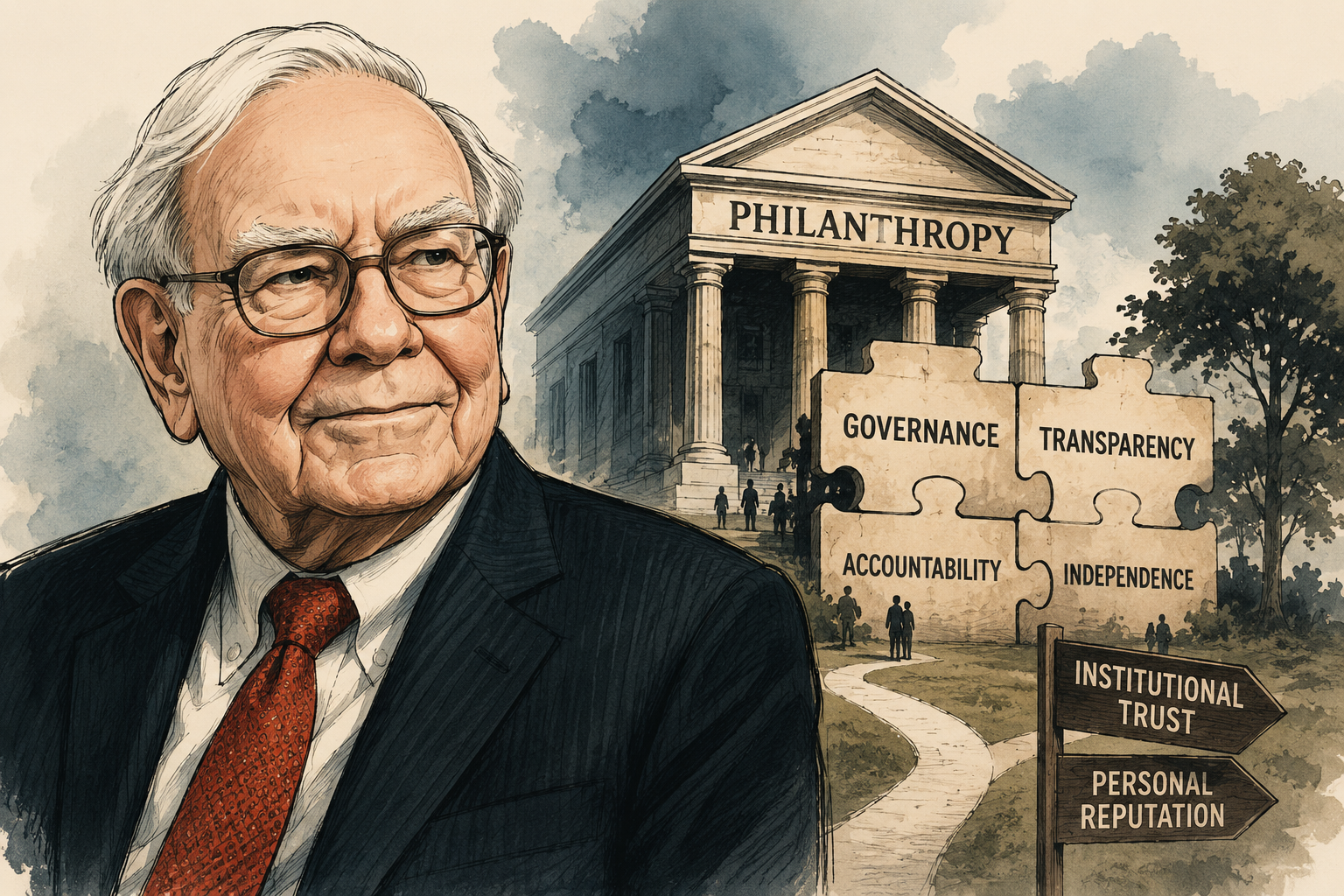
When Philanthropy Outgrows Its Founders
SIGNAL
Warren Buffett’s decision to redirect billions away from the Gates Foundation raises a larger question: in an era of immense private wealth, can philanthropic institutions preserve public trust independently of the individuals who created them?
Modern philanthropy has become one of the most influential forces shaping contemporary society. Private foundations finance medical research, global health programmes, education, climate initiatives and technological innovation at a scale once reserved for governments. Their resources increasingly influence not only charitable outcomes but also public priorities.
Warren Buffett’s decision to redirect his future charitable giving away from the Gates Foundation has therefore attracted attention far beyond philanthropy itself. Buffett has explained the move as part of a long-planned revision of his estate strategy and his confidence in his children’s ability to steward his wealth. Yet the announcement also coincides with renewed public scrutiny surrounding Bill Gates’ past association with Jeffrey Epstein.
The core issue is neither Buffett’s motivation nor Gates’ personal legacy. It is structural.
Can institutions built on extraordinary private wealth remain trusted when confidence in their founders becomes contested?
That question extends far beyond one foundation. It reaches into the ethical architecture of modern philanthropy itself.
🟦 When does a philanthropic institution become larger than its founder?
Most major foundations begin as the expression of an individual’s vision. Over time they evolve into global institutions, employing thousands of professionals, supporting programmes across continents and influencing public policy long after their founders step aside.
Yet public perception rarely follows that institutional evolution. The reputation of the organisation often remains inseparable from the reputation of the individual whose name it carries.
That is philanthropy’s first paradox: institutions are designed to outlive their founders, while public trust often remains deeply personal.
🟦 Can governance compensate for damaged reputation?
Large philanthropic organisations invest heavily in governance. Independent boards, professional management, external audits and transparency frameworks are all intended to ensure that institutional decisions do not depend upon one individual.
Yet governance alone cannot manufacture legitimacy.
Institutions may satisfy every formal requirement while still confronting profound questions about credibility. Ethical trust is earned not only through compliance, but through confidence in the values an institution is perceived to embody.
🟦 Should philanthropy depend on extraordinary individuals?
Modern philanthropy celebrates visionary founders—their wealth, ambition and willingness to tackle problems governments often struggle to solve.
Yet concentrating extraordinary charitable resources around a small number of individuals also concentrates ethical risk.
If the credibility of billion-dollar institutions depends upon the judgement of a handful of people, society inevitably inherits their personal vulnerabilities.
The question is therefore no longer simply whether philanthropists should give. It is whether modern philanthropy has become overly dependent on personal authority at the expense of institutional resilience.
🟦 What does Buffett’s decision reveal about trust?
Taken at face value, Buffett’s explanation is straightforward. His children are now prepared. The Gates Foundation has ample resources. His long-term estate planning has changed.
Those reasons are entirely plausible.
Yet timing shapes public interpretation. Even when governance decisions are unrelated to controversy, they are inevitably viewed through the broader public conversation surrounding them.
In ethics, perception cannot simply be dismissed. Institutions may remain unchanged while the trust surrounding them shifts dramatically.
🟦 Is philanthropy entering a more distributed era?
Perhaps the most revealing aspect of Buffett’s announcement is not where future donations will no longer go, but where they will.
Rather than reinforcing one already powerful institution, Buffett has chosen several family foundations with distinct responsibilities.
This reflects a broader trend visible across finance, technology and governance. Increasingly, resilience is associated not with a single centre of authority, but with distributed institutions capable of reinforcing one another.
Whether philanthropy ultimately follows that path remains uncertain. Yet Buffett’s decision suggests that future legitimacy may depend as much on resilient institutional networks as on extraordinary individual benefactors.
The Friction
Institutions seek stability through scale. Public trust, however, remains profoundly personal.
When the legitimacy of an organisation cannot be separated from the reputation of its founder, institutional scale may increase vulnerability rather than resilience. The larger the institution becomes, the greater the consequences when personal credibility comes under pressure.
That tension is no longer unique to philanthropy. It increasingly shapes universities, technology companies, financial institutions, media organisations and governments alike.
SIGNIFY
Modern philanthropy commands unprecedented financial resources. Its greatest challenge may no longer be generosity. It may be legitimacy.
The long-term success of philanthropic institutions will depend not simply on the wealth they distribute, but on their ability to earn public trust independently of the individuals who first created them.
Warren Buffett’s decision may ultimately be remembered as more than a change in charitable giving. It may mark another step in a broader transition—from philanthropy built around extraordinary personalities to philanthropy judged by the strength of its institutions.
Credit
Illustration by ChatGPT for Altair Media.
Caption
Warren Buffett’s decision to redirect his future charitable giving invites a broader discussion about institutional legitimacy, governance and the ethical foundations of modern philanthropy. As private foundations grow in scale and influence, public trust may increasingly depend on institutions proving they can stand independently of their founders.
