The Meaning of Imperfection
Why the marks we once tried to remove may be becoming part of what we value
The Human Hand
Perfection has always held a strange attraction. We polish surfaces until they are smooth, straighten lines until they are exact and refine objects until traces of their making almost disappear. Industrial production made that consistency scalable. Digital technology took it further, allowing images, shapes and surfaces to be reproduced with extraordinary precision.
Yet in the work of Dutch artist Denise Buisman Pilger, something very different happens.
Fibres escape their intended direction. Edges remain uneven. Water carries colour further than expected. Handmade Washi retains variations from one sheet to another. Instead of automatically correcting these moments, Buisman Pilger sometimes allows them to change the direction of the work itself. That raises a deceptively simple question.
When does an imperfection stop being a flaw and become part of the art?
🟦 What Do We Mean by Imperfection?
In industrial production, imperfection usually has a straightforward meaning. A deviation from the intended result is something to measure, reduce or eliminate. Art has never been quite so simple.
A brushstroke can move beyond its intended boundary and alter the balance of a composition. Pigment can spread through paper differently than anticipated. A fibre can settle in a direction the artist had not planned. The important moment comes next. Does the artist correct it? Or does she respond to it?
For Buisman Pilger, working with handmade materials creates space for precisely those decisions. The objective is not to celebrate every accident, but to recognise when the unexpected introduces something that a perfectly controlled process would never have produced.
Imperfection, in this sense, is not carelessness. It is the space between intention and response.
🟦 Can Mastery Include Letting Go?
Craftsmanship is often associated with control. The experienced maker understands tools and materials well enough to produce increasingly predictable results. But artistic mastery can require something else as well: knowing when not to correct.
Imagine a composition beginning to move in an unexpected direction because water has travelled differently through the paper. The technically obvious response might be to restore the original intention. The artistic response may be to reconsider the intention itself. That distinction is central to Buisman Pilger’s practice.
Experience does not merely help her eliminate deviations. It gives her the judgement to decide which deviations should remain, which should be developed further and which genuinely weaken the work.
Her observation about rules therefore acquires a deeper meaning:
“I’ve decided to stop following rules I didn’t write.”
Those rules can be cultural as much as technical: the expectation that edges should be clean, surfaces controlled and finished works resolved according to predetermined ideas of order.
Letting go of those expectations does not remove discipline. It creates room for another kind of discipline: the ability to recognise possibility inside deviation.
🟦 Why Do Traces of Making Matter?
Look closely at a handmade object and its history often remains visible.
A variation in an edge can reveal the movement of a hand. Differences in fibre density can show how a surface was formed. A shift in colour can preserve the route taken by water. Tension in a structure can reveal a decision made while the work was still changing. These details are not merely visual characteristics.They are traces of time.
An irregularity may preserve a particular moment: the instant an artist added more water, changed pressure, allowed a fibre to remain where it had settled or decided not to intervene.
The finished artwork therefore contains something that the viewer cannot necessarily reconstruct but can nevertheless encounter: a record of decisions made over time. That changes how we might understand imperfection. What appears to be an irregularity may actually be a fragment of the work’s history.
🟦 Has Technology Changed Our Relationship With Perfection?
For much of modern industrial history, technical progress meant reducing variation. Machines produced objects more consistently than hands. Digital tools made lines perfectly straight, colours repeatable and copies virtually indistinguishable from their originals.
Artificial intelligence adds another dimension. It can generate polished visual possibilities almost instantaneously, while the visual language of imperfection itself can increasingly be reproduced: grain, asymmetry, distressed surfaces, irregular edges and handmade textures.
A surface can therefore look handmade without having been made by hand. That does not make digital or AI-assisted work inherently less creative. But it does make the distinction between appearance and origin more interesting.
The question is no longer simply whether something looks imperfect. It becomes: how did the imperfection get there?
🟦 Can Imperfection Be Designed?
This creates an intriguing paradox. Once irregularity becomes desirable, it can become an aesthetic in its own right. Furniture can be deliberately distressed. Digital filters can introduce grain. Typefaces can simulate handwriting. Algorithms can produce asymmetry and apparent randomness.
All of these can create convincing visual imperfection. But visual irregularity and material uncertainty are not quite the same thing. One begins with a desired appearance. The other emerges because the process itself remains partly open.
In Buisman Pilger’s work, an unexpected edge or fibre does not become meaningful simply because irregularity is aesthetically attractive. Its significance comes from what happened next: the artist saw it, considered it and decided to let it become part of the work. That is the distinction.
Imperfection is not a style. It is a relationship between intention and what actually happens.
🟦 What Does the Artist Decide to Keep?
Perhaps this is where the human hand becomes most interesting. Not because hands are inherently superior to machines, but because physical making involves continuous acts of judgement.
The artist observes what is happening and decides whether to continue, intervene, remove, preserve or change direction. Some of those decisions are deliberate and considered; others happen almost intuitively, informed by years of accumulated experience. They rarely remain visible as individual decisions once the artwork is complete. Instead, they become embedded within it.
Buisman Pilger’s practice makes this particularly tangible because the materials continually present possibilities rather than simply executing instructions. The artist establishes direction, but the process can still answer back.
The finished work emerges somewhere between the two. And perhaps that is why imperfection can carry meaning. It reveals that creation was not merely execution.
🟦 The Human Touch
Perfection can be beautiful. Precision can be extraordinary, and craftsmanship should never be confused with celebrating every accident simply because it happened by hand. But Denise Buisman Pilger’s work points towards something that becomes easier to overlook as our tools become more capable.
An artwork does not have to conceal the conditions under which it was made. Its fibres can remain visible. An edge can preserve an unexpected movement. A surface can retain the path of water. The finished work can carry evidence that decisions were made, changed and sometimes reconsidered while it was coming into existence.
Perhaps that is the deeper meaning of imperfection. It is not the opposite of skill. It is not necessarily error. And it is certainly not failure. It can be evidence of an encounter between intention, material and time. That last element matters. Because if meaning can emerge through the time spent observing, responding and reconsidering, another question follows naturally.
What happens to creativity when we try to make everything faster?
That is where the next chapter of The Human Hand begins.
This article is part of The Human Hand, an Altair Media series exploring craftsmanship, materials and human creativity in the age of artificial intelligence. Denise Buisman Pilger will present her work in a solo exhibition at the World of Threads Festival 2026–2027 in Oakville, Ontario, Canada.
Photo Credit
Photo courtesy of Denise Buisman Pilger / Artist Abroad.
Caption
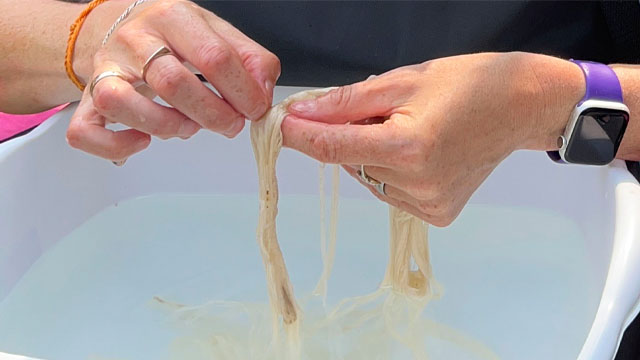
The hands of artist Denise Buisman Pilger working with natural fibres during the making process. Before a finished form emerges, the material is handled, observed and allowed to respond—leaving subtle variations that become part of the work’s history rather than imperfections to be erased.
