Google’s AI Reaches Orbit. Can the Economics Follow?
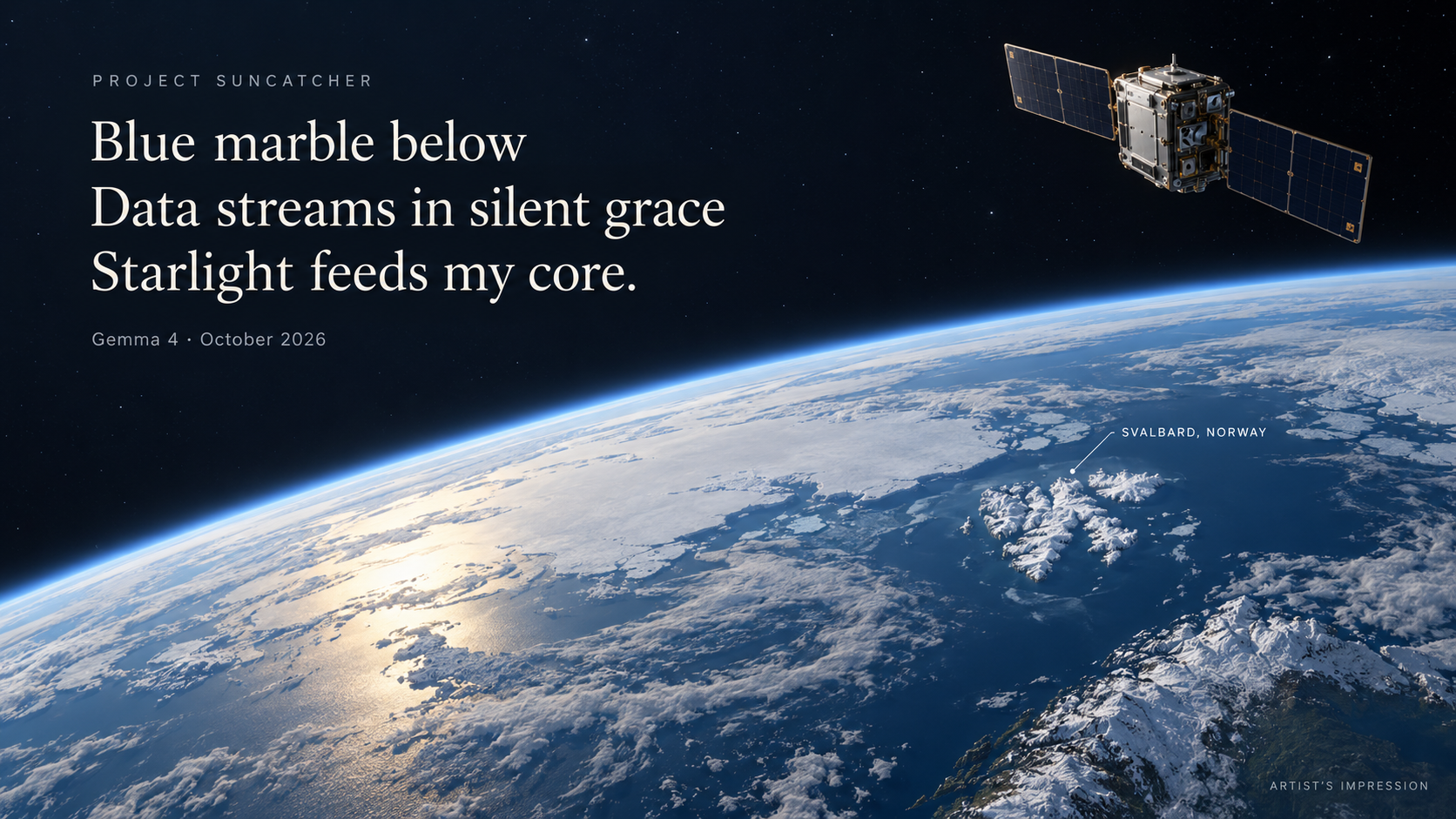
Project Suncatcher has passed an early hardware test. Its commercial future depends on the cost of delivering reliable computing in space.
Google’s Project Suncatcher has returned an AI-generated haiku from orbit. Announced on October 30, the demonstration shows that its AI hardware can execute a model in space. The harder question is whether orbital computing can deliver reliable capacity at a competitive cost once cooling, communications, launch prices and hardware replacement enter the calculation.
Developed with Planet and launched by SpaceX on October 1, the prototype demonstrates inference: running an existing model to generate an answer. Six questions separate that achievement from a commercially viable computing system.
🟥 What has Google actually proved?
An onboard Gemma 4 model processed a prompt using Google’s Tensor Processing Unit hardware and transmitted its response to Earth. Google subsequently tested additional poetry prompts and requests reporting the payload’s technical status. The announcement establishes an initial ability to execute AI workloads in orbit.
Commercial infrastructure requires sustained performance, predictable availability and effective recovery from failures. Radiation adds another challenge: energetic particles can alter stored bits, while cumulative exposure can degrade electronics. Google’s ground tests produced encouraging results on radiation tolerance; extended operation in orbit must establish how that translates into service reliability.
For a future customer, the decisive measure will be dependable output per dollar. A successful response provides little information about that figure over a satellite’s operating life.
🟥 Does abundant sunlight translate into cheap computing?
Google’s proposed architecture targets orbits with near-continuous sunlight. Its research estimates that, in the right orbit, solar panels can produce up to eight times more energy annually than comparable panels on Earth. That creates a potentially substantial energy advantage.
Capturing that advantage requires solar arrays, power electronics, thermal systems and launch capacity. Every supporting component adds cost before the first customer workload runs.
The economic question is how efficiently the complete spacecraft converts available sunlight into useful computation. A satellite with plentiful energy and limited processing time could still be an expensive asset. Energy availability and commercial productivity are separate measures.
🟥 How much computing can the cooling system sustain?
A vacuum removes the airflow used to carry heat away from terrestrial equipment. Heat must travel from the chips through a thermal system and ultimately leave the spacecraft as radiation. Google is testing combinations of heat pipes and radiators to manage that process.
Cooling therefore helps determine the spacecraft’s capacity ceiling. More processing generates more heat; supporting it can require additional radiator area and mass, increasing the burden on launch and spacecraft design.
The commercial consequence is utilization. If thermal limits force processors to slow down or pause, the same hardware investment produces fewer billable computing hours. Any savings on electricity must be assessed alongside the cost of that lost output.
🟥 Can separate satellites operate as one useful AI cluster?
Google envisions tightly grouped satellites connected by high-bandwidth optical links. Its research identifies connections supporting tens of terabits per second as a requirement for performance comparable to terrestrial data centers. That adds precision formation flying to the computing architecture.
Bandwidth is only part of the requirement. Distributed workloads also depend on low, predictable communication delays. Accelerators waiting for data from neighboring spacecraft consume resources without delivering their full processing capacity.
Google plans to test two interconnected satellites in 2027. That milestone should begin to reveal whether orbital networking can sustain useful joint workloads under actual flight conditions. The performance of a larger cluster remains an engineering proposition.
🟥 What must happen to launch prices for the numbers to work?
Google’s published research models launch prices falling to around $200 per kilogram or below by the mid-2030s, conditional on sustained cost reductions. Under selected spacecraft assumptions, the annualized launch cost per unit of onboard power could then approach reported electricity costs for US terrestrial data centers.
The scope of that comparison matters. Google explicitly describes it as a partial analysis. Comparing launch costs with terrestrial electricity spending does not establish parity between two complete computing services.
Spacecraft production, communications, operations, useful hardware life and replacement requirements still enter the investment case. Slower launch-price declines would weaken the economics even if the computing technology performs as intended.
🟥 Which customer gains enough to justify the additional complexity?
A plausible early market is processing data already generated in space. Analyzing observations onboard could reduce transmission requirements or accelerate decisions. That is a commercial hypothesis requiring evidence of customer demand and a measurable operational benefit.
Serving terrestrial AI users creates a tougher comparison. Data must travel between Earth and orbit, adding another constraint on service performance. Google’s research identifies atmospheric turbulence, relative motion and precision beam tracking as challenges for future high-capacity optical ground links.
An orbital service would therefore need to demonstrate an advantage after communications costs and interruptions are included. Cheap computation aboard a satellite has limited value if transferring the inputs and results makes the complete service expensive or unreliable.
The first convincing customer proposition will identify a workload whose benefits survive that calculation.
Signal
Project Suncatcher has demonstrated AI inference in orbit. Its investment case now depends on sustained utilization, reliable connections and launch economics. The commercially meaningful breakthrough will come when those elements produce dependable computing capacity at a price customers are prepared to pay.
Credit
AI-generated illustration: OpenAI for Altair Media. Haiku: Google’s Gemma 4, Project Suncatcher.
Caption
Artist’s impression of Project Suncatcher above Svalbard, Norway, featuring the haiku generated onboard by Gemma 4. Google announced the successful inference demonstration on October 30, 2026; sustained performance and commercial viability remain to be established.
