AI’s Next Test: Can the Infrastructure Pay for Itself?
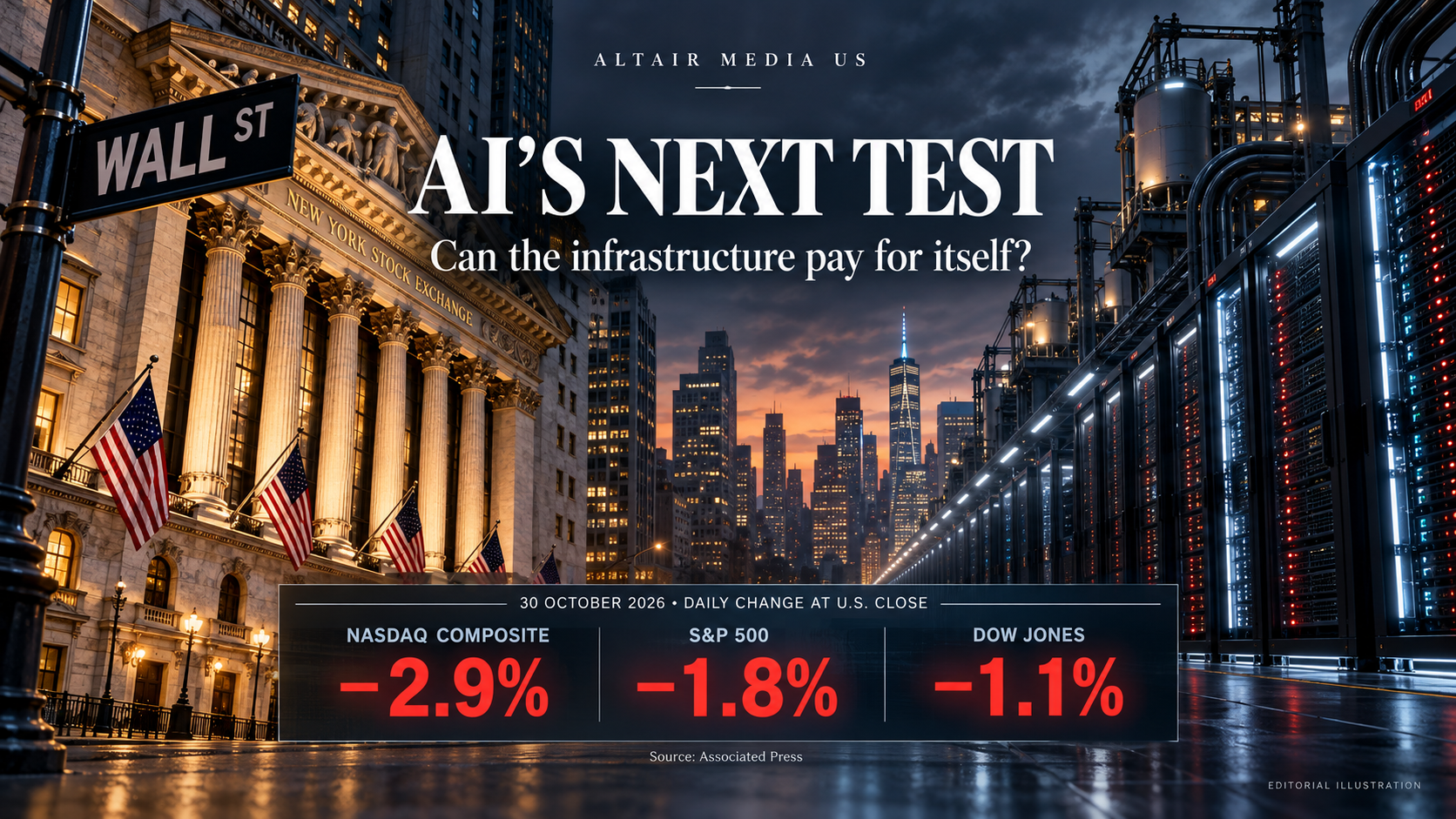
Rising capital intensity and rapid technological change test the economics of America’s AI build-out.
America’s AI investment boom faces a harder financial test. As technology shares retreat, investors are questioning whether rapidly expanding computing capacity can generate sufficient returns before equipment loses its competitive advantage. Demand can keep growing while prices fall, replacement costs rise and cash flow weakens. The technology’s success does not guarantee every investor’s return.
The latest results expose a gap between expanding businesses and the cash required to sustain their investment plans. Six questions connect the market correction to the underlying economics: who pays, how quickly assets earn their return, and where the risk ultimately sits.
🟥 Is infrastructure spending outrunning the cash available to fund it?
For some of the largest investors, it already is on a quarterly basis.
Meta reported $32.79 billion in operating cash flow in the third quarter of 2026, against $34.91 billion in capital expenditures, including principal payments on finance leases. Its free cash flow was negative $2.12 billion. Alphabet reported $42.29 billion in operating cash flow and $51.36 billion in capital expenditures, producing negative quarterly free cash flow of $9.07 billion.
These company-wide figures cover more than AI and compare investment with operating cash flow, rather than revenue. A quarterly deficit alone does not establish that an investment programme is unviable.
Financing and shareholder distributions provide further context. Neither company repurchased shares in the first nine months of 2026. Meta received $24.91 billion in net proceeds from its May bond issue; Alphabet raised $28.7 billion net from senior unsecured notes in the third quarter. The debt was issued for general corporate purposes, so those proceeds cannot all be assigned to AI.
The allocation choice is becoming sharper: how much cash should support expansion, how much should return to shareholders, and how much borrowing can future earnings sustain? Debt can bridge construction and commercial revenue. It also adds payment obligations before the return is certain.
🟥 Who ultimately pays for all this capacity?
There is substantial business growth behind the build-out. Amazon reported third-quarter AWS revenue of $46 billion, up 39% year on year. Yet Amazon’s company-wide free cash flow over the preceding twelve months was negative $42.4 billion, with increased investment in property and equipment primarily reflecting AI spending. Strong sales growth and heavy cash consumption are occurring together.
The relationship between investment and demand also deserves scrutiny. In April 2026, Anthropic announced a commitment to spend more than $100 billion on AWS technologies over ten years, alongside a new $5 billion investment from Amazon. The infrastructure supplier is also financing one of its customers.
That relationship can support real commercial growth. It also makes part of the demand dependent on a customer’s continuing access to funding until its own revenues cover its spending. If financing tightens, the pressure can travel back through the cloud supply chain.
The ultimate commercial test includes enterprises renewing subscriptions, developers earning margins after computing costs, and businesses obtaining measurable productivity gains. Returns can also come through existing services: Meta says AI is improving engagement, recommendations and advertising monetisation.
The question is whether those benefits generate enough additional cash to cover construction, operations, replacement and the cost of capital. Customer adoption and adequate investment returns are separate measures.
🟥 Can the equipment earn its return before its competitive advantage fades?
Amazon has already provided a concrete example of the accounting consequences.
From January 2025, it shortened the estimated useful lives of a subset of servers and networking equipment from six years to five, citing faster technological development, particularly in AI and machine learning. The change increased depreciation and amortisation expense by $1.4 billion in 2025.
A new processor does not automatically make an older one uneconomic. Older equipment may remain suitable for less demanding tasks. Its return depends on utilisation, energy consumption, maintenance and the price customers will pay when newer alternatives become available.
Accounting life, technical usability and commercial competitiveness can diverge. Shorter estimated lives bring depreciation forward and reduce reported earnings; they do not create a new cash payment when the estimate changes. Replacement purchases, however, require further cash.
An operator can therefore face pressure from both directions: lower prices for existing capacity and fresh spending to remain competitive.
🟥 Could more efficient AI weaken the returns on today’s infrastructure?
It could, depending on how demand responds.
If a task requires less computing, the cost of delivering it can fall. That can expand the market by making applications affordable to more customers. It can also reduce the capacity required for an existing workload or intensify competition over prices.
The decisive question is how much additional paid usage emerges, and who captures its value. Higher volumes can coexist with weaker margins if prices fall faster than costs or customers switch to competing services.
For an infrastructure owner, efficiency is therefore commercially ambiguous. A model developer may obtain better performance from fewer resources; an enterprise may secure lower bills; a capacity provider must still recover its investment.
The investment case needs evidence about workload growth, utilisation, pricing and customer retention. An expanding number of users or computational tasks, taken alone, cannot establish the return on the installed equipment.
🟥 Who carries the risk when long-lived infrastructure meets fast-changing technology?
A data centre contains assets with different economic lives. Amazon’s accounting policies, for example, distinguish buildings with lives of up to forty years from servers and networking equipment with estimated lives of five to six years.
Electricity agreements can extend across several equipment generations. In 2024, Constellation and Microsoft announced a twenty-year power purchase agreement to support the planned restart of Three Mile Island Unit 1 and help match Microsoft’s data-centre electricity use with carbon-free energy.
Such commitments can secure scarce supply and support future expansion. Their risk depends on purchase obligations, pricing, flexibility and the ability to use or resell power if requirements change. Faster chip replacement alone does not make a long-term energy agreement uneconomic.
Stranded-asset risk arises if demand or site economics deteriorate while infrastructure and contractual obligations remain difficult to redeploy or exit. A valuable location may retain its appeal but require expensive changes to cooling or power distribution.
Customer contracts distribute another layer of risk. Long commitments protect operators while potentially locking buyers into less competitive capacity; short contracts leave operators more exposed to repricing. The financial assessment must therefore connect equipment replacement, energy commitments, customer guarantees and debt repayments.
🟥 What would turn a market correction into an industry shake-out?
A sustained deterioration in operating and financing conditions would provide stronger evidence than falling share prices alone.
Warning signs would include declining realised rental prices, weaker utilisation, customer cancellations, delayed projects and impairments linked to lower expected cash flows. Refinancing difficulties, distressed asset sales or acquisitions driven by a shortage of cash would indicate that financial pressure was changing the industry’s ownership.
Such a shake-out could occur alongside continued growth in AI adoption. Providers with high costs, concentrated customers or inflexible debt obligations would have less room to absorb pricing pressure. Firms with diversified revenues and stronger balance sheets could acquire capacity or customers from weaker competitors.
The consequences would extend through Asian manufacturing supply chains and European infrastructure projects exposed to American purchasing decisions. The scale of that exposure would depend on which orders, projects and financing commitments were affected.
A shake-out remains a scenario to test. The evidence will come from operating performance and financing decisions as well as market valuations.
Signal
AI’s growing utility does not guarantee an investment return. Where capital spending exceeds operating cash flow, balance-sheet resilience becomes critical. The next test is whether realised prices and utilisation generate enough cash to operate, replace equipment and repay capital before the investment case weakens.
Image credit
AI-generated editorial illustration by OpenAI for Altair Media US. Market data: Associated Press, 30 October 2026.
Caption
Wall Street meets the physical infrastructure of artificial intelligence. Daily index declines on 30 October 2026 frame a deeper financial question: can expanding AI capacity generate sufficient cash to cover operations, equipment replacement and the cost of capital?
