Who Controls the Connections Between AI Chips?
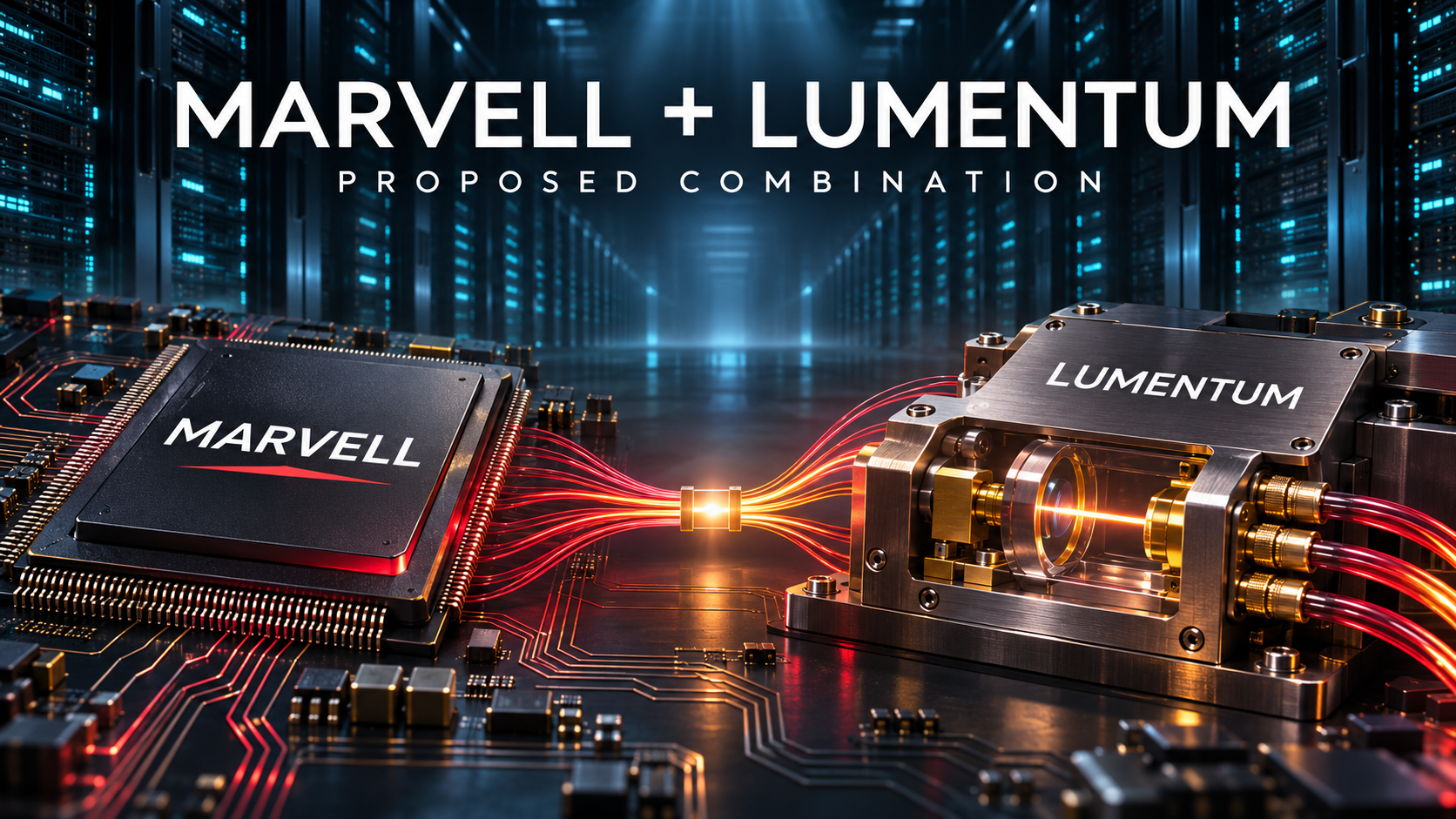
Marvell’s proposed Lumentum acquisition puts optical supply, infrastructure economics and customer dependence under scrutiny.
Marvell’s proposed acquisition of Lumentum, announced at an enterprise value of $115 billion, places optical connectivity at the center of AI’s infrastructure contest. The strategic question extends beyond faster data transmission: who will control the components, production capacity and design choices that determine whether increasingly expensive AI clusters can operate efficiently—and generate sufficient returns?
Completion is expected in the first half of 2028, subject to shareholder and regulatory approvals. Six questions test whether tighter technical integration can deliver reliable supply, customer value and adequate returns.
🟥 What does Marvell gain that a supply agreement cannot deliver?
The combination would unite Marvell’s networking and custom silicon capabilities with Lumentum’s lasers, optical components and specialized semiconductor manufacturing.
The strategic distinction is between purchasing components and influencing how they are developed. Common ownership could allow electrical interfaces, optical engines and manufacturing processes to be optimized around shared customer requirements.
That creates a commercial tension. Integration could reduce the work customers must perform to assemble a functioning system. It could also make individual components harder to replace without redesigning other parts of the infrastructure.
Timing adds another risk. During the period before expected completion, customers will continue selecting architectures and competitors will continue pursuing contracts. A merger timetable cannot ensure that the combined portfolio will meet the requirements customers have by 2028.
The test is whether integration delivers enough performance, reliability and deployment speed to compensate for reduced flexibility—and arrives in time to influence purchasing decisions.
🟥 Where does optics actually beat copper?
Copper remains part of current AI networking architectures. Nvidia’s own portfolio includes passive and active copper alongside optical transceivers and co-packaged optics. Its published specifications show active copper supporting short connections at high data rates, while optical products serve substantially longer distances.
The transition therefore depends on distance, bandwidth, power and cost. An optical connection must justify its components, packaging, installation and maintenance against the available electrical alternative.
Co-packaged optics brings optical engines close to switching silicon. Optical circuit switching performs a different function: establishing optical paths between endpoints, potentially avoiding intermediate electrical processing. Their benefits must be assessed separately.
A reduction in connection power also needs a clear denominator. Lower energy consumption in a particular link does not establish an equivalent reduction across an entire datacenter.
The economic measure is useful computing delivered within a given power and capital budget. That requires evidence from the operating system, including utilization, reliability and maintenance.
🟥 Does ownership create more supply—or change who gets access?
Lumentum’s latest results provide evidence of commercial demand. The company reported a second major near-packaged/co-packaged optics win backed by purchase commitments exceeding $5 billion. These are commitments reported by management, rather than revenue already delivered.
Acquiring manufacturing assets does not immediately increase their output.
Lumentum’s planned expansion in Greensboro, North Carolina, illustrates the physical timetable. In March, the company announced that an existing semiconductor facility acquired from Qorvo would be retrofitted for indium phosphide optical devices, including lasers. Production was expected to ramp in mid-2028, despite the site already having infrastructure and an experienced workforce.
The constraint extends beyond financing. Equipment installation, manufacturing processes, yields and qualification determine when additional capacity becomes usable supply.
Ownership could improve coordination between product development and investment. It could also influence allocation before substantial new output arrives.
Customers therefore need evidence of qualified volumes and delivery schedules. They also need to understand how existing contracts, new orders and jointly developed products would compete for capacity.
🟥 How independent can the alternative to Nvidia be?
Nvidia already has a strategic relationship with Lumentum. In March, it announced a $2 billion investment alongside a nonexclusive agreement covering multibillion-dollar purchase commitments and future capacity access rights for advanced laser components.
That complicates any simple account of Marvell assembling an opposing camp. Nvidia can compete in networking while supporting suppliers whose technologies also serve competing architectures.
The relevant questions concern the interaction between those roles. How would existing capacity rights operate after a merger? Would competing customers receive comparable access to new products? Could commercially sensitive development work remain sufficiently separated?
The nonexclusive nature of Nvidia’s agreement matters. It also leaves open the practical question of how much uncommitted capacity is available.
For hyperscalers seeking alternatives, supplier independence has several dimensions: ownership, contractual access, technical compatibility and the ability to obtain sufficient volume.
Competition in AI infrastructure requires examining those dependencies alongside corporate boundaries.
🟥 Who takes responsibility when the complete connection fails?
A broader component portfolio creates an opportunity to simplify system integration. It also raises expectations about responsibility.
Customers need to know which supplier diagnoses a failure when a problem involves the laser source, optical engine, electrical interface, package or cooling conditions. They also need clear replacement procedures and guarantees about operation across products from different vendors.
A component that passes its own specifications can still perform poorly within a particular system. The commercial value of integration therefore depends on testing, support and accountability extending across the connection.
This is also where claims of openness must be tested. Published interfaces, demonstrated interoperability and credible alternative suppliers determine how much practical choice a customer retains.
Tighter integration could make infrastructure easier to deploy and operate. The accompanying question is what happens when a customer needs to replace one supplier, upgrade one component or resolve a failure involving several companies.
A comprehensive portfolio becomes a stronger commercial proposition when responsibility is equally comprehensive.
🟥 Can a necessary technology justify this valuation?
Lumentum reported quarterly revenue of $1.26 billion and a GAAP operating margin of 28.5% in its latest results. Those figures demonstrate an expanding operating business; they do not establish the return on the proposed acquisition.
The agreement specifies 4.5 Marvell shares for each Lumentum share. Existing Marvell shareholders would own approximately 67% of the combined company, with Lumentum shareholders holding approximately 33%. The market value of the consideration will fluctuate with Marvell’s share price.
Both stocks traded lower during the November 2 session following the announcement. That movement alone cannot distinguish concerns about valuation, completion risk or wider market conditions. In a fixed-ratio transaction, movements in the buyer’s shares also change the value offered to the target’s shareholders.
Payment in shares still carries an economic cost through ownership surrendered by existing shareholders. Whether that exchange creates value depends on the earnings and cash flows acquired, the benefits of integration and the investment still required.
Optics can become more important while competition reduces supplier margins. Strong AI adoption can coexist with disappointing acquisition returns.
The valuation requires evidence that the combined company can capture durable economic value from the infrastructure it helps enable.
Signal
The proposed combination makes AI connectivity a test of industrial control and capital discipline. Ownership could strengthen coordination and influence access to supply. Its value will depend on qualified production, dependable systems and cash generation—delivered on a timetable that customers, competitors and shareholders will continue to challenge.
Image credit
Altair Media US / OpenAI — AI-generated conceptual illustration of Marvell’s proposed acquisition of Lumentum.
Caption
Marvell’s proposed acquisition of Lumentum links chip design with laser manufacturing, raising questions about who controls the connections, capacity and economics behind AI infrastructure. Conceptual illustration.
