Why Slow Creation Matters
What art reveals about time, attention and the value of making in an age of artificial intelligence
The Human Hand
We live in a world increasingly organised around speed. Information arrives instantly, decisions are accelerated by algorithms and artificial intelligence can generate images in seconds that once required hours or days of human work.
Speed has become one of the defining measures of technological progress. Yet in the studio of Dutch artist Denise Buisman Pilger, time plays a very different role.
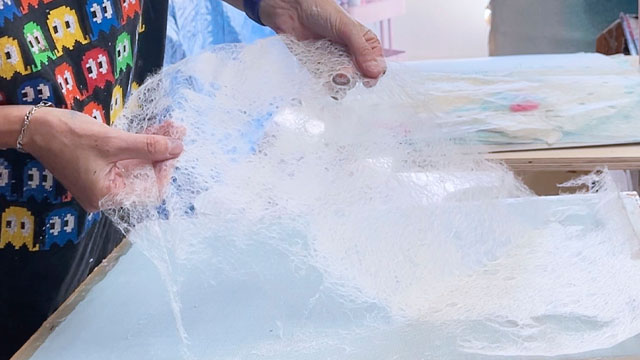
Kozo bark must be prepared before it can become fibre. Fibres must be processed before they can become Washi. Water influences their movement, drying changes their structure and metal wire introduces new possibilities as well as limitations.
Some processes can be accelerated. Others require waiting, observation and repeated adjustment.
The result is not simply an artwork that took time to produce. It is an artwork whose character was partly determined by what happened during that time. And that raises a question extending far beyond art.
If technology allows us to create almost anything faster, how do we recognise the moments when time itself contributes to value?
What Does It Mean to Create Slowly?
Slow creation is easily misunderstood. It can suggest nostalgia for traditional craftsmanship, resistance to technology or the belief that spending more time on something automatically makes it better.
None of those assumptions is necessarily correct.
A poorly conceived artwork does not become meaningful simply because it took months to complete. Equally, an idea developed quickly can be original, powerful and artistically significant. The important distinction lies elsewhere.
Some creative processes depend on developments that cannot be fully anticipated at the beginning. The maker needs opportunities to observe, reconsider and respond to what emerges. In Buisman Pilger’s work, this relationship becomes particularly visible.
Working with Kozo and Washi involves more than transforming raw materials into a predetermined shape. Natural fibres behave differently depending on their preparation, moisture and arrangement. Their response can influence what the artist decides to do next.
The work develops through a relationship between intention and discovery. Slowness, in this context, is not the objective. It is the space in which attention becomes possible.
Why Does Waiting Matter?
Waiting is often treated as an interruption. In industrial production, delays can increase costs, disrupt schedules and reduce efficiency. Modern technologies are therefore frequently designed to eliminate unnecessary waiting.
In creative work, however, waiting can serve another purpose. A material may need time to dry before its final structure becomes visible. An experiment may require distance before the artist can understand what has happened. A work that initially appears unsuccessful may reveal another possibility when viewed later.
These are different forms of waiting, but they share something important. They allow information to emerge that was not available at the beginning.
For Buisman Pilger, whose practice combines traditional Japanese papermaking techniques with contemporary abstraction, the relationship between material and time is particularly relevant.
Water, fibres and structural tension do not always produce immediate or predictable outcomes.
The artist can influence the process without controlling every consequence. That uncertainty requires patience, but patience should not be confused with passivity. Observing a material, recognising a change and deciding whether to intervene are themselves forms of creative work.
Sometimes the most important decision is to leave something alone.
“Sometimes the material needs time before I understand what it wants to become.”
Denise Buisman Pilger — Artist, Artist Abroad
The value of waiting lies not simply in the passage of time, but in what becomes possible because the process was not interrupted too early.
Can Efficiency Become a Creative Limitation?
Efficiency has transformed modern society.
Industrial production has made goods more accessible, digital communication has reduced distances and artificial intelligence is beginning to accelerate tasks across research, design, administration and creative industries.
These developments offer substantial benefits. But efficiency is always measured against an objective.
If the goal is to manufacture a thousand identical components, reducing production time while maintaining quality is a clear improvement.
Creative exploration presents a different problem. What happens when the objective itself has not yet been discovered?
An artist may begin with a material, an observation or a question rather than a defined final product. The direction of the work can change because an experiment reveals something unexpected.
In such circumstances, measuring success only through speed or output risks overlooking the purpose of the activity.
An abandoned experiment may influence a later work. An unfinished object may remain important because it contains an unresolved possibility. A technique that initially appears inefficient may produce characteristics unavailable through a more standardised process.
This does not mean inefficiency is inherently valuable. It means that efficiency becomes difficult to assess when the outcome is still being discovered. The distinction matters beyond the studio.
Scientific research, product development and technological innovation also depend on experimentation whose results cannot always be predicted.
A system that rewards only immediate success may become exceptionally good at producing expected outcomes while leaving less room for unexpected discoveries.
What Does AI Actually Accelerate?
Artificial intelligence introduces a new dimension to this discussion. Generative systems can produce visual concepts, explore variations and help creators evaluate possibilities at remarkable speed.
For an artist, designer or architect, that capability can be useful. Ideas that once required considerable time to visualise can now be compared almost immediately. But generating a possibility and developing it into meaningful work are not necessarily the same activity.
AI can shorten the time required to produce a representation. It does not automatically determine whether that representation deserves attention, how it relates to an artist’s intentions or what might happen when an idea encounters physical materials.
Consider the difference between generating an image of handmade Washi and actually making Washi.
A digital system can imitate the appearance of fibres, variations in thickness and irregular edges. A physical papermaking process involves preparing material, working with water, arranging fibres and responding to changes as they occur.
Both processes may involve creativity. But they operate under different conditions.
One can generate visual possibilities without requiring the depicted material to exist. The other produces an object through an interaction with matter.
The distinction is not between technology and authenticity, nor between fast and slow. It is between different kinds of creative activity.
AI can accelerate the exploration of possibilities. It cannot make every consequence of working with physical materials disappear.
Does Time Become Part of the Artwork?
When visitors encounter a finished artwork, they rarely see how long it took to make. They see composition, material, colour and form. They may recognise technical skill or experience an emotional response.
The hours spent preparing materials, reconsidering decisions or waiting for a process to develop are largely invisible. Yet those hours can influence what the object becomes.
In handmade paper, the preparation and arrangement of fibres affect structure and appearance. In work combining paper with metal wire, the relationship between flexible and rigid elements influences the resulting form.
These characteristics are not simply decorative choices applied at the end. They emerge through making. That is why the time invested in an artwork cannot always be separated from its physical properties.
Nevertheless, time alone does not establish artistic or economic value. A work’s significance also depends on its originality, execution, context and the response it creates.
The more interesting argument is that certain qualities may depend on processes that require time. When those processes are accelerated or removed, the outcome may change.
The question is therefore not whether slow art is better than fast art. It is whether we understand what might be lost when speed becomes the dominant objective.
Can Slowness Change the Artist?
Creative processes do not only transform materials. They can also change the person working with them.
A maker who repeatedly encounters resistance develops practical knowledge that cannot always be reduced to written instructions.
The hand learns how much pressure to apply. The eye becomes more sensitive to subtle variations. Experience helps the artist recognise when a material can be pushed further and when intervention may damage what has emerged.
This knowledge develops through repeated encounters. It is partly technical, but it also involves judgement, attention and an increasing awareness of uncertainty.
For Buisman Pilger, working with natural fibres creates opportunities for this relationship between maker and material. The artist does not simply impose a vision on a passive substance. The process can challenge expectations and require a different response. That makes slow creation interesting from a psychological perspective as well.
The ability to tolerate uncertainty, reconsider an intention and remain attentive without demanding an immediate result is relevant far beyond artistic practice. It concerns how people learn, solve problems and develop confidence in their own judgement.
“Working with materials teaches me when to act, and when to let things happen.”
Denise Buisman Pilger — Artist, Artist Abroad
Perhaps one of the less visible outcomes of craftsmanship is that the maker develops alongside the work.
What Happens When Slow Work Enters a Fast World?
There is an interesting tension between the time required to create an artwork and the speed with which its image can circulate.
A piece may develop over weeks or months, yet its photograph can reach audiences across continents almost instantly.
Digital platforms make art more accessible. They allow artists to communicate internationally, develop audiences and reach people who may never visit their studios. But the image also changes the encounter.
On a screen, artworks appear within an endless stream of other images. Viewers may spend only seconds looking at something that required extensive preparation and experimentation.
The difference becomes particularly relevant when the work is physical and three-dimensional.
Scale, texture, structure and the relationship between materials are difficult to experience fully through a photograph.
Buisman Pilger’s solo exhibition at the World of Threads Festival 2026–2027 in Oakville, Ontario, Canada, offers visitors an opportunity to encounter the work differently.
The exhibition, now underway, brings objects created through physical processes into a space where viewers can spend time with them.
That does not mean visitors will automatically understand every decision behind their creation. But it allows the artwork to occupy its own physical environment rather than appearing only as another image on a screen.
The artist may have spent considerable time making the object.
The viewer must decide how much time to give it.
Is Attention Becoming the Real Scarcity?
Perhaps this is where slow creation connects most directly with contemporary society. Digital technology has dramatically expanded access to information, images and creative possibilities.
Artificial intelligence accelerates that expansion. But the amount of attention available to any individual remains limited.
We can generate more images than we can meaningfully examine, produce more ideas than we can develop and receive more information than we can carefully evaluate.
The challenge therefore begins to shift. It is no longer only about producing possibilities. It is about recognising which possibilities deserve time.
For artists, that may mean remaining with a material long enough to discover something unexpected.
For researchers, it may mean investigating an observation that does not fit an existing explanation.
For organisations, it may mean allowing an experiment to develop before demanding measurable results.
And for audiences, it may mean spending more than a few seconds with an object, an idea or a work of art.
Slowness becomes valuable not because speed is undesirable, but because attention cannot be expanded indefinitely.
Technology can increase the number of things we create. It cannot guarantee that we will understand what we have created.
The Value of Taking Time
There is no reason to romanticise slow creation.
Artists face deadlines, financial constraints and practical obligations. Materials cost money, exhibitions require preparation and artistic work must eventually find its place in the world.
Nor should technological acceleration be dismissed. New tools can remove repetitive tasks, expand creative opportunities and give artists more freedom to concentrate on the aspects of their work they consider important.
The challenge is to distinguish between time that can usefully be saved and time that contributes to the result.
In the work of Denise Buisman Pilger, the preparation of Kozo, the behaviour of Washi and the interaction between paper and metal demonstrate how physical creation can depend on sequences that cannot simply be reduced to a final image.
Some stages are technical necessities. Others create opportunities for discovery. Together, they influence the character of the work. That is the deeper significance of slow creation. It does not reject progress. It asks us to consider what progress is supposed to improve.
A faster process can be better when it removes unnecessary effort. But when the purpose is exploration, understanding or developing something genuinely new, the time spent may be part of what makes the result meaningful.
In an age increasingly capable of producing answers instantly, perhaps we should become more attentive to the processes that still require us to wait, observe and reconsider.
The value of slow creation is not that it takes longer.
It is that some things become possible only when we give them time.
This article is part of The Human Hand, an Altair Media series exploring craftsmanship, materials and human creativity in the age of artificial intelligence. Denise Buisman Pilger’s solo exhibition at the World of Threads Festival 2026–2027 in Oakville, Ontario, Canada, runs through January 17, 2027.
Credit
Photo courtesy of Denise Buisman Pilger / Artist Abroad.
Caption
The art of taking time. Delicate fibres take shape through the hands of Denise Buisman Pilger, revealing how attention, patience and the behaviour of materials become part of the creative process. Featured in The Human Hand, Altair Media’s series on art and creativity in the age of AI.
