
Artificial intelligence is evolving into a new infrastructure layer beneath the global economy. This article explores how compute, cloud systems, semiconductors and sovereign AI are reshaping geopolitical competition between the United States, China and the emerging autonomous world order.
Industry
Industrial systems and corporate dynamics shaping production, innovation and the structural evolution of the US economy.
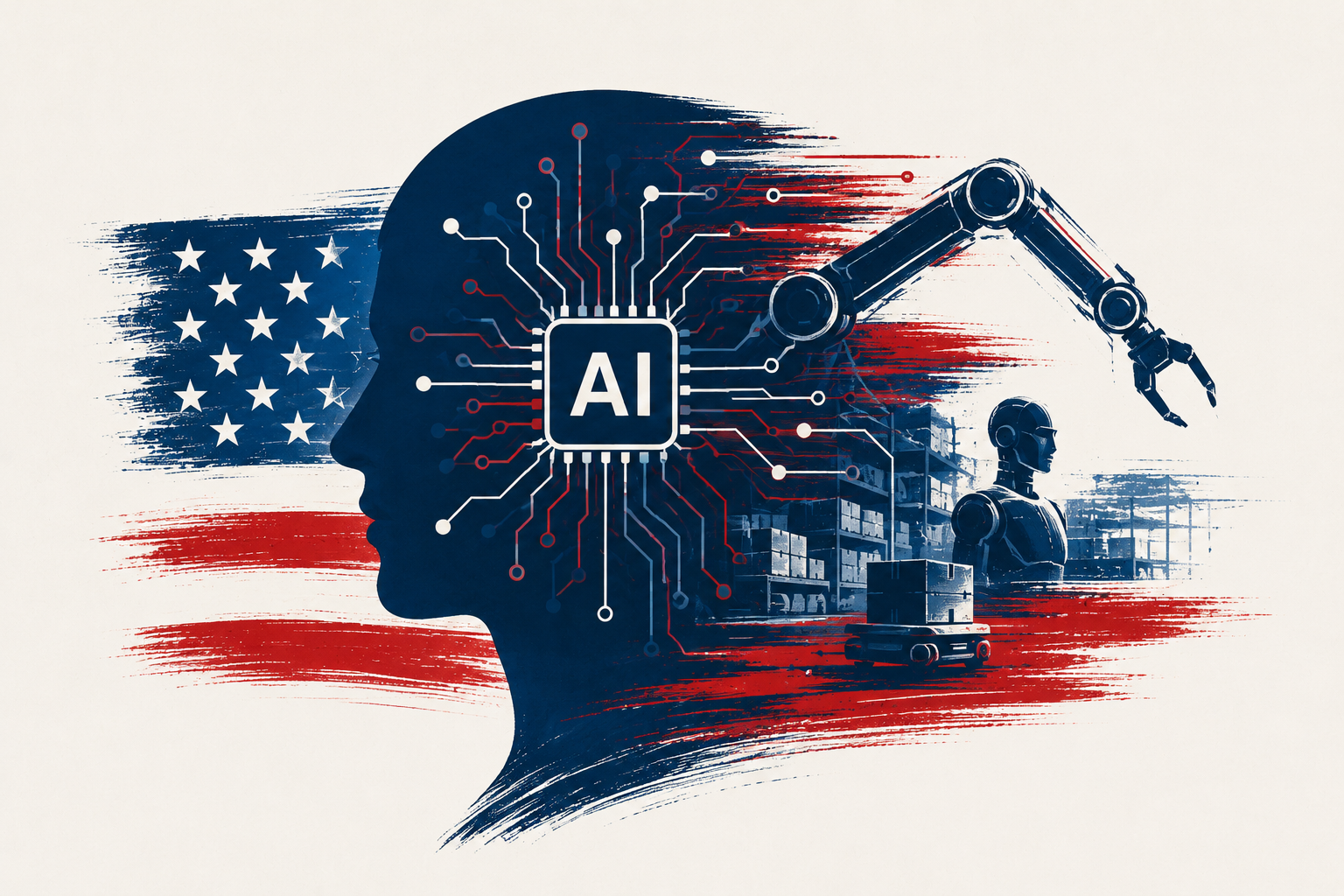
Artificial intelligence is beginning to move beyond screens and software into warehouses, robotics and industrial systems. This article explores how embodied AI could transform logistics, infrastructure, manufacturing and the future relationship between humans and machines.

Algorithms are no longer tools but an invisible layer shaping what people see, choose, and value. As systems move from response to prediction, they redefine markets, behavior and decision-making — quietly structuring the conditions under which society operates.

AI is pushing compute from a shared resource into a strategic asset. As demand outpaces supply, companies are no longer optimizing for access—they’re building for control, collapsing the tech stack into tightly integrated, self-owned systems.

Google’s TurboQuant reduces AI memory usage by up to six times without performance loss, challenging the assumption that AI scaling requires ever more hardware. The shift signals a decoupling of software efficiency from traditional memory-driven infrastructure demand.

As AI systems scale to thousands of processors, the challenge is shifting from computing power to data movement. From Silicon Valley to Eindhoven, a new generation of photonic chips—using light instead of electricity—could become the backbone of future AI data center infrastructure.
