Friday, April 24, 2026
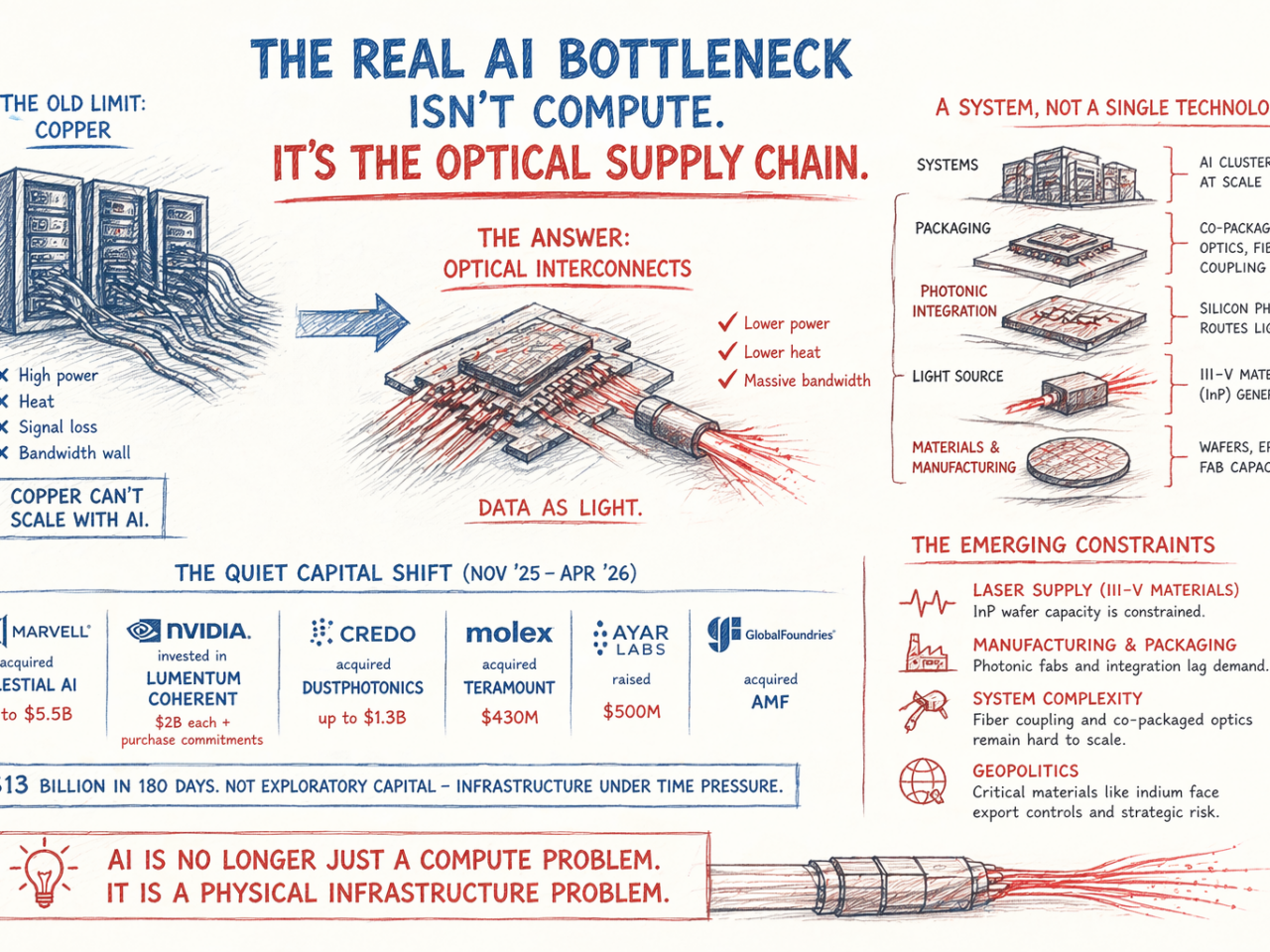
In six months, over $13 billion flowed into optical technologies — not as a bet on innovation, but as a response to a growing constraint. As AI systems scale beyond the limits of copper, the real bottleneck is no longer compute, but the ability to move data. The race is shifting from GPUs to the optical supply chain that connects them.
Read More
Saturday, March 7, 2026

Artificial intelligence relies on one of the most complex industrial systems ever built. From chip design and lithography to semiconductor manufacturing and hyperscale data centers, the global AI supply chain reveals how machine intelligence ultimately depends on materials, infrastructure and geopolitics.
Read More
Friday, March 6, 2026

As artificial intelligence pushes data centers to unprecedented scale, the real bottleneck is shifting from compute to connectivity. Silicon photonics—using light instead of electricity—could redefine how AI systems move data, enabling the ultra-fast networks required for the next generation of hyperscale infrastructure.
Read More
Monday, March 2, 2026

As AI systems grow to unprecedented scale, computation is no longer the primary constraint — communication is. NVIDIA’s multibillion-dollar bet on optical technologies signals a historic shift from copper to light, redefining the physical infrastructure that will determine how far artificial intelligence can advance.
Read More
Wednesday, February 18, 2026

We believed artificial intelligence would be a contest of code — faster models, larger datasets, smarter architectures. But the decisive battles of the coming decade are unlikely to be fought inside neural networks. They will unfold in substations, cooling plants, transmission corridors and the mud of construction sites. The constraint is no longer how much intelligence we can design, but how much physical reality we can sustain.
Read More
Wednesday, February 18, 2026

Artificial intelligence appears weightless, yet it runs on energy-hungry machines nearing physical limits. As moving data becomes costlier than computing it, engineers are turning from electrons to photons. This shift toward light-based hardware may determine the scalability, economics, and geopolitics of AI.
Read More
