When AI Enters the Physical World
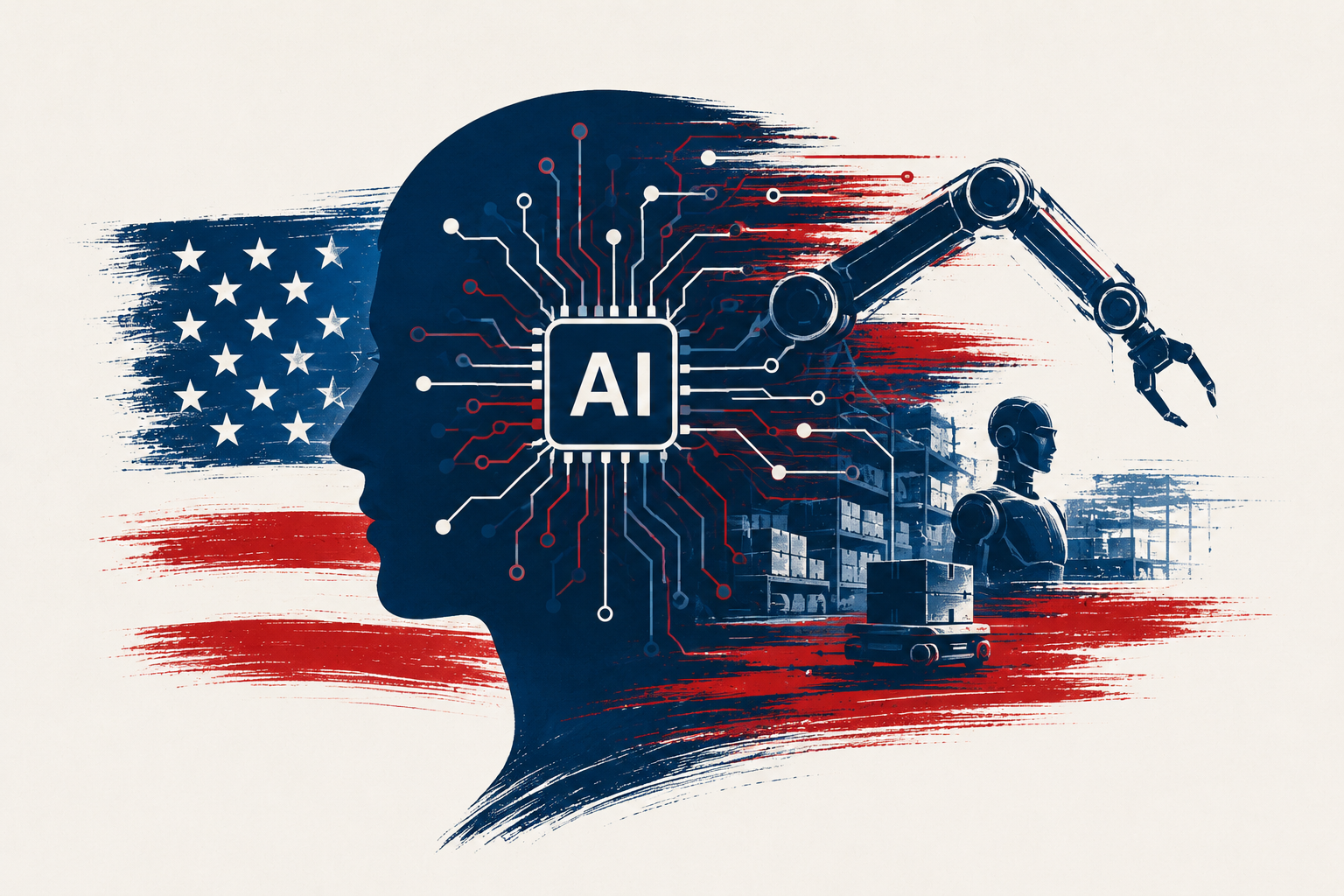
From software agents to robotics and autonomous systems
After AI agents began transforming the software world, they are now starting to move beyond screens and into physical environments. A new generation of embodied systems is bringing artificial intelligence into factories, warehouses, logistics networks and industrial infrastructure itself.
For the past several years, artificial intelligence has largely existed inside digital environments. AI generated text, analyzed information and interacted through screens. Even the first wave of AI agents remained mostly confined to software workflows.
That boundary is now beginning to change.
Technology companies are increasingly combining AI agents with sensors, robotics and physical machines. The result is the emergence of what many researchers describe as embodied AI: systems capable not only of processing information, but also interacting with the physical world.
This may become one of the most important technological transitions of the decade.
From Digital Intelligence to Physical Action
Traditional AI systems operate in abstract environments. They process language, images and data. But the physical world is far more unpredictable than software.
Objects move unexpectedly. Humans behave irregularly. Warehouses, streets and factories constantly change in real time.
This is why robotics has historically been much harder than software automation.
An AI chatbot can generate thousands of responses per second with little physical consequence. A robotic system operating in a warehouse or factory must deal with gravity, movement, uncertainty and safety.
The challenge is no longer simply cognition. It is coordination between intelligence, sensors and physical action.
The Rise of Embodied AI
Embodied AI combines several technological layers:
- AI agents
- Computer vision
- Sensors
- Robotics
- Spatial awareness
- Real-time feedback systems
Instead of merely generating outputs, these systems continuously interpret and react to their environment.
A warehouse robot, for example, may:
- identify objects;
- navigate obstacles;
- coordinate with logistics systems;
- adjust routes dynamically;
- and interact with human workers.
This creates a continuous feedback loop between digital intelligence and physical reality.
The importance of this shift is growing rapidly because advances in generative AI are now accelerating robotics itself. Large language models help robots interpret instructions, understand environments and coordinate workflows far more flexibly than earlier generations of industrial automation.
In other words: AI is slowly moving from the cloud into the physical economy.
“The next generation of robotics will be general-purpose, autonomous and powered by AI.”
Jensen Huang, CEO, NVIDIA
Few companies illustrate this transition more clearly than NVIDIA.
Why NVIDIA Matters
Originally known for gaming chips, NVIDIA has increasingly positioned itself as a foundational infrastructure provider for artificial intelligence, robotics and autonomous systems. Its hardware now powers large parts of the AI economy, from data centers to robotics simulations.
But NVIDIA is not only building chips.
It is increasingly building the simulation layer — sometimes described as the digital twin of the physical world — where robots can train digitally before operating in real environments. This allows machines to practice tasks millions of times virtually before interacting with physical systems.
This approach addresses one of the biggest bottlenecks in robotics: the so-called Sim-to-Real problem.
A robot may perform flawlessly inside a digital simulation, yet struggle in reality where friction, lighting, dust, wear and unpredictable movement constantly change the environment. Bridging this gap between simulation and reality remains one of the central challenges of embodied AI.
The strategy reveals something important: the future of AI may depend as much on physics, simulation and industrial infrastructure as on language itself.
This is one reason why many analysts increasingly view NVIDIA not simply as a semiconductor company, but as a strategic infrastructure company for autonomous intelligence.
Tesla, Figure AI and the New Robotics Race
The growing interest in humanoid robotics reflects a broader ambition inside the technology sector.
Companies such as Tesla and Figure AI are now developing robots designed to operate in environments originally built for humans. Instead of redesigning factories around machines, these systems attempt to adapt machines to human environments.
Tesla’s Optimus project is perhaps the most visible example.
The long-term vision is not simply industrial robotics, but general-purpose robotic labor capable of performing repetitive physical tasks across logistics, manufacturing and services.
Figure AI follows a similar direction, combining large language models with humanoid robotics systems intended for warehouses and industrial operations.
The goal is ambitious: machines that can understand instructions, navigate spaces and physically execute tasks with increasing autonomy.
Whether this vision succeeds remains uncertain. Robotics has repeatedly moved slower than expected.
But investment levels suggest that major technology companies increasingly see physical AI as the next strategic frontier.
Warehouses, Logistics and Autonomous Infrastructure
The first large-scale impact of embodied AI will likely appear in controlled industrial environments.
Warehouses, ports, logistics centers and manufacturing facilities offer structured conditions where autonomous systems can operate more safely and predictably than in open public environments.
This is already visible in:
- automated fulfillment centers;
- robotic inventory systems;
- autonomous delivery experiments;
- AI-assisted industrial operations.
The combination of AI agents, sensors and robotics may gradually transform logistics into a semi-autonomous operational layer.
This matters because logistics is infrastructure.
Whoever controls the autonomous coordination of goods, warehouses and industrial systems may increasingly control critical parts of the modern economy itself.
The implications may extend even further. As physical automation becomes more advanced, countries with high labor costs could increasingly move parts of manufacturing and logistics closer to home. Autonomous infrastructure may therefore reshape not only productivity, but also the geography of globalization itself.
Military and Strategic Implications
The implications extend far beyond commerce.
Military organizations are investing heavily in autonomous systems, AI-assisted drones, robotic logistics and intelligent battlefield coordination. The strategic importance of embodied AI is becoming increasingly clear to governments.
Future geopolitical competition may therefore involve not only:
- chips;
- cloud infrastructure;
- and data centers,
but also autonomous industrial and robotic capacity.
The countries capable of integrating AI into physical infrastructure may gain significant advantages in manufacturing, defense, logistics and supply-chain resilience.
This is one reason why embodied AI is becoming part of a broader geopolitical race between the United States and China.
When AI Becomes Physical
The transition from digital intelligence to physical autonomy will likely happen gradually rather than suddenly.
For now, most embodied AI systems remain limited, specialized and heavily supervised. Fully autonomous humanoid robots operating freely across society remain technically difficult and economically expensive. But the direction of travel is becoming clearer.
Artificial intelligence is no longer confined to screens. It is beginning to enter factories, warehouses, logistics systems and industrial infrastructure. The long-term significance may resemble the arrival of industrial automation in the twentieth century — except this time the machines are becoming adaptive, connected and increasingly autonomous.
The central question is therefore no longer whether AI can generate information. It is whether AI can operate safely and effectively inside the physical world itself.
In the final part of this series, Altair Media US examines how AI agents and autonomous systems are reshaping geopolitics, economic power and the global competition for technological infrastructure.
This article is part of The Autonomous Layer — an Altair Media US series exploring how AI agents, autonomous systems and intelligent infrastructure are reshaping work, governance and geopolitical power in the emerging AI economy.
Credit
Illustration generated by OpenAI for Altair Media US
Caption
A symbolic interpretation of embodied AI, where artificial intelligence moves beyond software into robotics, logistics and the physical infrastructure of the modern economy.
