Lightmatter and the Next Layer of AI
Photonics is moving from component technology to industrial architecture
SIGNAL |AI has spent years pushing the limits of compute. Now the pressure is moving outward. As clusters grow, connecting ever more accelerators is becoming a physical problem of bandwidth, power, packaging, connectors and fiber. The next constraint on artificial intelligence may no longer sit inside the processor itself, but increasingly in the architecture between processors.
🔴 What actually changed?
On September 17, Lightmatter introduced Passage L20 CPX, which the company describes as the first Open CPX module for AI infrastructure using bidirectional optical links. It is designed for 12.8 Tbps of aggregate bandwidth: 6.4 Tbps transmitting and 6.4 Tbps receiving.
The optical engine itself is not the breakthrough. Lightmatter introduced the underlying Passage L20 platform in March. What has changed is the architecture around it: the engine is now being placed inside an emerging standardized form factor designed to bring high-density optics close to the ASIC, switch or accelerator.
That changes the significance of the announcement. The question is no longer merely whether photonics can move data fast enough. It is whether optical interconnect can become something the AI infrastructure industry can integrate predictably, repeatedly and at scale.
🔴 When does a component become infrastructure?
Performance alone does not create an industry. A technology also needs standardized interfaces, defined mechanical and thermal requirements, compatible connectors, multiple suppliers, manufacturability and eventually a supply chain capable of reproducing the same architecture at volume.
That industrial layer is precisely what the Open CPX Multi-Source Agreement is attempting to construct. Established in March by Ciena, Coherent, Marvell, Molex, Samtec and TeraHop, it is developing specifications for interoperable near-package and co-packaged optical engines, including a defined pluggable socket and electrical connector system between the ASIC and the optical interconnect.
The ambition is deceptively important. System designers should eventually be able to integrate optical engines without rebuilding the surrounding architecture around one proprietary implementation.
Lightmatter joining that effort therefore represents something more consequential than another bandwidth record. The photonic engine is beginning to acquire an industrial interface.
🔴 Is AI running into its own wiring?
The AI infrastructure race has concentrated heavily on compute: faster accelerators, denser high-bandwidth memory, larger clusters and increasingly powerful data centers. Yet every increase in computational capacity creates a parallel communications problem. Thousands of processors have little value as a cluster unless enormous quantities of data can move between them quickly enough.
The scaling pressure therefore moves outward: from transistor performance into memory bandwidth, from memory into networking fabrics, and from networking into the physical interconnect itself.
Electrical connections remain extraordinarily effective over short distances, but the trade-offs become harsher as bandwidth density, distance and cluster size increase. Signal integrity becomes more difficult, power requirements rise and routing becomes increasingly complex. That is one reason optics is moving progressively closer to the silicon.
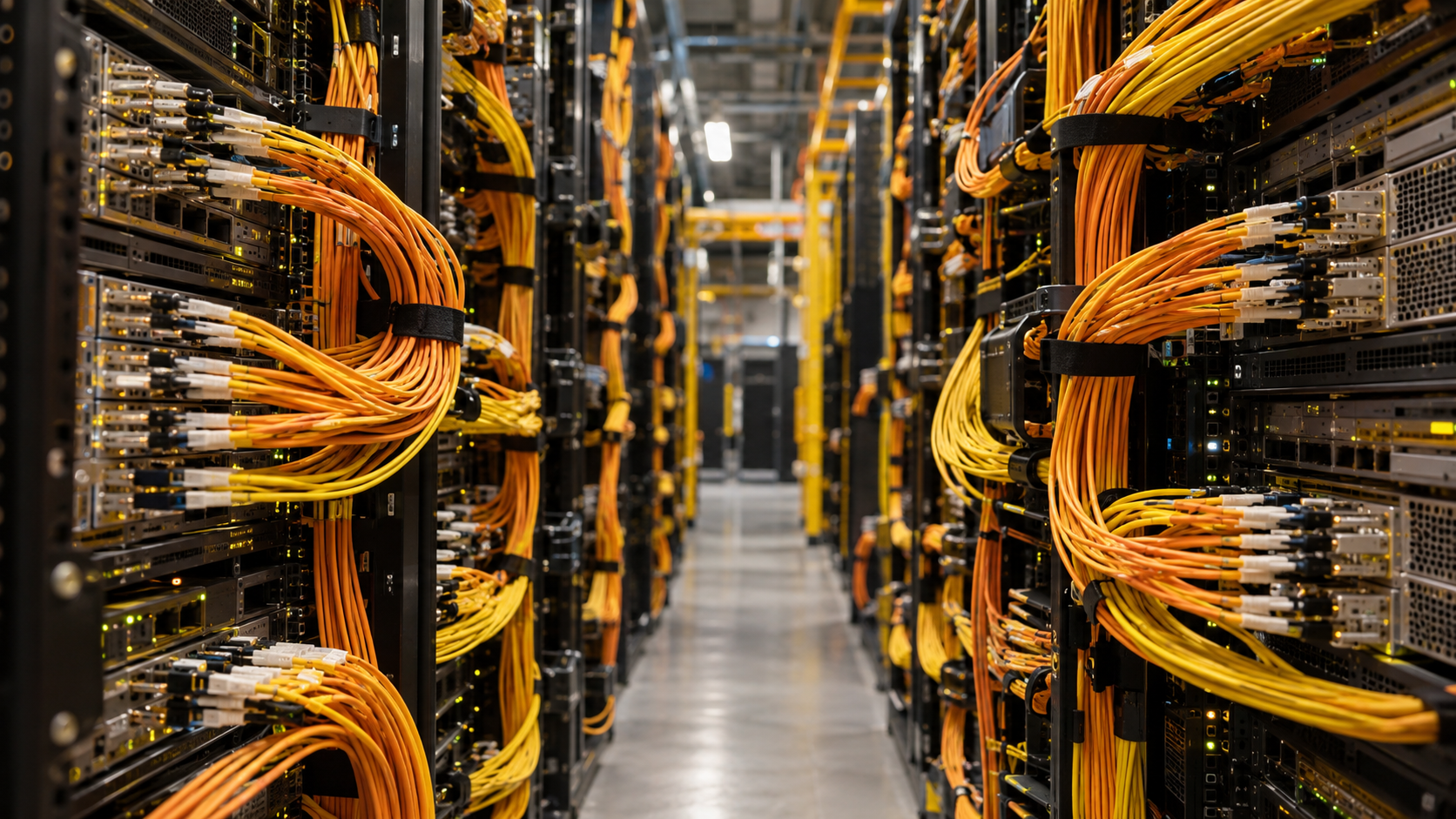
Lightmatter’s own modelling makes the physical consequences unusually visible. In a 512-GPU scale-up pod, the company calculates that conventional unidirectional optical links could require roughly 130,000 fibers. Using separate wavelengths for transmit and receive on the same fiber could reduce that to around 65,000, while removing approximately 16,000 connectors and more than 200 miles of fiber. Lightmatter estimates that this could reduce scale-up interconnect network costs by around 15 percent, while explicitly noting that these figures are based on internal modelling and may vary in actual deployments.
The exact savings will have to be demonstrated in real systems. The architectural problem is already visible. At AI scale, fiber count, connector density and cable management are becoming part of the compute equation itself. The larger AI becomes, the more physical its constraints become.
🔴 Does photonics need to replace the GPU?
Probably not. And that may be one of the more important changes in how photonics should now be understood.
For years, much of the excitement around photonic computing centred on a radical proposition: use light not merely for communications, but to replace parts of electronic computation itself. That research continues, but the nearer-term route into large-scale AI infrastructure may prove more pragmatic.
Photonics does not need to replace the processor. It can move next to it.
A Nature Photonics Perspective published on September 15 gives that interpretation important scientific context. The authors find that photonic accelerators are closing the gap with leading digital systems in areas including energy efficiency, throughput, density and latency, but they also identify significant barriers. In cloud systems, optical losses and energy-intensive electro-optical interfaces can dominate power consumption and restrict throughput, while reconfigurability, scalability and optical footprint remain significant problems in other applications.
Their conclusion is notably pragmatic: photonics represents a viable near-term strategy within the existing digital ecosystem, rather than requiring a wholesale replacement of it.
That reframes the transition. The processor can remain electronic, as can memory and much of the control logic, while optical technology moves into precisely those parts of the architecture where electrical interconnect becomes increasingly difficult to scale.
The first mass-market photonic AI system may therefore look nothing like the optical computers once imagined. It may look like an electronic computer increasingly surrounded by light.
🔴 Can photonics become boring enough to win?
This may be the harder industrial test.
Successful infrastructure eventually becomes boring because the interface stops demanding attention. Ethernet became foundational once connecting machines no longer required reinventing the network. USB scaled because manufacturers could build around a predictable interface. PCI Express became part of the computing substrate because different suppliers could design products against a shared architecture.
The same transition has not yet happened fully for photonics inside AI systems. Co-packaged and near-package optics still face substantial challenges involving thermal management, manufacturing, testability, reliability, servicing, lasers and supply-chain coordination. Lightmatter itself does not expect Passage L20 CPX evaluation kits to ship until the first quarter of 2027, and describes the current specifications as preliminary. That makes the Open CPX effort more interesting, not less.
This is not the moment at which optical interconnect suddenly becomes universal. It is the moment at which companies begin constructing the conditions that could make it ordinary: standardized sockets and interfaces, interoperable components, multiple suppliers and repeatable manufacturing.
Photonics has spent years demonstrating that it can be spectacular. The next challenge is harder. It has to become dependable, interchangeable and sufficiently predictable that engineers no longer need to treat every deployment as a photonics project. It has to become boring.
🔴 So what is the Signal?
AI still describes progress predominantly through compute: faster accelerators, larger clusters and ever greater power requirements. But each increase in compute shifts pressure onto the architecture surrounding it — memory, networking, cooling, packaging and increasingly the physical links connecting the machine.
The constraint is moving from the chip toward the system. That is why the most interesting part of Lightmatter’s announcement may not be its headline bandwidth.
6.4 Tbps is the specification. CPX is the signal.
If photonic interconnect becomes modular, interoperable and replaceable across suppliers, the competitive question changes with it. Building the fastest optical engine will still matter, but so will the ability to manufacture, package, integrate and supply those engines as part of a much larger industrial ecosystem.
That is the transition from photonics as a performance technology to photonics as infrastructure. And it points toward a different kind of optical future for AI.
Not one in which photons replace the GPU.
One in which the GPU increasingly depends on photons to scale.
Credit
Image: Altair Media / AI-generated editorial visualization
Caption
Dense fiber connections inside modern AI infrastructure illustrate the physical challenge behind the next stage of scale. As clusters grow, optical interconnect is moving from a specialist technology toward a standardized part of the computing stack.
