Beyond the Thread
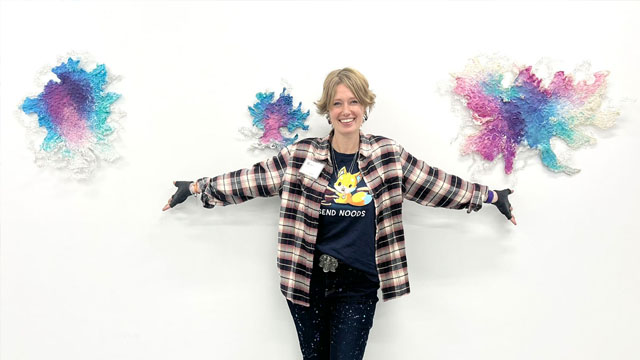
Inside Canada’s World of Threads Festival, where 900 artworks challenge the boundaries between craft and fine art
It took Dutch artist Denise Buisman Pilger almost an hour to find her own exhibition. Not because her work had been overlooked, but because the World of Threads Festival in Oakville, Canada, is an extraordinary maze of galleries, corridors and artistic discoveries. With approximately 900 artworks on display, even finding six familiar pieces can become an adventure.
For Buisman Pilger, the search carried particular meaning. Her mothers had travelled from the Netherlands to attend the opening, a rare opportunity to experience her work together in person.
When they finally reached the hallway where her six works were displayed, the moment was about more than finding a familiar name on the wall.
“It is really at that moment when a piece is truly finished.”
In the studio, an artwork exists among brushes, unfinished experiments and other materials. On a gallery wall, it begins a different life. The lighting changes, the surroundings introduce new relationships and visitors bring interpretations of their own.
For Buisman Pilger, whose practice moves between handmade Japanese Washi, Kozo fibres and contemporary abstract art, the festival also represented something new: her first opportunity to see her work presented within a major fibre-art context.
What followed was not simply an exhibition opening, but an encounter with an artistic field whose boundaries are becoming increasingly difficult to define.
Where Colour Meets Shadow
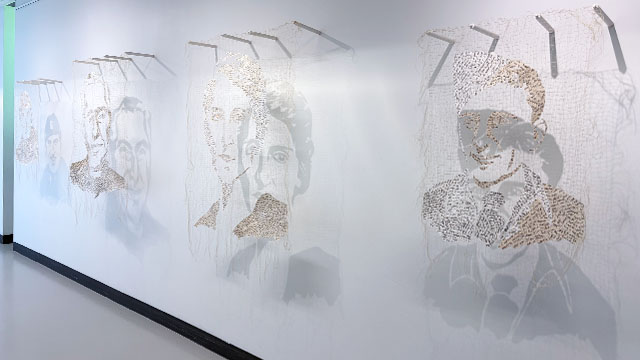
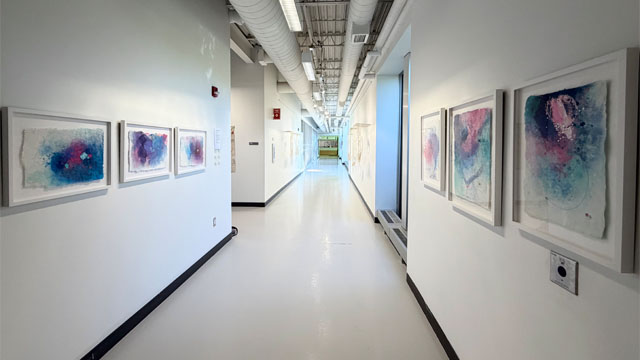
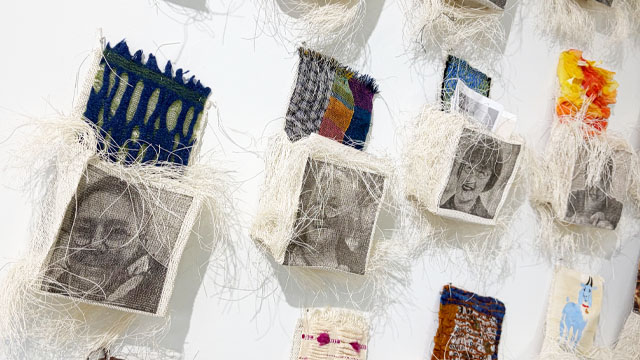
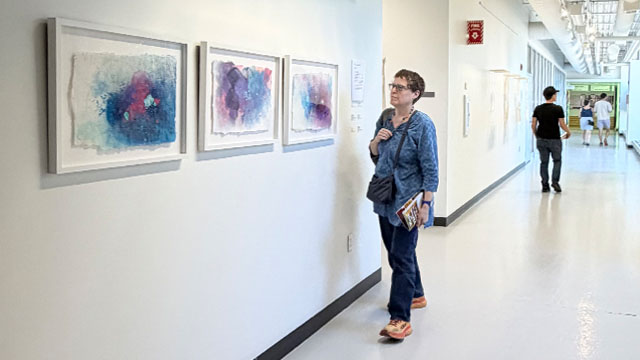
Buisman Pilger’s six works occupy a bright hallway in the Queen Elizabeth Park Community and Cultural Centre. Their vivid colours and layered surfaces stand alongside a very different visual language: the predominantly white textile portraits of Loretta Kaveri.
Kaveri’s works respond to light and shadow, changing in appearance as visitors move past them. Beside Buisman Pilger’s colourful compositions, they create a striking dialogue between subtlety and intensity.
The relatively narrow corridor encourages visitors to approach the artworks closely. That matters for work in which delicate fibres and layered textures are integral to the experience.
Visitors were particularly interested in the labour involved in preparing Kozo fibres and surprised by how much of the process begins before an artwork takes shape. But some conversations went beyond technique.
Buisman Pilger encountered visitors who connected with the personal ideas behind her work: authenticity, self-discovery and the freedom to abandon expectations of perfection.
In her exhibition statement, she describes the six pieces as tracing a journey:
“From hesitation to messy, unapologetic joy.”
The exhibition thus becomes more than a presentation of technique. It offers visitors an invitation to reconsider their own relationship with expectations and self-expression.
Nine Hundred Ways of Working With Fibre
Beyond her own exhibition, Buisman Pilger encountered an extraordinary range of approaches to fibre art.

Artwork featuring a kayak by Stan Olthuis, presented at the World of Threads Festival 2026–2027.
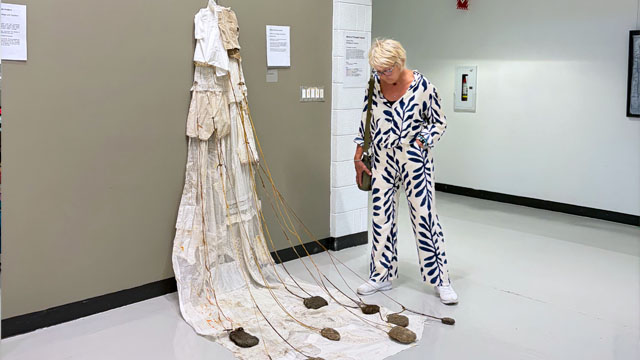
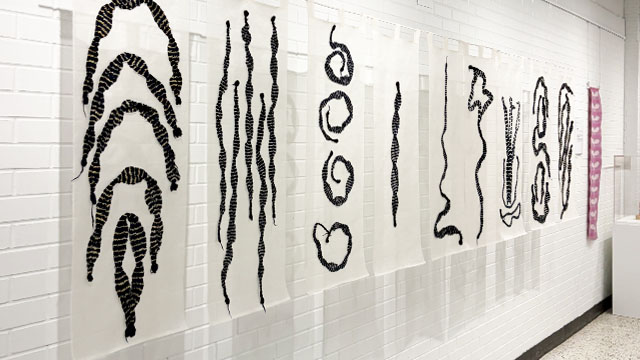
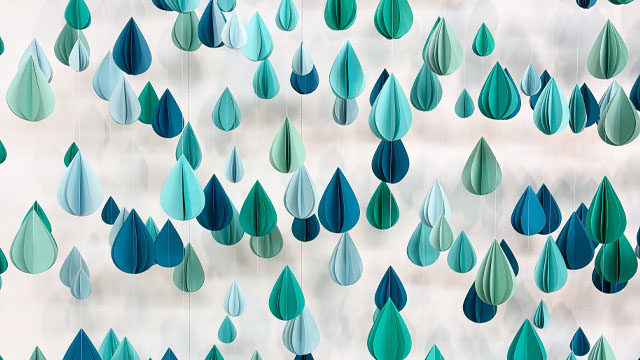
The festival brings together tapestries, quilts, sculptures, wearable works and installations that stretch far beyond conventional expectations of textile practice. Some are monumental, covering entire walls, while others invite close inspection of delicate stitching, woven structures and minute material details.
One of the central exhibitions, Water Stories, illustrates that diversity particularly well.
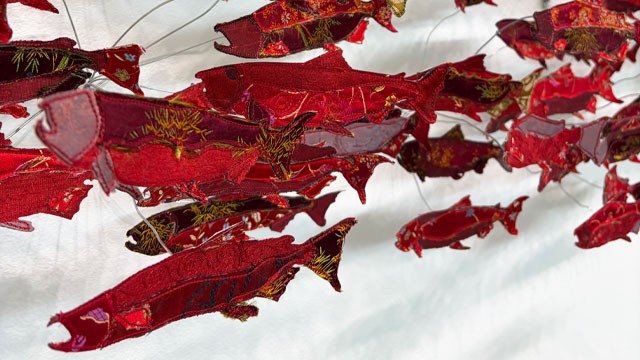
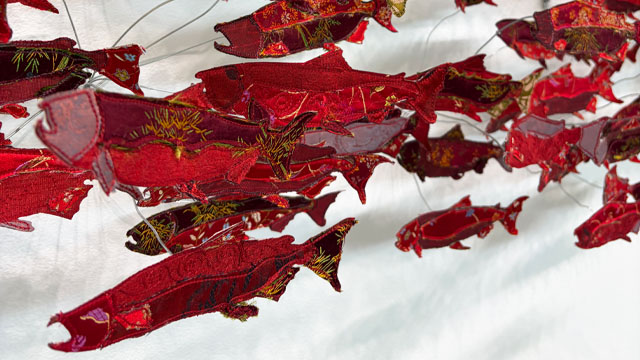
Meshell Melvin — Invocation to the Chinook of Chu Niikwän’
Hundreds of intricately constructed fish extend across two adjoining walls. Their layered surfaces and collective movement create an almost physical impression of a swimming school. For Buisman Pilger, its scale and complexity made it one of the festival’s most memorable works.
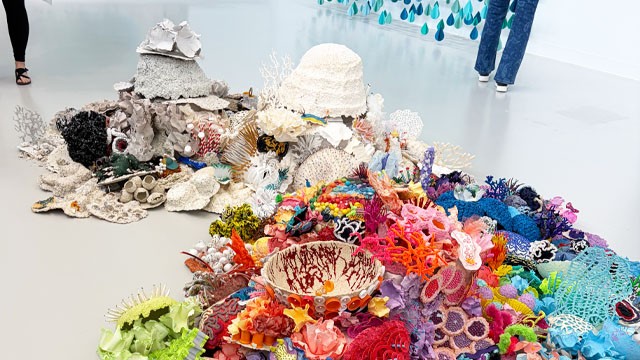
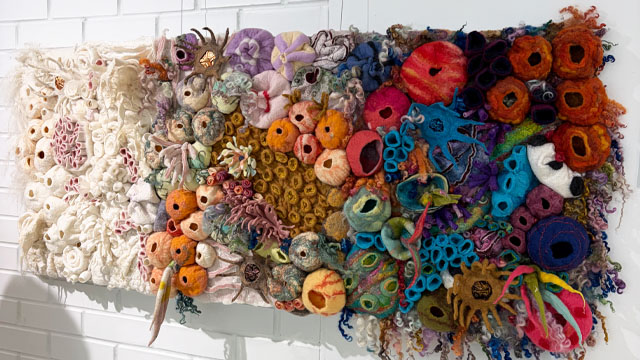
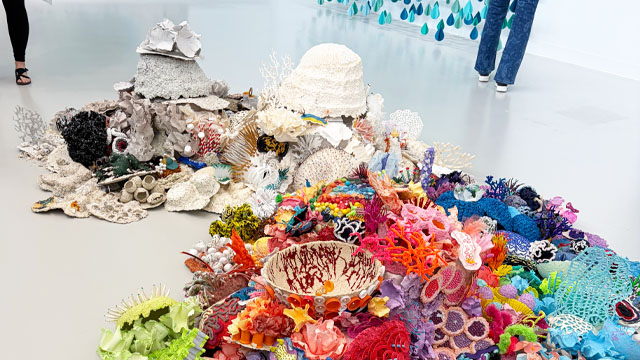
Lorna Livey — Reclamation: Idyllic, Bleached, Dead.
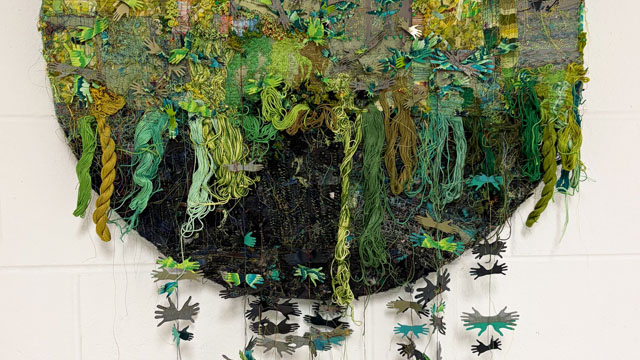
A sprawling textile reef transitions from vivid marine life to a bleached and lifeless environment. The installation turns the richness of textile materials into a visual reflection on environmental degradation.
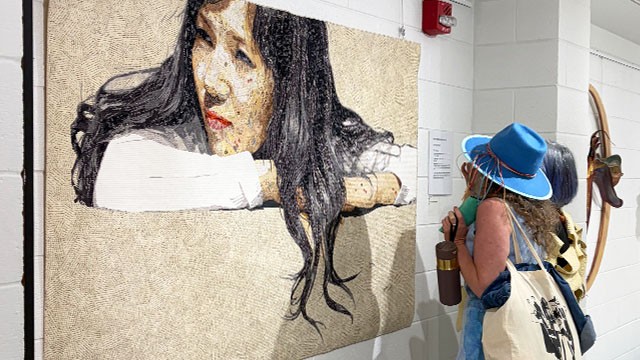
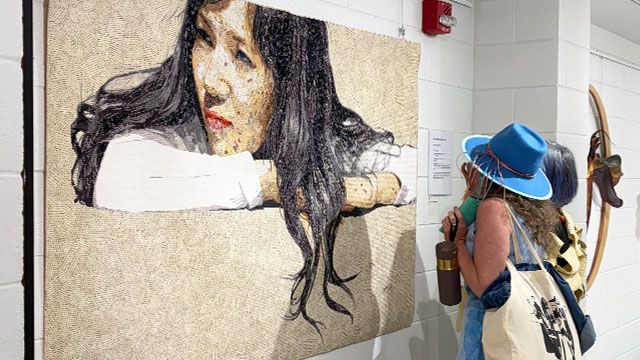
Wenrui Zhang — Gaze
An exceptionally detailed machine-quilted portrait that challenges assumptions about the expressive possibilities of textile techniques. Buisman Pilger was particularly struck by the precision, emotional expression and layered textures.
These works illustrate how fibre art can move between environmental commentary, portraiture and sculptural installation without losing its connection to traditional techniques.
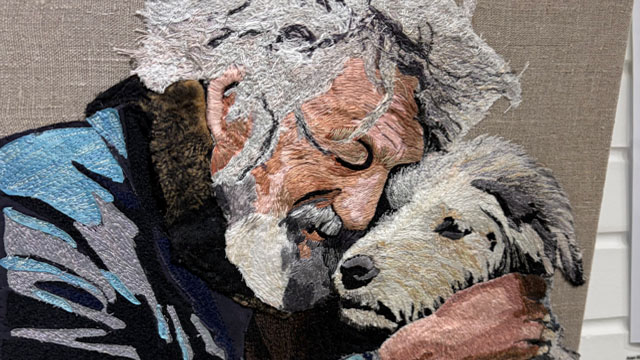
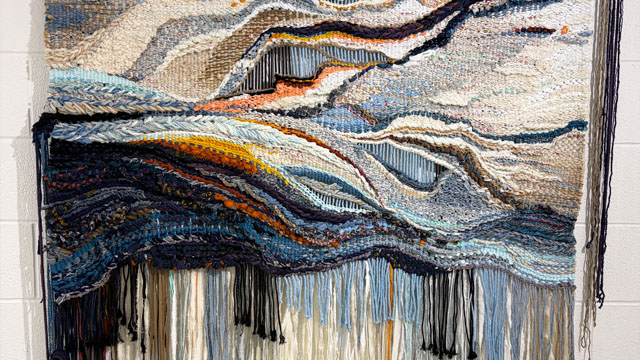
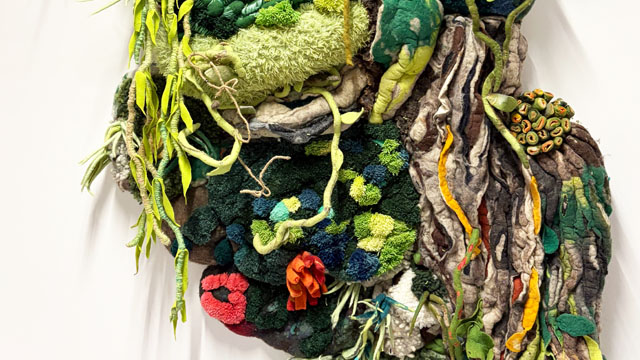
Elsewhere, Buisman Pilger found inspiration in Between the Moss by fellow Dutch artist Judy Hooymeyer, the layered landscape of Canadian Prairies by Myroslava Boikiv, and the intimate textile portrait Man and His Best Friend 3 by Aran Illingworth.
The diversity was striking not simply because of the number of techniques represented, but because familiar techniques produced such radically different artistic outcomes.
When Craft Becomes Fine Art
The festival also raises a broader cultural question. Why have techniques such as weaving, quilting and felting so often been separated from the category of fine art?
Historically associated with domestic production, utility and traditional craftsmanship, these practices have not always enjoyed the same institutional status as painting or sculpture.
Yet the works presented in Oakville challenge any simple distinction between technique and artistic ambition.
A quilt can become a portrait. A tapestry can become a landscape. Textile sculpture can address environmental destruction, identity or collective memory.
The medium does not determine the intellectual or artistic significance of the work.
For Buisman Pilger, who comes from a fine-art background, this was especially revealing. Her own work occupies a space between painting, paper and sculpture, making the festival an opportunity to discover how naturally it could sit alongside artists whose practices originate in textile traditions.
She was also struck by the number of works that moved beyond conventional rectangular or square formats. Materials were stretched, suspended, layered and transformed into unexpected shapes.
Her experience reflects a broader question facing contemporary art institutions: whether traditional distinctions between craft and fine art still adequately describe the work artists are producing.
The World of Threads Festival does not resolve that debate. It demonstrates why the debate deserves attention.
The Conversations Behind the Exhibition
For Buisman Pilger, the opening was also an opportunity to meet fellow artists.
The organisers had arranged short, rotating conversations between participants, allowing artists to exchange experiences before moving on to another conversation partner. What might otherwise have been an awkward networking exercise became an enjoyable part of the opening.
Discussions ranged from techniques and materials to the practical difficulties of transporting artwork, navigating galleries and working within the international art market.
The conversations continued over dinner.
These exchanges matter because exhibitions are not only places where finished works are presented. They are also environments in which artistic ideas circulate, new relationships emerge and unexpected influences begin to take shape.
Buisman Pilger expects some of the textures, colours and installation ideas she encountered in Oakville to resurface in her own work, perhaps months or even years from now.
Not necessarily as direct references, but as small discoveries that quietly become part of her creative vocabulary.
What Remains After the Opening
For all the artistic discoveries, one memory stood above the others. Sharing the exhibition with her mothers.
Living far from the Netherlands means that Buisman Pilger rarely has the opportunity to show them her work in person. Photographs can communicate colour and composition, but they cannot fully convey the scale, texture and physical presence of an artwork.
Seeing her mothers walk through the galleries, discover her work and experience it alongside hundreds of other pieces became the most meaningful moment of the festival. That experience captures something essential about the World of Threads Festival.
Its significance lies not simply in the number of artworks on display, but in the encounters those artworks make possible: between artists and audiences, traditional techniques and contemporary ideas, materials and meaning.
The exhibition demonstrates that fibre art is not confined to a particular technique, tradition or artistic category. It is a field in which inherited knowledge and contemporary experimentation continue to reshape one another.
And sometimes, amid 900 artworks and a maze of gallery corridors, the most memorable discovery is seeing familiar work through someone else’s eyes.
Exhibition information
The World of Threads Festival 2026–2027 takes place in Oakville, Ontario, Canada, from September 23, 2026, to January 17, 2027.
More information: World of Threads Festival
Explore More: The Human Hand
Why craftsmanship still matters in the age of artificial intelligence
Denise Buisman Pilger’s artistic practice is also at the heart of The Human Hand, an editorial series by Altair Media exploring craftsmanship, material culture and human creativity in an increasingly digital world.
Through her work with Japanese Washi paper, Kozo fibres and experimental forms, the series examines the relationship between artistic intention, materials, imperfection and the irreplaceable experience of making something by hand.
Discover the series:
When Handmade Becomes Extraordinary Again · Why Washi Matters · The Philosophy of Kozo
Photo Credit
Photo courtesy of Denise Buisman Pilger / Artist Abroad.
Caption
Dutch artist Denise Buisman Pilger pictured with her colourful, textured artworks. Her participation in Canada’s World of Threads Festival 2026–2027 offers a personal perspective on an international exhibition featuring approximately 900 works, where traditional craftsmanship, contemporary artistic expression and material experimentation come together.
