When Handmade Becomes Extraordinary Again
Why Denise Buisman Pilger’s international exhibition reflects a wider cultural shift
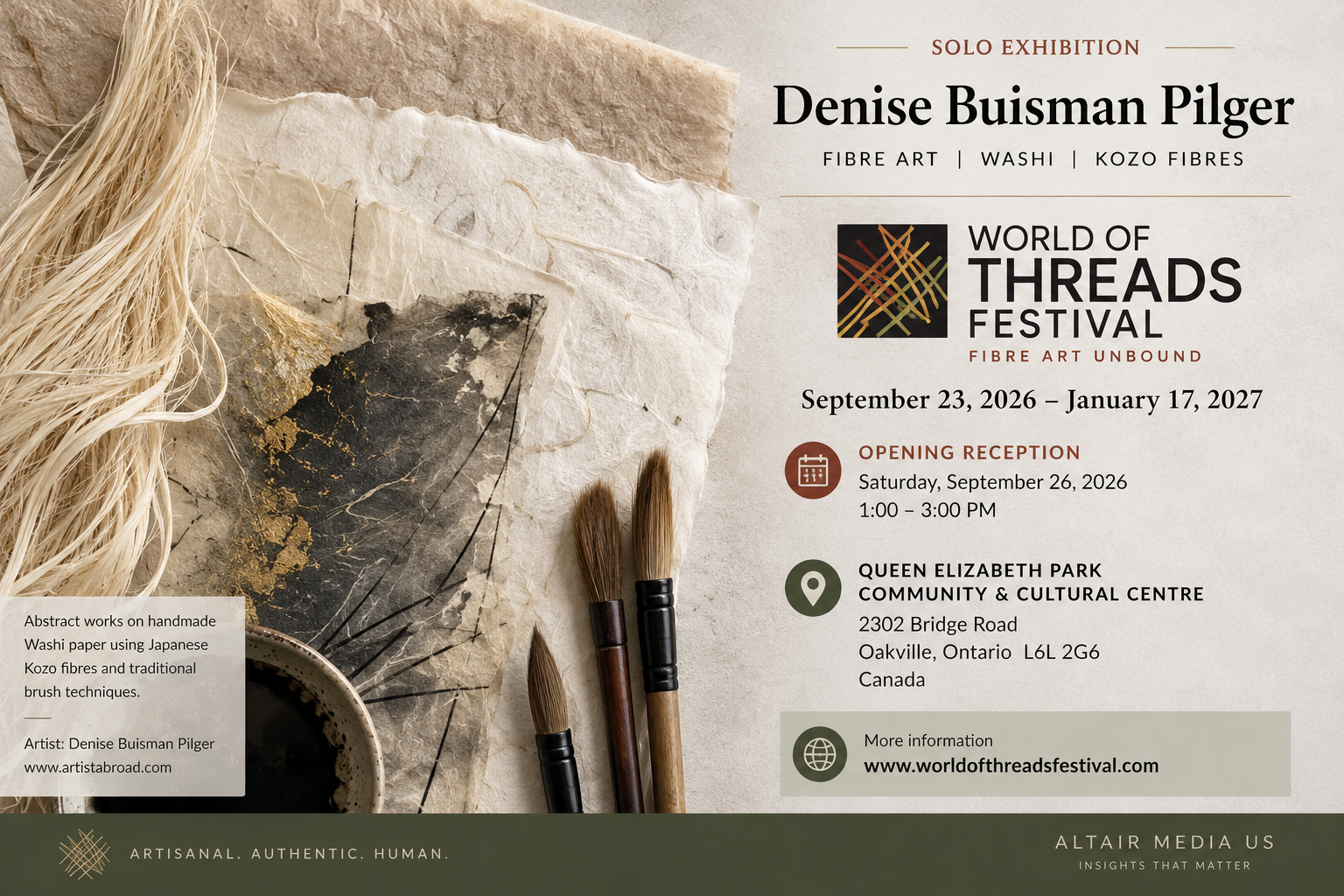
Dutch artist Denise Buisman Pilger has been selected for a solo exhibition at Canada’s World of Threads Festival 2026–2027, one of the world’s leading international festivals for fibre and textile art.
Working with hand-processed Japanese Kozo fibres, handmade Washi paper and traditional Japanese brushes, Buisman Pilger has developed an artistic practice centred on intuition, craftsmanship and the dialogue between artist and material.
Her selection is an important personal milestone. It may also reveal something about how our relationship with creativity is changing.
🟦 Why Are Handmade Materials Becoming More Valuable?
Artificial intelligence can now generate sophisticated images within seconds.
Yet as digital creation becomes faster and more accessible, artists like Denise Buisman Pilger are deliberately moving in the opposite direction. Rather than relying on speed, they embrace slow processes, physical materials and the unpredictable nature of craftsmanship.
The easier it becomes to create digitally, the more distinctive handmade work appears.
🟦 Why Does Washi Matter?
For Buisman Pilger, Washi is more than a surface to paint on.
Every handmade sheet responds differently. Kozo fibres shift, absorb and interact in unexpected ways. The material influences the artwork as much as the artist does.
That relationship cannot simply be replicated by an algorithm.
The artwork becomes a conversation rather than a product.
🟦 What Does Her Exhibition Tell Us About Contemporary Art?
Buisman Pilger’s solo exhibition is not an isolated success.
Across museums, galleries and international festivals, fibre art, ceramics and other material-based practices are receiving renewed attention.
Collectors increasingly value works that reveal the creative process instead of hiding it.
In an age of digital abundance, physical authenticity has become increasingly rare.
🟦 Is AI Replacing Craftsmanship?
Not necessarily.
Artificial intelligence is expanding what artists can create.
Craftsmanship reminds us why the creative process still matters.
Rather than competing with technology, handmade art highlights qualities that technology cannot fully reproduce: touch, resistance, material history and human presence.
Both may shape the future of creativity—but in different ways.
🟦 Signify
Denise Buisman Pilger’s exhibition represents an important moment in her own artistic journey. It also points towards a broader cultural movement.
As artificial intelligence reshapes visual creation, the value of art may increasingly be found not only in the finished image, but in the visible relationship between artist and material.
The future of creativity may therefore depend not simply on technological innovation, but also on society’s continuing appreciation for the human hand.
Series Reference
Part of Signals, Altair Media’s editorial series exploring emerging shifts in technology, society, culture and the systems shaping tomorrow.
Photo Credit
Editorial illustration by Altair Media US, inspired by the artistic practice of Denise Buisman Pilger and the World of Threads Festival 2026–2027.
Caption
Dutch artist Denise Buisman Pilger creates abstract works using handmade Japanese Washi paper, Kozo fibres and traditional brush techniques. Her solo exhibition at Canada’s World of Threads Festival 2026–2027 reflects a growing international appreciation for craftsmanship, materiality and the enduring value of the human hand in an increasingly AI-driven world.
