Constellation Energy
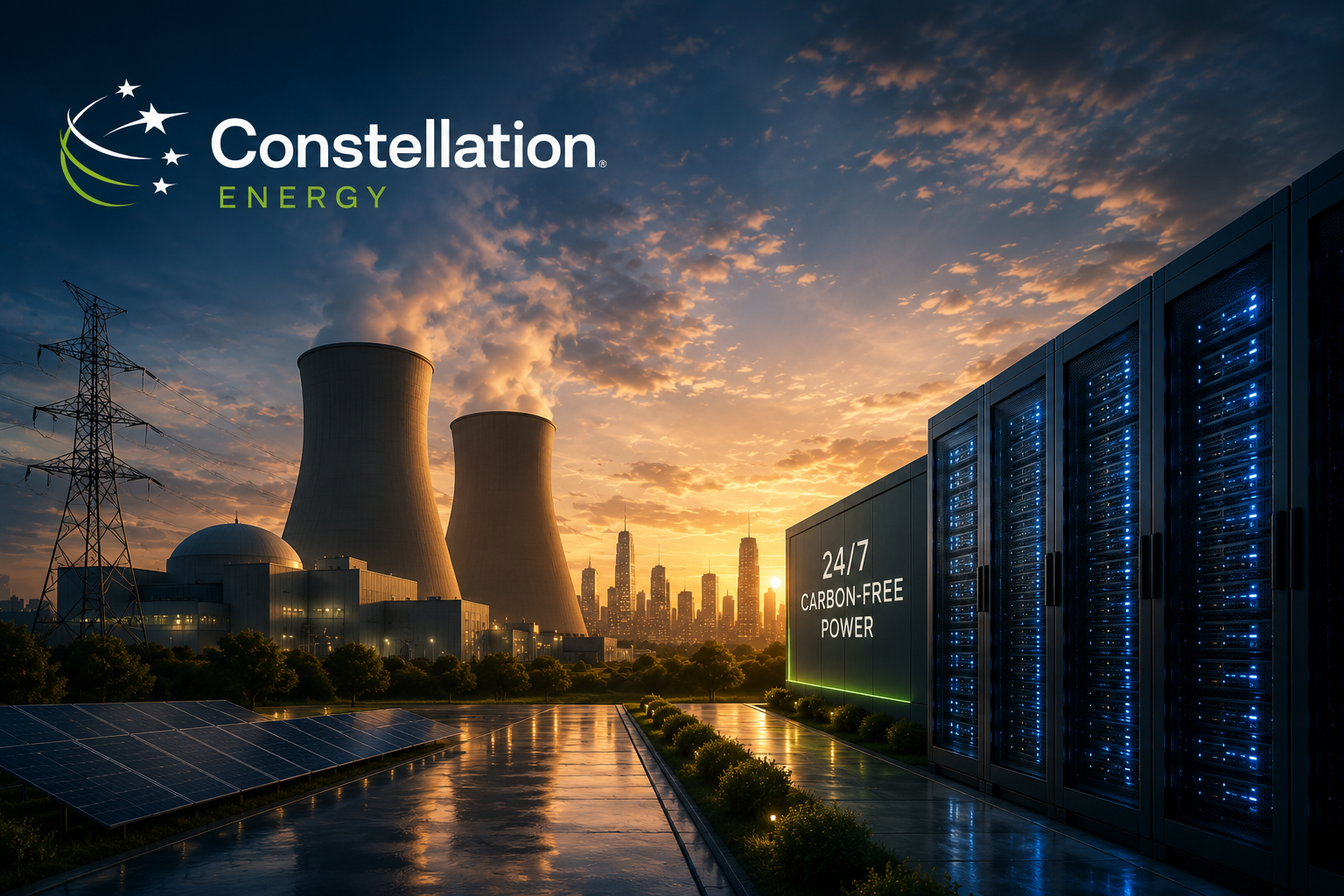
Why certainty may be becoming one of the most valuable resources in the AI economy
Strategic Briefings
Artificial intelligence is creating unprecedented demand for electricity. Yet the challenge facing the energy sector is not simply generating more power. It is providing certainty.
Data centres operate around the clock. Cloud infrastructure never closes. AI systems continue processing information regardless of weather conditions or time of day. In this environment, an industry that once seemed to belong to the twentieth century is suddenly becoming increasingly relevant to the twenty-first.
Among the companies at the centre of that shift is Constellation Energy. As America’s largest operator of commercial nuclear power plants, the company occupies a position that extends beyond traditional electricity generation.
“Artificial intelligence requires more than electricity. It requires certainty.”
Increasingly, it sits at the intersection of energy security, digital infrastructure and artificial intelligence.
Beyond the Nuclear Debate
For decades, discussions surrounding nuclear energy were often framed around safety, environmental concerns and public acceptance. Today, a different perspective is emerging. Infrastructure.
As artificial intelligence expands, technology companies are beginning to view energy through a new lens. The question is no longer only where electricity comes from. The question is whether sufficient electricity can be delivered continuously, reliably and at scale. This shifts the conversation.
Nuclear energy is increasingly being discussed not simply as a source of electricity, but as part of the foundation upon which long-term digital growth depends.
The Decarbonisation Paradox
Artificial intelligence is creating a new challenge for the technology sector. Most large technology companies have committed themselves to ambitious sustainability goals. At the same time, they continue expanding AI infrastructure that requires enormous amounts of electricity.
These objectives do not always align easily. AI systems require energy twenty-four hours a day. Renewable energy continues to expand rapidly, yet output remains dependent upon weather conditions and time of day. This creates what might be described as a decarbonisation paradox.
How do organisations simultaneously increase computing capacity, reduce emissions and maintain reliable access to electricity? For many observers, nuclear energy is increasingly becoming part of the answer. Not because it is new. But because it offers something increasingly valuable. Predictability.
Why Reliability Matters
Not all electricity is the same from an infrastructure perspective. Solar facilities depend upon sunlight. Wind farms depend upon weather patterns. Battery technologies continue improving, but remain constrained by duration and scale.
Nuclear facilities operate differently. They provide continuous generation over extended periods of time, often supplying electricity for months without interruption. For industries that depend upon uninterrupted operations, this characteristic becomes increasingly important. Artificial intelligence is one of those industries.
The greater the role AI plays within economic activity, the greater the importance of certainty becomes.
When Power Plants and Data Centres Converge
A subtle but important shift is beginning to emerge within the relationship between energy and digital infrastructure. Historically, power plants generated electricity while data centres consumed it. Increasingly, those functions are moving closer together.
Technology companies are exploring arrangements that place large-scale computing facilities near major sources of electricity generation. In some cases, energy production and digital infrastructure are beginning to form integrated ecosystems.
This development reflects a broader reality. Electricity is no longer simply an input into the digital economy. Increasingly, it influences where digital infrastructure can be built in the first place. The geography of artificial intelligence is becoming inseparable from the geography of energy.
From Power Producer to Strategic Asset
Infrastructure often becomes visible only when society begins to depend upon it in new ways. Railways became strategic when industrial economies expanded. Ports became strategic when global trade accelerated. Semiconductor manufacturing became strategic when digital technologies transformed modern economies.
Energy may be following a similar path. As artificial intelligence becomes more deeply embedded within economic activity, reliable electricity generation is acquiring greater strategic significance.
In this environment, companies such as Constellation Energy become more than power producers. They become custodians of capabilities that influence technological development, economic competitiveness and long-term national capacity.
The future competitiveness of the United States may depend not only upon advances in software and semiconductors, but also upon access to reliable energy systems capable of supporting large-scale digital infrastructure.
The race for artificial intelligence is often described as a contest between technology companies. Increasingly, it may also be a contest between infrastructure systems.
Looking Ahead
Much of the discussion surrounding artificial intelligence focuses on algorithms, chips and data centres. Yet another question is quietly moving to the foreground. Who can provide certainty?
As America’s AI economy continues to expand, organisations capable of delivering reliable, long-term energy supplies are becoming increasingly important.
Companies such as Constellation Energy sit at the centre of that conversation. The future of artificial intelligence may be powered by innovation. But innovation itself depends upon something more fundamental. Reliable electricity.
Credit
Image: AI-generated illustration for Altair Media
Concept & Editorial Direction: Altair Media
Visualisation: Artificial Intelligence
Caption
The Value of Certainty
Artificial intelligence requires more than electricity. It requires reliable energy systems capable of delivering power every hour of every day.
