Duke Energy
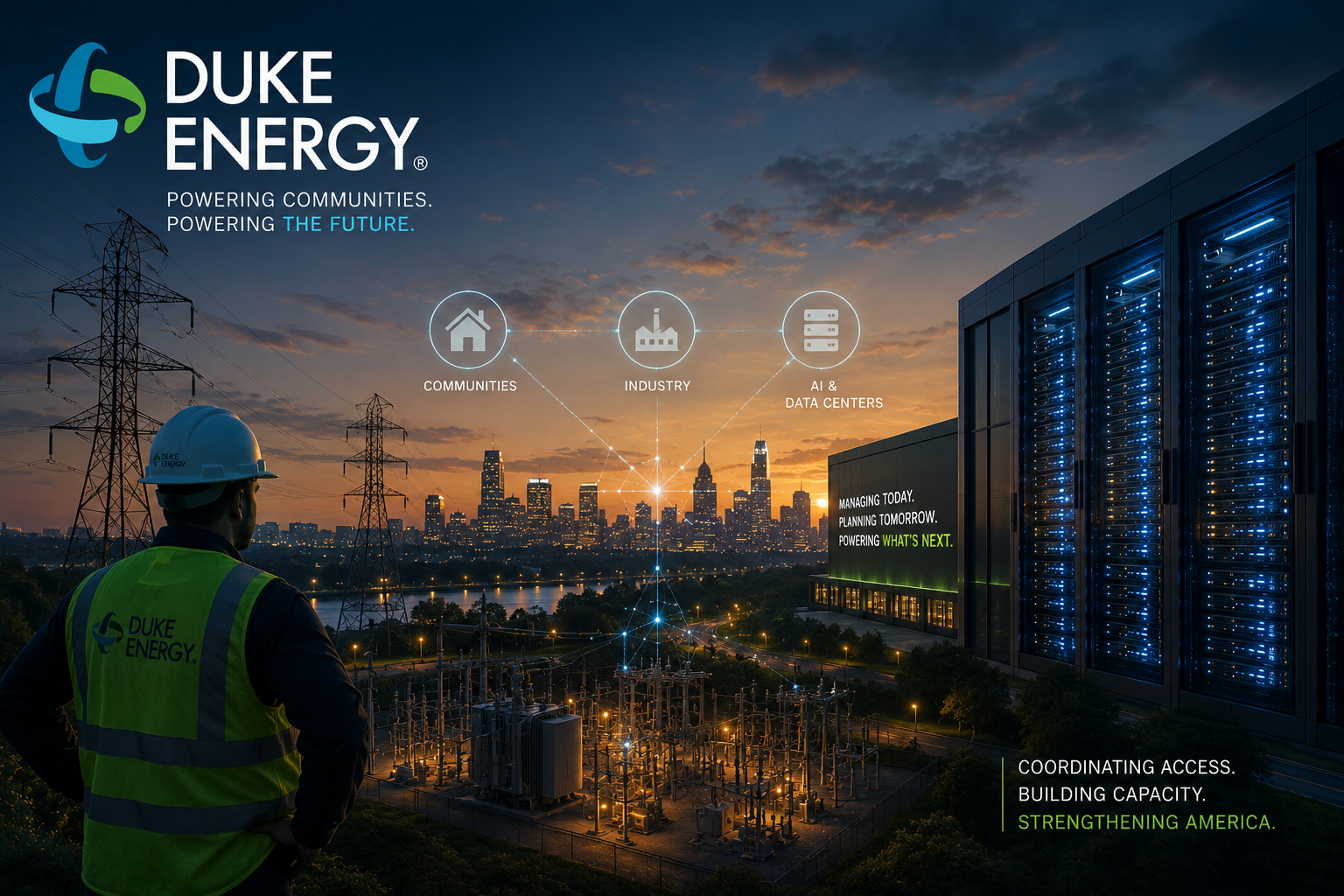
Why the future of artificial intelligence may depend on who gets access to the grid
Strategic Briefings
Artificial intelligence is creating unprecedented demand for electricity. Much of the discussion focuses on how that electricity is generated. Far less attention is paid to another question. Who gets access to it?
As data centres expand across the United States, access to energy is becoming increasingly important. Yet electricity generation alone is not enough. Digital expansion remains bound by the physics of transmission — the lines, substations and distribution networks that move power across space.
“The challenge is no longer simply generating electricity. The challenge is delivering it.”
In that environment, organisations such as Duke Energy occupy a position that extends beyond electricity production. They help manage the infrastructure that connects energy supply with economic activity.
The Invisible Infrastructure
Most people rarely think about the electrical grid. Electricity appears when a switch is activated. Data centres operate. Factories continue production. Cities remain illuminated. The system works so consistently that its complexity often remains invisible.
Yet the modern economy depends upon one of the largest and most complex infrastructure systems ever constructed. Power plants generate electricity. Transmission networks move it. Substations distribute it. Utilities coordinate and maintain the entire system.
Artificial intelligence is beginning to place new demands upon every layer of that structure.
When Demand Arrives Faster Than Infrastructure
Digital infrastructure can often be deployed quickly. Physical infrastructure cannot. A new data centre may be developed within a few years. Expanding transmission corridors, upgrading substations and reinforcing grid capacity often requires much longer timelines.
This creates a growing tension. The pace of technological development increasingly exceeds the pace of infrastructure development. In several regions of the United States, utilities are receiving requests for electricity that exceed previous planning assumptions. Some proposed AI facilities require power levels comparable to those of entire communities.
The challenge is no longer theoretical. It is operational. The result is an increasingly visible reality. Demand is arriving faster than the infrastructure designed to support it.
The Coordination Challenge
The challenge facing utilities is no longer simply providing electricity. Increasingly, it involves coordinating competing forms of demand across a shared network. That task is becoming more complex as artificial intelligence enters the system.
Households require electricity. Hospitals require electricity. Manufacturers require electricity.Schools require electricity. Increasingly, AI infrastructure requires electricity as well.
This creates a new responsibility for utilities such as Duke Energy. They do not merely connect infrastructure. They coordinate access to infrastructure. As demand grows, questions that were once largely technical begin to acquire economic and social significance.
The Allocation Question
Every infrastructure system eventually faces questions about allocation. Road networks must balance different forms of transport. Ports must prioritise cargo flows. Water systems must manage competing demands. Electricity networks face similar realities.
Across parts of the United States, requests for new grid connections increasingly exceed available capacity. The result is a growing queue of projects waiting for access to the network.
This phenomenon is often discussed in technical language. Its implications are anything but technical. When capacity becomes constrained, decisions must be made. Who receives priority? Which projects move forward? Which projects wait?
Artificial intelligence is often presented as a technological challenge. Increasingly, it may also become an allocation challenge.
The Grid as Strategic Infrastructure
For decades, electricity grids were often viewed as background infrastructure. Necessary but largely unnoticed. Artificial intelligence is changing that perception.
As computing capacity becomes a strategic economic resource, the networks that support that computing capacity acquire greater importance as well. This shifts attention toward organisations responsible for planning, maintaining and expanding electrical networks.
In this environment, companies such as Duke Energy become more than utilities. They become stewards of infrastructure that influences economic development, industrial competitiveness and digital growth.
The question is no longer only whether sufficient electricity can be generated. The question is whether the grid can evolve quickly enough to support the sheer velocity of digital demand.
The future competitiveness of the United States may depend not only upon software, semiconductors and data centres, but also upon the ability to coordinate access to the infrastructure that supports them.
Looking Ahead
Artificial intelligence is often associated with algorithms, chips and cloud platforms. Yet beneath those technologies lies a physical reality. Electricity must move before intelligence can operate.
As America’s AI economy continues to expand, transmission networks, substations and grid operators may become increasingly important participants in the digital ecosystem.
The future of artificial intelligence may be built inside data centres. But it depends upon infrastructure extending far beyond them.
The grid may prove to be one of the most important technologies of all. And the organisations responsible for coordinating that grid may become some of the most important actors in the AI economy.
Credit
Image: AI-generated illustration for Altair Media
Concept & Editorial Direction: Altair Media
Visualisation: Artificial Intelligence
Caption
Who Gets Access?
The future of artificial intelligence may depend not only on how much electricity is generated, but on how effectively that electricity can be delivered, coordinated and allocated across a shared network.
