Financing the Physical Republic
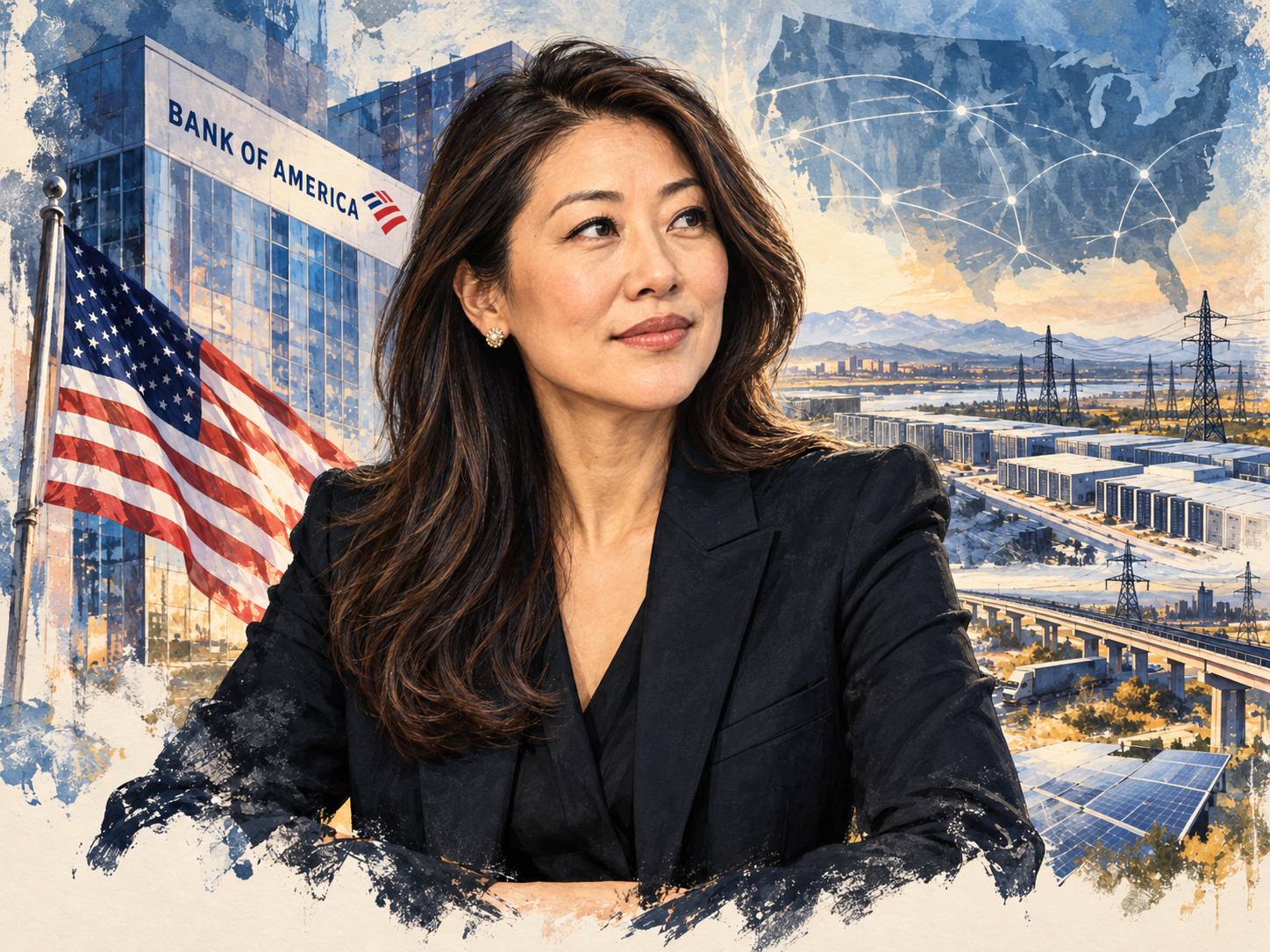
Karen Fang and the financial engineering behind America’s infrastructure cycle
America’s next investment cycle is becoming increasingly physical. Artificial intelligence requires data centres, power generation and transmission. Semiconductor manufacturing needs fabs, equipment and supply chains. Energy security depends on generation, storage and grids, while transportation, water systems and critical minerals require investment on timelines far longer than those associated with software.
That makes Karen Fang one of the more revealing figures inside Bank of America.
She is not the bank’s chief executive. As Global Head of Infrastructure & Sustainable Finance and co-head of Global Capital Solutions, her role sits closer to the machinery underneath the investment cycle: connecting corporations, projects and investors whose risks, return expectations and time horizons rarely align naturally.
The capital stack itself is becoming part of the infrastructure.
The challenge is no longer simply finding capital. It is making very different forms of capital work together.
From derivatives to infrastructure
Fang’s career makes that role less surprising than it first appears.
Before moving into sustainable and infrastructure finance, she led cross-asset trading and Americas fixed-income sales and solutions at Bank of America. Earlier, she ran cross-asset solutions for pensions, endowments and foundations at Goldman Sachs and held senior derivatives-structuring roles at Merrill Lynch in Tokyo and Deutsche Bank in London.
Structuring across asset classes is fundamentally about separating risks that arrive bundled together. Credit risk, duration, liquidity and counterparty exposure can appeal to very different investors. Modern infrastructure presents a similar problem on a much larger physical scale.
The challenge is no longer simply finding capital. It is making different forms of capital work together.
A data-centre campus combines buildings that may last for decades, electricity contracts and grid connections with their own economics, and computing equipment whose technological value can fall much faster. These components do not share the same risk profile or investment horizon.
Fang’s relevance lies in translating that physical complexity into something financial markets can actually absorb.
The $250 billion signal
Bank of America made that ambition explicit in August with its $250 billion Critical Infrastructure Finance Initiative, covering digital infrastructure, semiconductors, power generation and storage, transmission, transportation, water and critical minerals.
The headline number needs to be understood correctly. This is not a $250 billion fund sitting on Bank of America’s balance sheet. It measures eligible lending, investment, capital-markets and advisory activity across the institution. That distinction is the point.
A bank cannot — and need not — finance America’s infrastructure requirements alone. Its increasingly valuable function is to become an aggregation layer between corporate balance sheets, bond markets, infrastructure investors, private capital and project-level financing.
As Fang put it:
“Meeting America’s growing infrastructure needs requires mobilizing capital at scale across increasingly interconnected sectors.”
Karen Fang, Bank of America
Her emphasis is on integration: corporate and project finance, public and private markets, developers and investors brought into the same capital architecture.
When the capital stack becomes the product
The $16 billion Oracle data-centre campus in Saline Township, Michigan, shows what this begins to look like.
Related Digital and Blackstone provided equity, long-term fixed-rate debt was anchored by PIMCO-managed funds, and Bank of America acted as structuring agent and financial adviser. The project itself includes more than a gigawatt of capacity, while Oracle is financing additional battery storage associated with its power supply. The importance of the transaction is not simply its size.
Physical infrastructure contains several clocks at once. Buildings may operate for decades. Power infrastructure develops on utility timelines. Computing equipment can become obsolete much faster. The technology customer, property owner, electricity provider and creditor therefore encounter different risks even though they participate in the same project.
Public policy can define priorities. Private finance still has to make projects bankable.
The bank’s task becomes one of financial translation: distributing those risks towards investors whose balance sheets and time horizons can carry them. In that sense, the capital stack itself becomes part of the infrastructure.
A private layer beneath industrial strategy
This has consequences beyond banking.
The United States increasingly treats semiconductors, power systems, digital infrastructure, critical minerals and supply-chain resilience as strategic economic capabilities. Government can set priorities, provide incentives and alter the economics of particular investments. But public strategy does not automatically create a financeable project.
Someone still has to connect policy objectives to corporate cash flows, debt capacity, institutional investors and project economics. The larger and more physical the industrial ambition becomes, the more important that intermediary function becomes.
Bank of America is not executing American industrial policy, and Fang does not decide what the country should build. Yet institutions capable of transforming strategic ambition into investable structures become part of the mechanism through which industrial policy acquires scale.
Fang’s role is to translate physical complexity into something financial markets can absorb.
The boundary between financial infrastructure and industrial infrastructure consequently becomes harder to see.
Beyond sustainable finance
Fang’s own trajectory mirrors that change. She became Global Head of Sustainable Finance after a career in markets and helped lead Bank of America’s commitment to mobilise and deploy $1.5 trillion in sustainable finance by 2030. Her remit now explicitly combines infrastructure and sustainable finance.
That evolution matters because many problems once discussed as ESG themes have become operational constraints.
Electricity is not merely a climate question when an AI campus cannot connect to the grid. Energy security is not separate from decarbonisation when both compete for generation, networks and capital. Digital infrastructure cannot be analysed independently from the power system required to operate it.
Fang’s world is therefore less about assigning labels to assets than making systems financeable when several objectives collide.
Financing the physical republic
That is what makes her different from a traditional Wall Street protagonist.
Ted Pick represents a financial institution adapting to the enormous capital requirements of a new investment cycle. Fang operates closer to the point where that capital encounters the physical world — where a power contract, a data centre, a bond investor and a technology company have to become one viable structure.
Her career in derivatives and cross-asset markets suddenly looks almost like preparation for infrastructure finance.
The underlying problem has remained remarkably consistent: identify the risks, separate them, price them and find the balance sheet capable of carrying each one.
Only now those risks increasingly arrive wrapped in concrete, copper, electricity and silicon. And that may become one of Wall Street’s most important functions: not merely financing companies, but making national productive capacity financially possible.
This article is part of The New Architecture of American Capital, an Altair Media series examining how banks, private markets and long-term investors are adapting to an economy that increasingly depends on infrastructure, energy and physical capacity.
The series asks a broader question: how is American finance changing as the next growth cycle becomes more capital-intensive, more physical and more dependent on long-term investment?
Credit
Illustration: Altair Media / OpenAI
Caption
Karen Fang, Global Head of Infrastructure & Sustainable Finance at Bank of America. Her role sits at the intersection of capital markets, energy systems and digital infrastructure — helping turn complex physical projects into financeable structures.
