NextEra Energy
Why one of America’s largest renewable energy companies may be becoming part of the AI economy
Strategic Briefings
Artificial intelligence is often associated with semiconductor manufacturers, cloud providers and technology companies. Yet as demand for computing power continues to grow, another group of actors is moving to the forefront. Energy companies.
Among them, few occupy a larger position within America’s energy landscape than NextEra Energy. The company is widely known for its investments in renewable energy. Less visible is its potential role in supporting the infrastructure required for the next generation of artificial intelligence.
As AI expands, the question is no longer simply how advanced algorithms can become. The question is whether the physical systems that support them can keep pace.
Beyond Electricity Generation
For decades, NextEra Energy was primarily viewed as a utility company. A provider of electricity. An operator of power networks. A participant in regulated energy markets.
Today, that description may no longer be sufficient. Artificial intelligence is transforming electricity from a background resource into a strategic economic input. Data centres require continuous access to power. Cloud infrastructure depends upon reliability. Digital growth increasingly depends upon energy availability.
“Digital intelligence ultimately depends upon physical energy.”
This places companies such as NextEra in a different position than they occupied only a decade ago. The question is no longer simply how much electricity they generate. The question is what role they play within America’s emerging AI infrastructure.
The Scale of NextEra
Scale matters. NextEra Energy has grown into one of the largest energy companies in North America, with operations spanning power generation, transmission assets and renewable energy development. Its portfolio includes substantial investments in:
- Wind energy
- Solar energy
- Battery storage
- Transmission infrastructure
This combination is becoming increasingly significant. Large-scale AI facilities require access to vast amounts of electricity over long periods of time. Meeting that demand is not solely a matter of producing more energy. It also requires the ability to move electricity efficiently across regions and deliver it where new digital infrastructure is being developed.
The challenge is therefore as much about networks as it is about generation.
A Different Perspective on Renewable Energy
For many years, renewable energy was discussed primarily through the lens of sustainability. Artificial intelligence introduces a different perspective. Industrial capacity.
As technology companies continue expanding their data centre footprints, demand for electricity is growing alongside demand for computing power. The discussion increasingly revolves around scale, availability and long-term supply.
The question is no longer only how energy is generated. Increasingly, the question is whether sufficient energy can be delivered to support the next generation of digital infrastructure.
This shifts the conversation. Renewable energy is no longer simply part of an environmental transition. It is becoming part of a broader discussion about economic capacity and technological development.
Why AI Changes the Equation
For large-scale AI infrastructure, electricity availability is only part of the equation. Equally important is the ability to provide reliable capacity at the required scale and location.
Data centres cannot operate according to weather conditions or intermittent supply. They require predictable access to energy and long-term planning certainty. This places growing importance on transmission networks, grid connectivity and infrastructure investment.
The relationship between technology companies and energy companies is therefore becoming increasingly interconnected. What happens in the energy sector now influences what becomes possible in the digital sector.
The distance between a solar farm and an AI model is becoming shorter than many people realise.
From Utility to Strategic Infrastructure
Infrastructure often becomes visible only when it reaches its limits. Roads attract attention when traffic stops moving. Ports attract attention when supply chains are disrupted. Electric grids attract attention when demand begins to exceed available capacity.
Artificial intelligence is accelerating awareness of a reality that has always existed. Digital systems depend upon physical systems.
In this environment, organisations such as NextEra become more than energy providers alone. They become participants in the broader ecosystem that supports economic growth, technological development and national competitiveness.
The ability to build advanced AI systems increasingly depends upon access to reliable and scalable energy systems. In that sense, the future competitiveness of the United States may be influenced not only by technology companies and semiconductor manufacturers, but also by the organisations responsible for generating and delivering electricity.
The race for artificial intelligence is often described as a contest between software platforms. Increasingly, it may also be a contest between infrastructure systems.
Looking Ahead
Much of the discussion surrounding artificial intelligence focuses on software companies, semiconductor manufacturers and data centres.
Yet another question may be becoming increasingly important. Who provides the energy that makes those systems possible?
As America’s AI economy continues to expand, companies such as NextEra Energy may find themselves occupying a more strategic position than many observers currently recognise.
The future of artificial intelligence may be built inside data centres. But it begins long before electricity reaches the server rack.
Credit
Image: AI-generated illustration for Altair Media
Concept & Editorial Direction: Altair Media
Visualisation: Artificial Intelligence
Caption
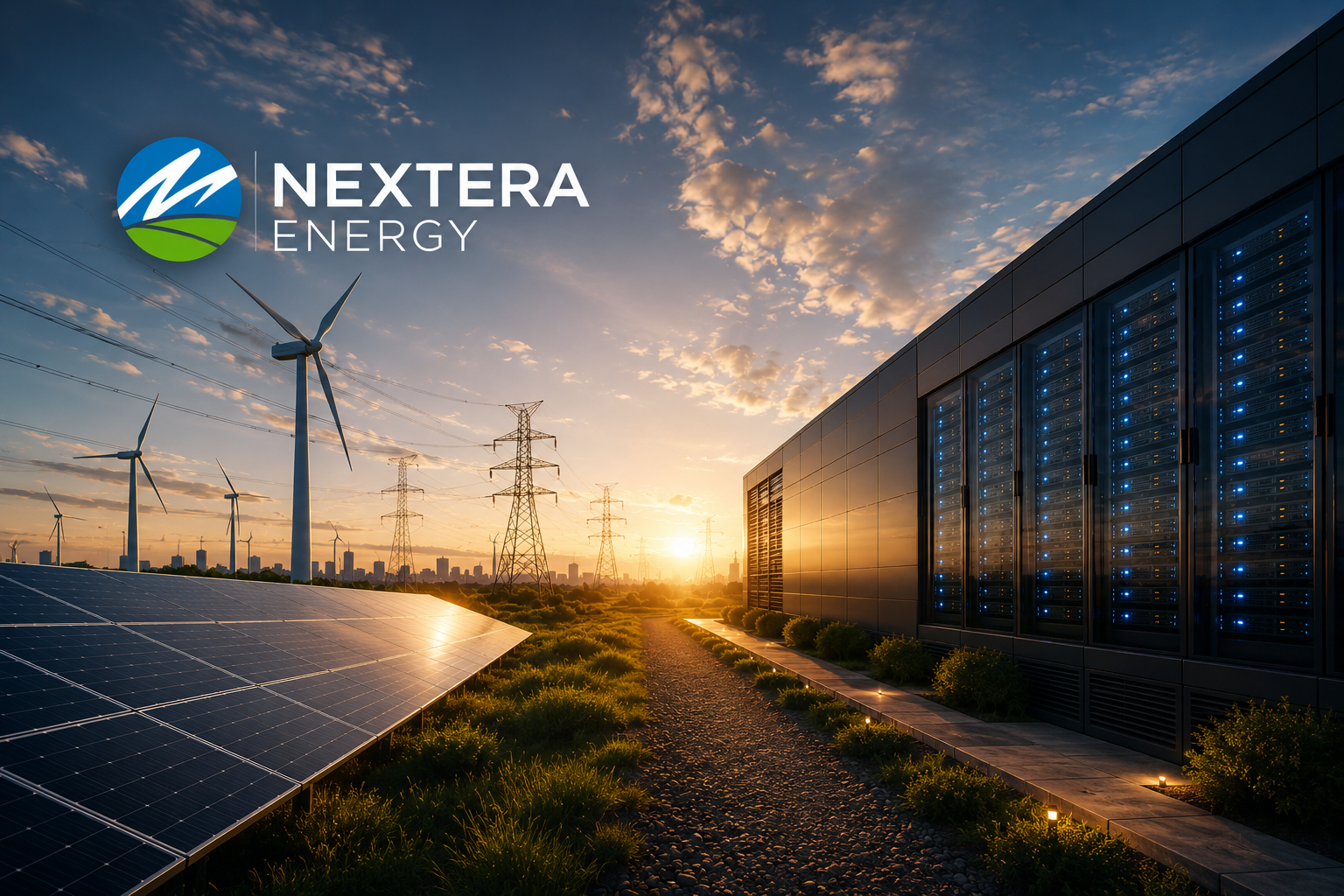
Powering the Digital Economy
The future of artificial intelligence may be built inside data centres. But it begins with the energy systems that make those data centres possible.
