T-Mobile Draws a Line: Who Controls the AI Network?
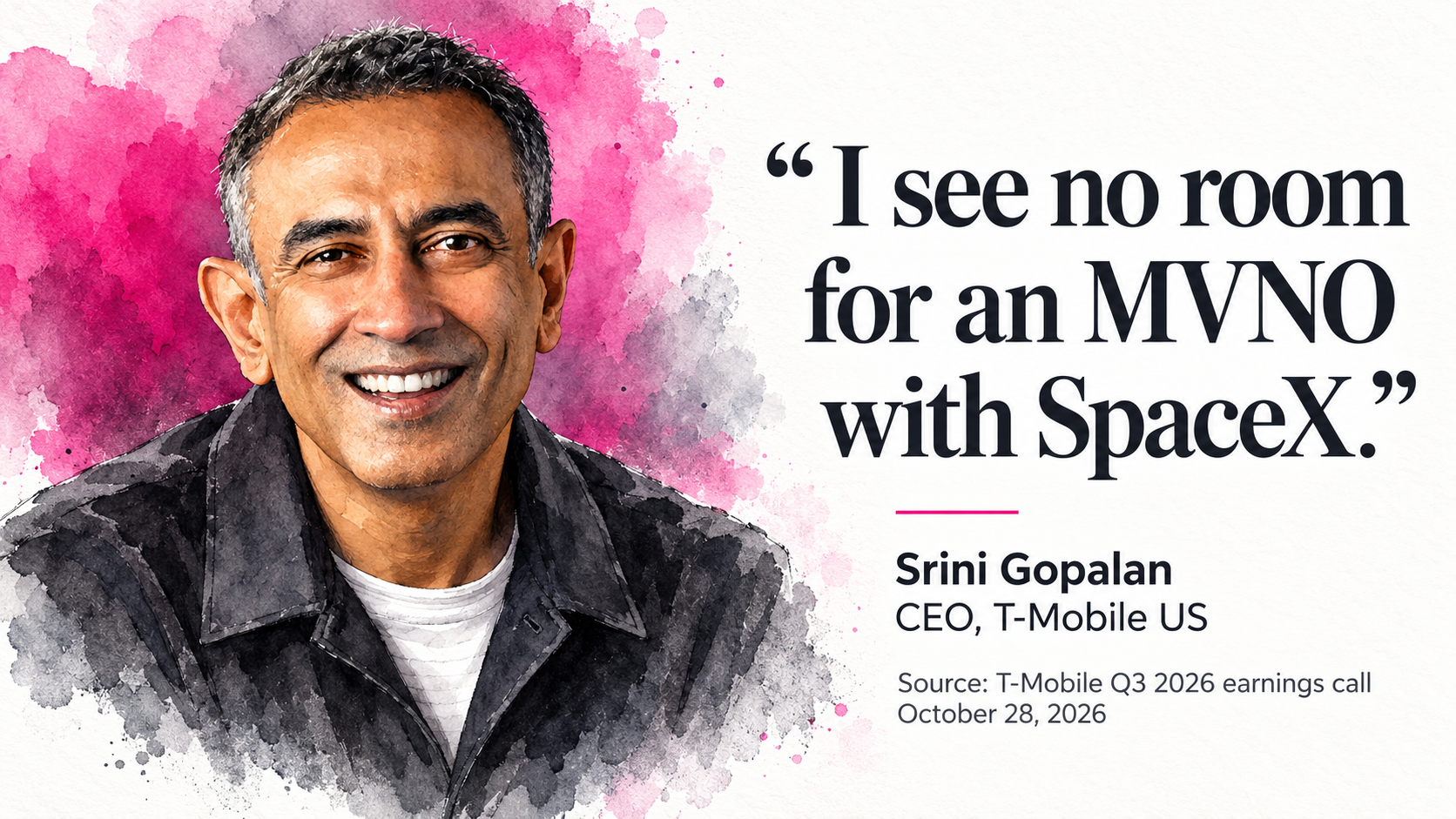
Its stance on a SpaceX MVNO raises a wider question: how much value can a mobile operator retain as connectivity and AI computing converge?
T-Mobile sees no room for a SpaceX MVNO agreement, even as it uses Starlink to extend satellite coverage. CEO Srini Gopalan’s October 28 comments frame a wider commercial question: as mobile networks take on AI workloads, which partners add value—and who controls the customer relationship, service guarantees and resulting recurring revenue?
T-Mobile is drawing boundaries around some partnerships while developing others, including edge infrastructure with AWS. Six questions explain how those choices could affect its revenues, investment requirements and dependence on technology partners.
🟥 What would SpaceX add that T-Mobile cannot already sell?
Gopalan’s stated test for a mobile virtual network operator agreement is whether it brings additional markets, distribution channels or capabilities. He said he saw no room for a SpaceX MVNO in consumer services or physical and edge AI, while leaving ordinary commercial customer-supplier arrangements open.
An MVNO sells mobile services using another operator’s network. For the host, that can generate wholesale revenue and reach customers it would otherwise struggle to acquire.
The calculation changes when the prospective partner can also build its own customer relationships and competing services. Additional network revenue must then be weighed against the value of the retail business potentially conceded.
Gopalan’s remarks establish T-Mobile’s position. Their broader significance is the commercial threshold he sets: access needs to deliver something the operator considers worth sharing its network for.
🟥 Can a satellite supplier also become a retail competitor?
T-Mobile already packages Starlink connectivity through T-Satellite. The service extends beyond emergency messaging: its October 2025 expansion introduced support for selected applications covering communication, navigation and weather. Satellite capacity therefore has an existing place in T-Mobile’s commercial offering.
Buying that capacity and hosting a satellite company as a virtual mobile operator would create different relationships.
In the first arrangement, satellite connectivity can strengthen the service T-Mobile sells. In an MVNO arrangement, another provider could use terrestrial capacity within its own customer proposition.
The strategic question is who assembles the complete offer, sets its price and handles the customer. Those responsibilities shape bargaining power even when the underlying networks remain complementary.
🟥 Is AI-RAN delivering efficiency—or creating another investment cycle?
On October 21, NVIDIA reported that T-Mobile had completed an AI-RAN call on its commercial network in Bellevue with Nokia and NVIDIA. The setup connected accelerated computing and Nokia radio software to an existing 5G Standalone core and a commercial smartphone.
That establishes a technical milestone. The investment case requires a comparison with existing radio-processing infrastructure across equipment cost, electricity, cooling, software fees and useful operating life. Nokia’s proposed subscription model also makes continuing software expenditure part of that calculation.
Shared computing could improve utilization by carrying both radio and customer AI workloads. The operator must still preserve the timing requirements of its core network.
The financial test is whether additional capacity and paid workloads cover the complete cost. High processor utilization is valuable only when the work performed supports dependable service and an attractive return.
🟥 Who captures the revenue from intelligence at the edge?
T-Mobile is working with AWS on the first instances of its Kinetic Edge. The proposed infrastructure combines T-Mobile’s 5G Advanced network and distributed edge with AWS cloud orchestration and AI services, bringing processing closer to machines and their operating environments.
The announcement describes a technical combination without specifying the full commercial allocation of customer ownership, billing and revenue.
Those terms matter. A business customer might purchase connectivity, reserved capacity, computing resources or a managed application. Each product gives T-Mobile a different role.
If a cloud partner controls the developer interface, application purchase and billing relationship, the operator could remain principally a supplier of connectivity and physical infrastructure. If T-Mobile contracts for the complete service, it could retain more revenue while accepting greater responsibility for delivery.
The SpaceX boundary therefore raises a parallel question for the AWS partnership: which commercial rights must T-Mobile retain to secure an adequate return on its contribution?
🟥 Does physical AI change what customers need from a network?
T-Mobile is evaluating edge inference with Figure AI and exploring applications with Serve Robotics. These projects test whether some intelligence can be delivered through nearby infrastructure while preserving the responsiveness machines require. They remain development work rather than evidence of a mature market at scale.
CTO John Saw also expects more uplink traffic from AI devices, robots and other machines, identifying radio uplink capacity as an area requiring attention.
Bandwidth is only one requirement. A useful service must deliver responses within the time limits of the task. Fast average performance can conceal occasional delays that make an application unreliable.
Trials must establish which functions can be offloaded, which remain on the device and how the machine behaves during disconnection. Any service guarantee must cover the combined delays of transmission, processing and the return path.
That shifts the commercial discussion toward measurable task performance and responsibility when deadlines are missed.
🟥 What must be proven before 6G becomes a business case?
Saw has stated T-Mobile’s ambition to be the first US operator with 6G, placing network development around 2030. That is a forward-looking competitive claim.
Meanwhile, AI-RAN and edge development are already proceeding on 5G infrastructure. Their results can help establish demand before a new network generation arrives.
The investment case needs to connect technical improvements with customer economics. Which applications require additional capabilities? How much will customers pay for them? Can shared infrastructure generate enough useful work to justify its cost?
T-Mobile must also show how responsibility travels across its partnerships. The organisation promising an industrial customer dependable service needs sufficient authority over the network, computing resources and software required to deliver it.
Being first with a new generation would create a milestone. Sustaining attractive returns requires repeatable demand and a workable division of risk and revenue.
Signal
T-Mobile’s SpaceX stance sets a commercial boundary around access to its network. Its AI partnerships now face a parallel test: whether the operator can turn connectivity and distributed computing into dependable services while retaining enough customer value to justify the investment.
Credit
AI-generated watercolor illustration: OpenAI for Altair Media. Portrait reference: T-Mobile. Quotation: T-Mobile Q3 2026 earnings call, October 28, 2026.
Caption
T-Mobile US CEO Srini Gopalan, illustrated in watercolor, alongside an excerpt from his October 28 earnings-call remarks. Gopalan said he saw no room for a SpaceX MVNO agreement, while leaving customer-supplier cooperation open.
