The Energy Wall of AI
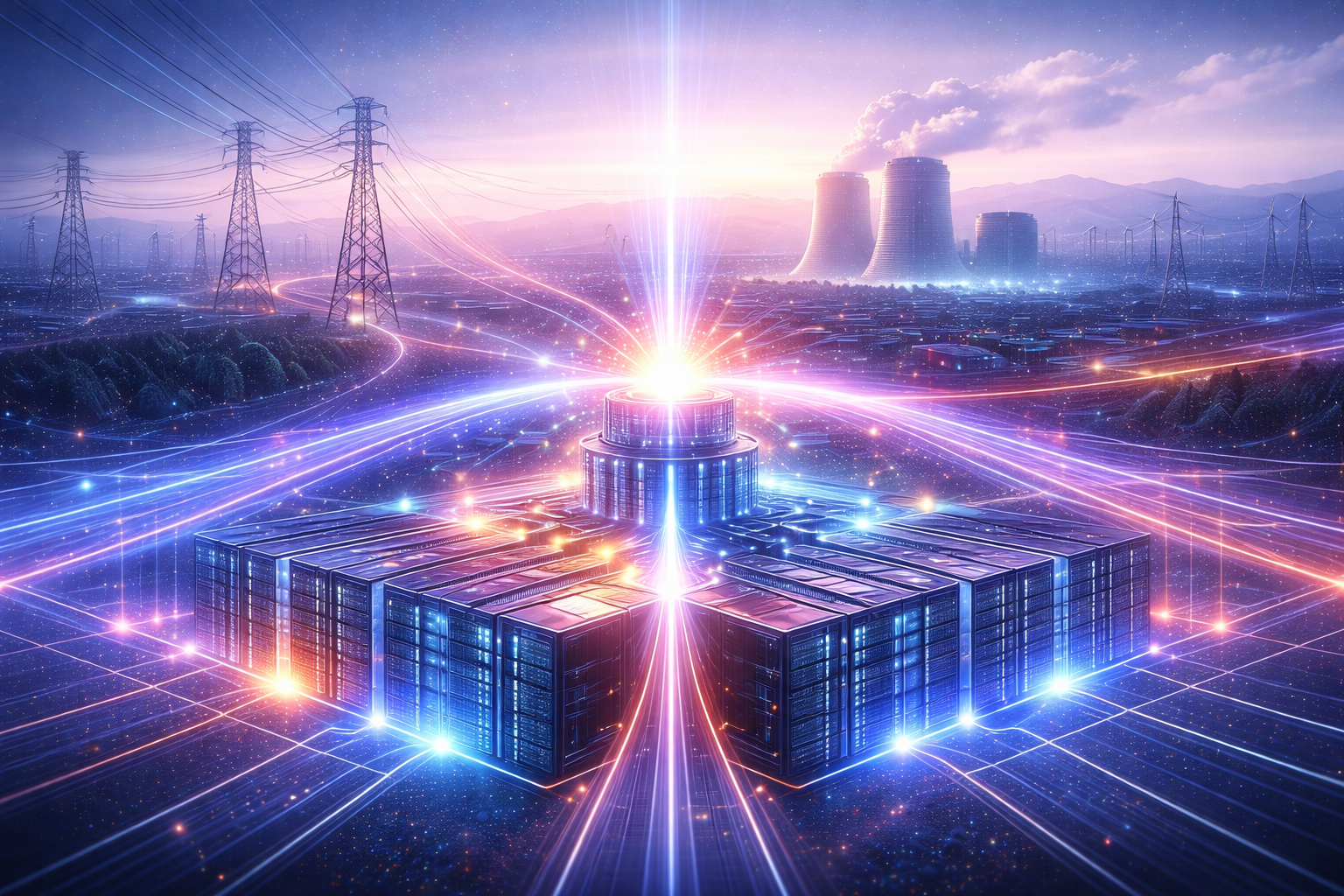
Why Power May Become the Real Bottleneck of Artificial Intelligence
Artificial intelligence is often described as a revolution in software. Advances in machine learning models, neural networks and algorithms dominate headlines, while the race between technology giants focuses largely on who can build the most powerful chips.
But behind the software layer lies a far more physical reality. Modern AI systems depend on vast networks of processors running inside hyperscale data centers—facilities that resemble industrial infrastructure more than traditional computing environments.
As artificial intelligence scales, these facilities are consuming extraordinary amounts of electricity. The challenge facing the industry is no longer simply how to design faster chips or train larger models. Increasingly, it is about how to supply enough power to run them.
In other words, the next bottleneck in the AI revolution may not be compute or networking.
It may simply be energy.
“The biggest issue we are now having is not a compute glut, but power. I have a bunch of chips sitting in inventory that I can’t plug in because I don’t have the ‘warm shells’ to put them in.”
Satya Nadella
CEO, Microsoft
Statement referenced in industry discussions, 2025
Nadella’s observation highlights a paradox of the current AI boom. Technology companies are producing increasingly powerful processors and building enormous clusters of GPUs, yet many of those systems cannot be fully deployed because the infrastructure supplying them with electricity has not kept pace.
The AI race is therefore evolving into something broader than a competition in algorithms or hardware.
It is becoming a competition in energy.
The Rise of the AI Data Center
The modern AI data center bears little resemblance to the cloud infrastructure of a decade ago.
Where earlier facilities focused primarily on storing data and running web services, AI data centers function more like computational factories. They host thousands—sometimes tens of thousands—of specialized processors designed to train and operate large language models and other machine learning systems.
These clusters rely on GPUs from companies such as NVIDIA and AMD, connected through high-speed networking and supported by advanced cooling systems.
The scale is staggering.
A single large AI cluster can consume hundreds of megawatts of electricity—comparable to the power requirements of a small city. Hyperscale operators such as Amazon, Google and Microsoft are now planning data center campuses that require gigawatts of power capacity.
This shift is transforming how infrastructure is designed. Instead of simply building server farms near network hubs, companies must increasingly locate new data centers near reliable energy sources and transmission infrastructure.
In many regions, electricity availability has become the primary constraint.
GPUs and the Power Curve
The rapid rise in energy demand is closely tied to the evolution of AI hardware.
Each new generation of AI processors delivers dramatically higher computational performance. Advanced architectures incorporate massive parallel processing, high-bandwidth memory and increasingly sophisticated interconnect technologies.
But these improvements also increase energy consumption.
Training state-of-the-art AI models requires thousands of GPUs operating simultaneously, often for weeks or months at a time. Running those systems generates enormous electrical loads and produces large amounts of heat, which must then be removed through equally energy-intensive cooling systems.
Even the companies designing these processors recognize the magnitude of the challenge.
“The next industrial revolution will require an extraordinary amount of energy. Datacenters are no longer just places to store data; they are AI factories.”
Jensen Huang
CEO, NVIDIA
Huang’s description of data centers as “AI factories” reflects a broader shift in how computing infrastructure is perceived. Instead of passive repositories of information, these facilities are increasingly viewed as industrial systems that transform electricity into intelligence.
Like traditional factories, they require a constant and reliable supply of energy to operate.
The Grid Problem
The growing energy demand of AI is beginning to expose limitations in existing electrical infrastructure.
In many parts of the world, electricity grids were not designed to support large concentrations of energy-intensive computing facilities. Transmission lines, substations and transformers often lack the capacity to deliver the power required by new AI data centers.
As a result, utilities and regulators in several regions are reporting long waiting lists for new grid connections.
Developers planning large data centers must sometimes wait years for the necessary infrastructure upgrades. In other cases, projects are being relocated entirely to areas with more abundant energy supplies.
This emerging constraint has led some industry leaders to warn that electricity itself may become the next major shortage in the technology sector.
“The chip shortage may be behind us, but the next shortage will be electricity and transformers.”
Elon Musk
CEO, Tesla and xAI
The observation captures the essence of the challenge: even if the semiconductor industry can produce enough processors, those processors still need power to operate.
And the energy infrastructure required to support them cannot be built overnight.
The Return of Nuclear
Faced with rising energy demand, several technology companies are exploring new approaches to securing reliable power.
Among the most notable trends is a renewed interest in nuclear energy.
Unlike solar or wind power, nuclear reactors provide continuous baseload electricity, making them particularly attractive for facilities that must operate around the clock. They also produce minimal carbon emissions, an important factor for companies with ambitious climate commitments.
In recent years, major technology firms have begun investing in nuclear energy projects and signing long-term agreements with energy providers.
“We need to move toward nuclear, wind and solar very quickly to meet this demand without destroying the climate.”
Sam Altman
CEO, OpenAI
One emerging technology attracting attention is the Small Modular Reactor (SMR), a new generation of compact nuclear reactors designed to be easier and faster to deploy than traditional plants.
If widely adopted, SMRs could provide dedicated power sources for future data center campuses, effectively turning energy generation into an integral part of digital infrastructure.
In that sense, the growth of artificial intelligence could inadvertently accelerate the development of next-generation nuclear technologies.
Efficiency: The Race to Reduce Energy per AI Operation
While expanding energy supply is one solution, the industry is also pursuing another strategy: improving efficiency.
Reducing the amount of energy required for each AI computation could dramatically lower the total power consumption of large-scale systems.
Researchers and engineers are exploring several approaches to achieve this goal.
Specialized AI accelerators are designed to perform machine learning tasks more efficiently than general-purpose processors. Advances in semiconductor design aim to reduce energy consumption per transistor operation. Meanwhile, new networking technologies—such as optical interconnects based on silicon photonics—promise to reduce the energy required to move data between processors.
These developments connect directly to earlier layers of the AI infrastructure stack.
Faster photonic interconnects can move data more efficiently than traditional electrical connections, while new chip architectures can perform complex computations using less power.
Each incremental improvement helps reduce the energy footprint of AI systems.
But the scale of demand continues to grow.
Energy, Compute and the Physics of Intelligence
At its core, artificial intelligence is not merely a software phenomenon.
It is a physical process.
Every calculation performed by a neural network consumes energy. Every data transfer between processors requires electricity. Every data center must dissipate heat generated by billions of electronic operations per second.
This reality has led some researchers to describe AI development as a confrontation with the fundamental limits of physics.
“The only thing blocking real-time reasoning at scale is inference cost. Ultimately we are fighting the physics of energy per operation.”
Dario Amodei
CEO, Anthropic
Seen from this perspective, the evolution of artificial intelligence is inseparable from advances in energy systems, semiconductor technology and physical infrastructure.
Scaling intelligence requires scaling the energy systems that sustain it.
The Power Behind the AI Era
The AI revolution is often framed as a race between algorithms, datasets and chip manufacturers.
Yet the deeper story may be more fundamental.
Behind every AI model lies a vast network of infrastructure: semiconductor fabrication plants, optical networks, cooling systems, transmission lines and power stations. Together, these systems convert electricity into computation and computation into intelligence.
As AI continues to expand, the defining constraint may not be the availability of processors or the sophistication of algorithms.
It may simply be whether the world can produce—and deliver—enough electricity to power them.
In that sense, the future of artificial intelligence may depend as much on energy infrastructure as it does on machine learning breakthroughs.
The AI revolution, it turns out, runs on power.
Artificial intelligence is not just about software and algorithms. It also depends on a vast physical infrastructure of chips, photonics and data centers.
Explore the series: https://altairmedia.us/the-ai-infrastructure-stack/
Photo credit
AI illustration / OpenAI
Caption
Artificial intelligence is increasingly limited not only by chips and networks, but by the energy required to power large-scale computing infrastructure.
This shift—from electrons to photons—is part of a deeper transformation in how we understand intelligence: not just as software, but as something rooted in physics, energy and infrastructure.
I explore this idea further in my ebook The Age of Light — Meaning, Machines and the Physics of Intelligence, about how photonics and physical computing architectures are reshaping AI and global power.
Available worldwide on Amazon (Kindle):
https://www.amazon.com/dp/B0GMXLX56T
