The Geography of AI Power
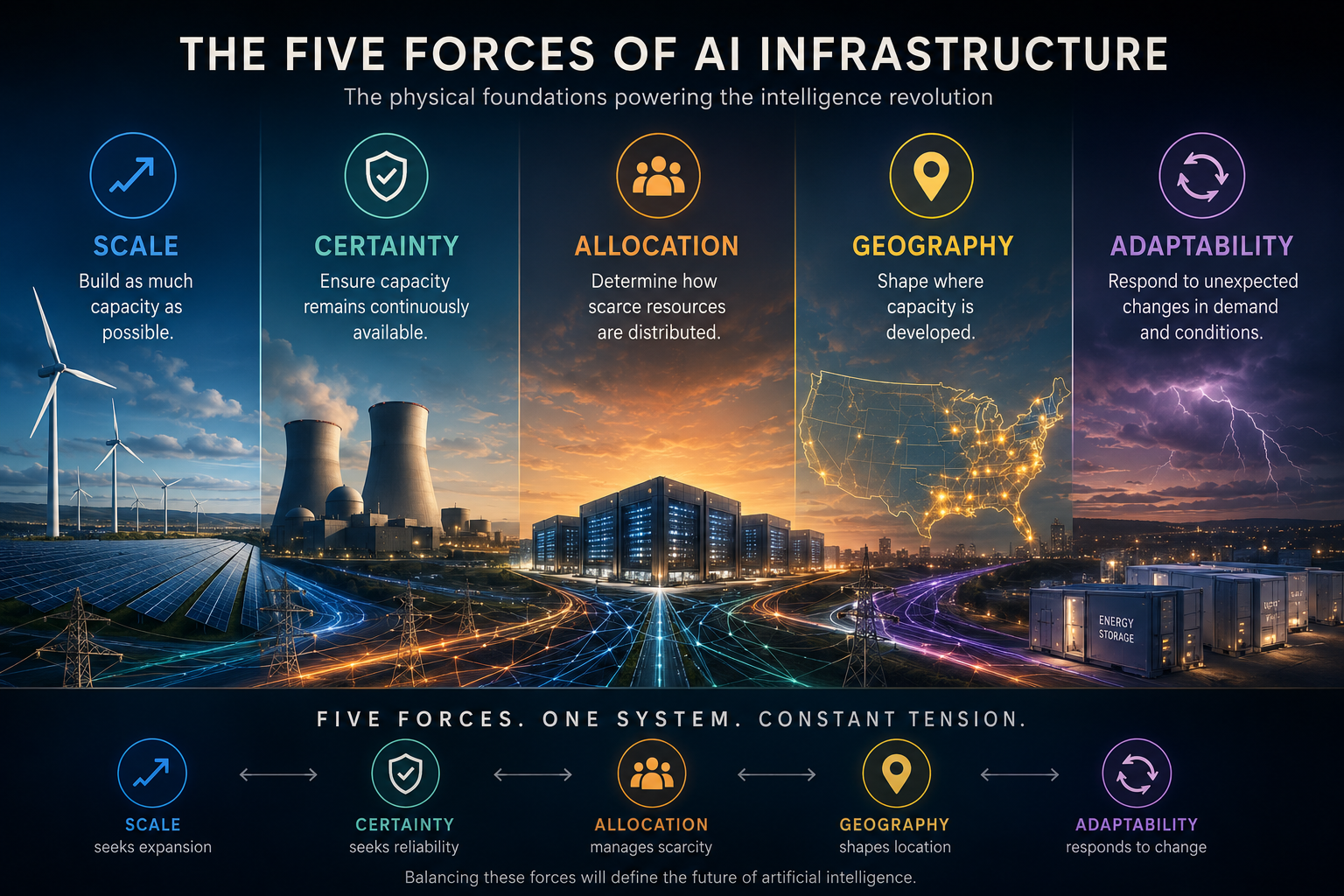
How scale, certainty, allocation, geography and adaptability are reshaping the physical foundations of artificial intelligence
The Five Forces Shaping AI Infrastructure
Artificial intelligence is often described as a revolution in software, algorithms and computing power. Yet beneath that digital narrative lies a growing physical reality. As AI expands, it is increasingly colliding with the infrastructure systems that make digital intelligence possible.
The physical infrastructure supporting artificial intelligence is increasingly shaped by five competing forces.
Scale seeks to build as much capacity as possible.
Certainty seeks to ensure that capacity remains continuously available.
Allocation determines how scarce infrastructure resources are distributed.
Geography influences where capacity is ultimately developed.
Adaptability enables systems to respond to unexpected changes in demand.
Taken individually, these forces appear straightforward. Taken together, they form the emerging architecture of the AI economy.
The challenge is that they do not always move in the same direction. Scale seeks expansion. Certainty seeks reliability. Allocation manages scarcity. Geography shapes location. Adaptability responds to change.
As artificial intelligence grows, these forces increasingly collide with one another. Every solution creates new constraints. Every constraint creates new trade-offs.
The future of AI may depend less on any single technology than on how successfully these competing infrastructure priorities are balanced.
The Illusion of the Cloud
For years, digital technologies appeared detached from physical constraints. Applications scaled globally. Cloud services expanded continuously. Artificial intelligence seemed to belong primarily to the world of software.
Yet every digital system ultimately depends upon physical resources. Semiconductors require factories. Networks require fibre. Data centres require energy. The cloud was never weightless. Its infrastructure simply remained largely invisible. Artificial intelligence is making that infrastructure visible again.
The First Force: Scale
The first challenge is capacity. Artificial intelligence requires enormous quantities of electricity. Data centres consume energy at a scale previously associated with heavy industry.
This is the challenge represented by organisations such as NextEra Energy. Can enough electricity be generated? Can energy systems expand rapidly enough to support growing digital demand? Without scale, digital expansion eventually encounters a physical ceiling. Yet scale alone is not enough.
The Second Force: Certainty
Electricity must not only exist. It must remain available continuously. Data centres cannot operate according to weather conditions. Cloud infrastructure does not close overnight.
Artificial intelligence requires reliability. This is the challenge represented by Constellation Energy. The growing interest in nuclear power reflects a broader reality. Digital infrastructure increasingly depends upon certainty.
The future of artificial intelligence may require not only more energy, but energy that remains available every hour of every day.
The Third Force: Allocation
Infrastructure eventually encounters limits. When demand grows faster than capacity, choices emerge. Who receives access? Which projects move forward? Which projects wait This is the challenge represented by Duke Energy and the electrical grid itself.
Artificial intelligence is introducing new forms of competition for infrastructure resources. The issue is no longer simply generation. It is coordination. Access to infrastructure may become just as important as infrastructure itself.
The Fourth Force: Geography
Artificial intelligence is often discussed as a global phenomenon. Its infrastructure is not.
Data centres occupy specific locations. Power plants occupy specific locations. Transmission networks occupy specific locations. This creates a new geography of digital development.
Regions capable of providing land, energy, institutional capacity and infrastructure increasingly attract investment. This is the reality illustrated by Southern Company and the rise of the American South.
The geography of innovation and the geography of infrastructure are becoming increasingly separate conversations. Where artificial intelligence is developed may not be the same as where it is physically supported.
The Fifth Force: Adaptability
Even scale, certainty, allocation and geography are not enough. Complex systems must also adapt.
Artificial intelligence is creating forms of demand that are often difficult to predict. New facilities emerge. Energy requirements change. Infrastructure planning becomes increasingly dynamic. This is the challenge represented by Vistra Corp.
Adaptability is becoming a strategic capability. The ability to respond quickly may prove just as important as the ability to build. Flexibility becomes a form of infrastructure in its own right.
When Infrastructure Priorities Collide
The future of artificial intelligence will not be shaped by a single infrastructure challenge. It will be shaped by the interaction between many infrastructure challenges.
Scale and certainty do not always align. Renewable energy can increase capacity rapidly. Yet large-scale digital infrastructure often requires continuous availability. Geography and allocation frequently collide.
Regions that attract investment may simultaneously place new pressures on local infrastructure systems. Adaptability can conflict with long-term planning. The faster demand changes, the more difficult infrastructure becomes to design efficiently.
Artificial intelligence is therefore creating something larger than an energy challenge. It is creating an infrastructure balancing act. Every solution introduces new constraints. Every constraint creates new priorities.
The future of artificial intelligence will depend upon how successfully these competing forces are managed.
A New Infrastructure Age
Taken individually, these challenges appear separate. Together, they reveal something larger. Artificial intelligence is not merely creating demand for more computing power. It is exposing the physical foundations of the digital economy.
Generation. Reliability. Coordination. Location. Adaptability. These are not technology questions alone. They are infrastructure questions.
The conversation surrounding artificial intelligence often focuses on models, applications and corporate competition. Yet the future of AI may depend just as much upon transmission lines, substations, power plants, regional planning decisions and institutional capacity. The digital economy remains bound by physical reality.
Looking Ahead
Every technological revolution eventually collides with the physical limits of its host infrastructure. Railways transformed industrial economies. Electrical networks transformed cities. Telecommunications transformed global commerce.
Artificial intelligence appears to be following a similar path. The systems enabling AI are becoming increasingly important in their own right.
The future of artificial intelligence will not be determined solely by software. It will be shaped by the physical infrastructure capable of supporting it. The cloud is not separate from the world. It is built upon it.
And as artificial intelligence continues to expand, the geography of power may increasingly become the geography of intelligence itself.
Credit
Image: AI-generated conceptual illustration for Altair Media
Concept & Editorial Direction: Altair Media
Visualisation: Artificial Intelligence
Caption
Five Forces. One System.
Scale builds capacity. Certainty provides reliability. Allocation manages scarcity. Geography shapes location. Adaptability responds to change. Together, these forces increasingly determine the future of artificial intelligence.
