Posted by Altair Media on June 6, 2026 · Leave a Comment
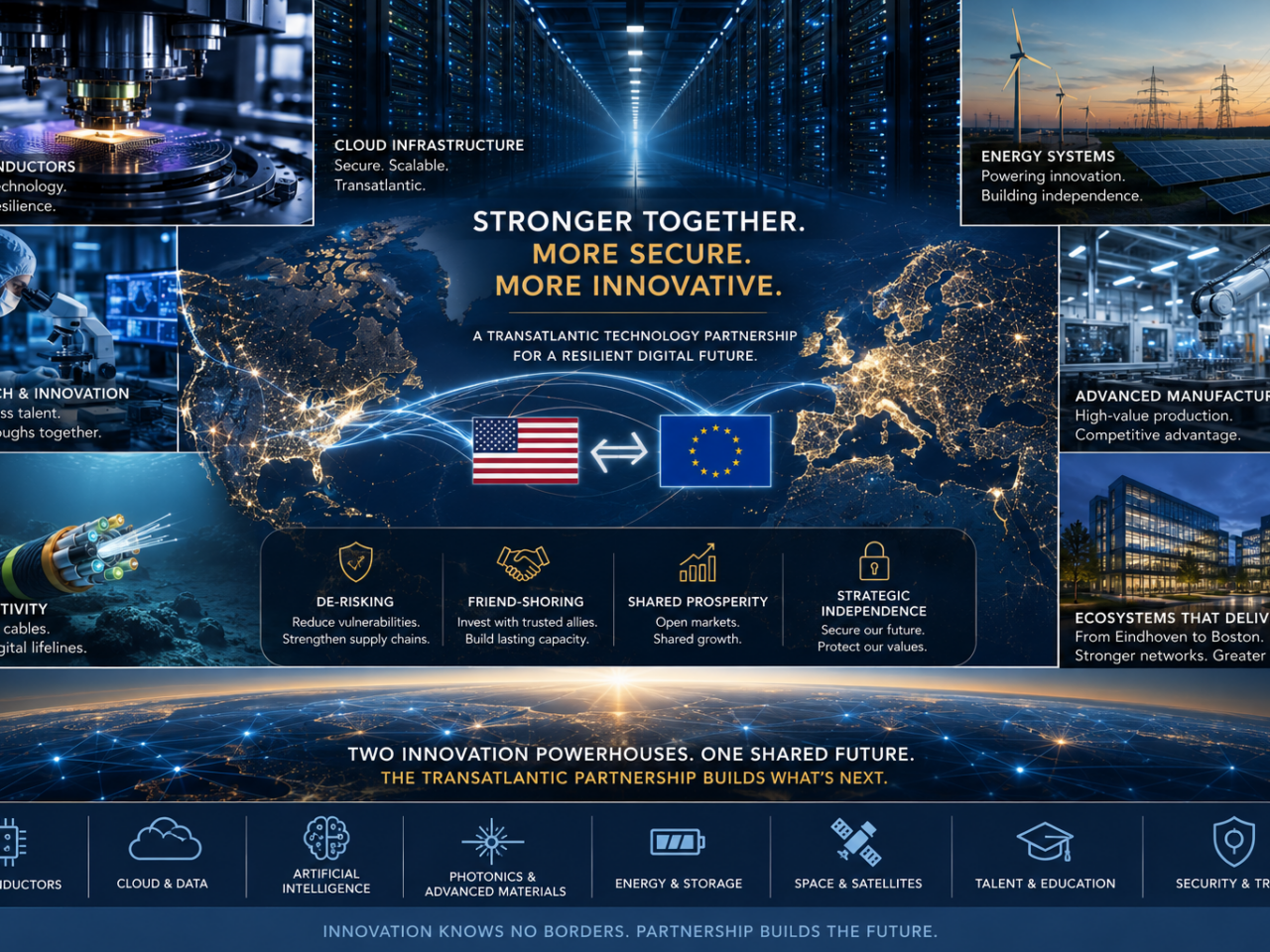
Why Washington should pay attention to Europe’s new technology strategy
For years, discussions about global technology leadership followed a familiar script. The United States was seen as the innovator. China was seen as the manufacturer. Europe was seen as the regulator. That narrative is becoming increasingly outdated.
With the launch of the European Union’s new Tech Sovereignty Package, Brussels is signaling a broader ambition. The objective is no longer simply to regulate technology markets. It is to strengthen Europe’s position within the technologies and infrastructures that underpin the digital economy.
This shift matters not only for Europe. It also matters for the United States.
Read More
Category: Semiconductors, Analysis, Artificial Intelligence, Capital, Energy, Energy, Featured Headlines, Industry, Industry, Infrastructure, Infrastructure, Insights, Manufacturing, Markets, Photonics, Photonics, Supply Chains, Technology · Tags: Artificial Intelligence, Europe, Innovation Ecosystems, Semiconductors, supply chains, Tech Sovereignty, Transatlantic Relations, United States
Posted by Altair Media on March 20, 2026 · Leave a Comment

Slower growth, ageing and migration volatility are quietly redefining the foundations of the US economy
The United States is not running out of people. But it is running out of demographic momentum.
For decades, population growth functioned as a silent engine of economic expansion. More workers, more consumers, more housing demand — growth reinforced itself. That dynamic is now weakening.
Fertility rates have fallen below replacement level. Immigration, long the system’s release valve, is becoming more volatile and politically constrained. At the same time, the population is ageing as baby boomers exit the workforce in large numbers.
Individually, these trends are familiar.
Together, they signal a structural break.
The issue is not absolute decline, but changing composition. Fewer entrants into the labour force tighten markets in ways that are not cyclical, but systemic. Wage pressures increase, but so do constraints on output. Growth becomes harder to scale.
Ageing amplifies the shift. As the share of older Americans rises, the economy gradually reorients — away from expansion-driven sectors such as housing and education, and toward healthcare and services. Consumption does not disappear, but it changes direction.
Public finances face a parallel transition. A shrinking ratio of workers to retirees places increasing strain on entitlement systems, forcing difficult trade-offs between taxation, spending and growth.
Migration remains the most immediate lever — but no longer a stable one. What was once a predictable source of renewal is now shaped by political cycles, turning demographic stability into policy risk.
The conventional view is that US population growth is simply slowing.
The signal is that its function within the economy is changing.
This marks a deeper transition. Growth can no longer rely on demographic expansion alone. It must increasingly come from productivity, labour participation and technological leverage.
That is a more complex model — and a more fragile one.
Demography does not dictate outcomes.
But it defines the boundaries within which strategy operates.
Photo credit: Photo by Christopher Campbell / Unsplash
Posted by Altair Media on March 19, 2026 · Leave a Comment

AI scaling is often framed as a question of computing power. The constraint is shifting elsewhere.
As models grow larger and data centres expand, energy demand is rising at a pace infrastructure struggles to match. Power availability and grid capacity are becoming limiting factors in how AI systems scale.
This shift changes how technological leadership is defined. It is no longer only about chips or models, but about access to reliable and scalable energy systems.
Emerging technologies are not just advancing computation — they are redefining the relationship between technology and infrastructure.
Illustration: AI infrastructure and energy systems convergence (generated by OpenAI DALL·E)
Posted by Altair Media on March 19, 2026 · Leave a Comment

The Federal Reserve’s decision to hold rates steady this week was widely expected. The context, however, was not.
With inflation projections revised upward — driven in part by rising energy prices — and financial markets still anticipating easing, the Fed is navigating a landscape in which signals no longer align. Growth is slowing, inflation is persistent and geopolitical risk is re-entering the equation.
The result is not a clear policy direction, but a pause.
That pause is often interpreted as indecision. It is better understood as a reflection of uncertainty within the system itself. Monetary policy is increasingly shaped not only by domestic indicators, but by external shocks — energy markets, geopolitical tensions and global supply dynamics.
In this environment, interest rates are no longer just a tool for managing inflation. They become part of a broader feedback loop between markets, expectations and systemic risk.
The Fed’s message is therefore less about what it will do next, and more about what it cannot yet determine.
Image: AI generated — Market volatility and shifting signals in a complex macro environment
Posted by Altair Media on March 19, 2026 · Leave a Comment

How semiconductors became the most strategic resource of the 21st century
In a quiet corner of the Netherlands, far from the geopolitical flashpoints that typically dominate headlines, sits one of the most consequential companies in the modern world. Its products are not consumer-facing. Its name is barely known outside industry circles. Yet without it, the global economy would stall within months.
Semiconductors—tiny slices of engineered silicon—have become the invisible infrastructure of our time. They power everything from smartphones and electric vehicles to artificial intelligence systems and military hardware. But to describe them merely as components is to miss their true significance. Today, semiconductors are instruments of power.
Their importance lies not just in what they do, but in where and how they are made. The global semiconductor supply chain is one of the most complex and fragile industrial systems ever created—hyper-specialized, geographically concentrated and increasingly politicized.
Only in recent years has the broader world begun to grasp what industry insiders have long understood: control over semiconductors is no longer an economic advantage. It is a strategic necessity.
“Chips are the new oil. The past fifty years were defined by where oil and gas reserves were located. The next fifty years will be defined by where semiconductor supply chains are and where chips are produced.”
Pat Gelsinger, CEO, Intel
(Source: CNBC, 2023)
Read More
Category: Semiconductors, Analysis, Featured Headlines, Technology · Tags: AI, ASML, chip industry, Geopolitics, Photonics, Semiconductors, supply chain, technology strategy
