Light After Copper
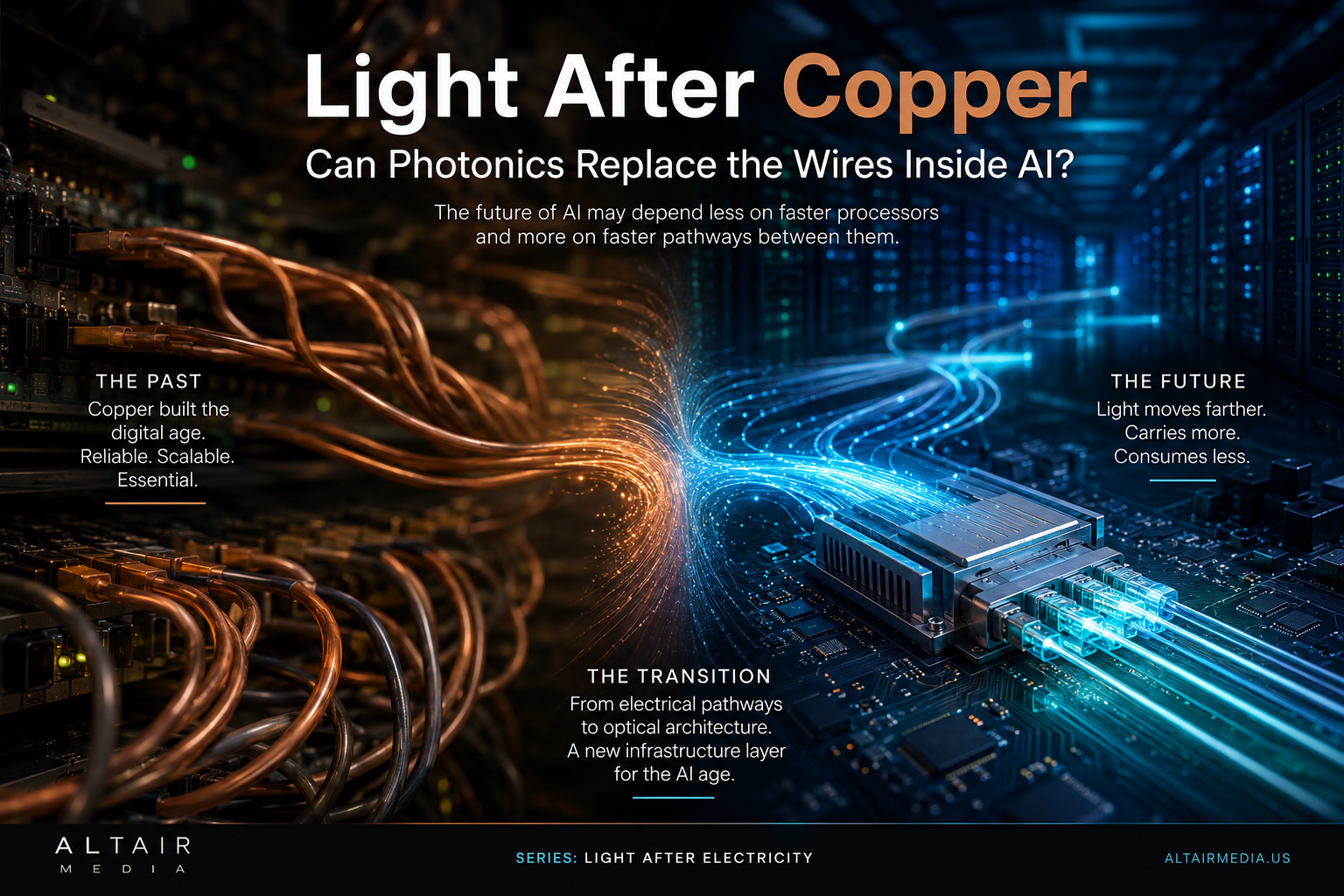
Can Photonics Replace the Wires Inside AI?
Modern computing has long been described as a triumph of semiconductors. That description is no longer sufficient. Artificial intelligence is not simply creating faster computers. It is creating computing systems in which communication is becoming as important as computation itself.
For decades, progress depended largely on improving processors. Today, it increasingly depends on moving information efficiently between them. The future of AI may therefore be determined less by computing power than by communication architecture.
Copper Built the Digital Age
Copper rarely appears in discussions about artificial intelligence. Yet few materials have contributed more to the digital economy.
For decades it connected processors, memory, storage and networks, quietly carrying electrical signals through every layer of modern computing. Cloud services, hyperscale datacentres and today’s AI infrastructure all emerged on foundations built with copper.
Every computing revolution has depended upon an invisible communication system.
Its importance was never its visibility. It was its reliability. Without copper, modern computing would never have achieved its extraordinary scale.
AI Changes the Architecture
Traditional computing systems were designed around relatively compact architectures. A processor communicated with nearby memory. Information travelled short distances, while most calculations occurred within a single machine. Artificial intelligence fundamentally changes that balance.
Training and deploying modern AI models requires thousands of processors operating simultaneously, continuously exchanging enormous volumes of information. Computation remains essential. Communication becomes indispensable.
The modern datacentre is becoming less a computer and more a network.
The larger AI systems become, the more coordination they require. Increasingly, performance depends not only on the speed of individual processors, but on the efficiency with which they exchange information.
The modern AI datacentre is no longer simply a computer. It is becoming a communication system.
When Copper Meets Physics
For decades, electrical interconnects evolved alongside processors. They became faster. Smaller. More efficient. Yet unlike software, physics does not scale indefinitely.
As transmission speeds increase, electrical signals lose energy over distance, generate more heat and require increasingly complex engineering to maintain signal quality. Copper is not failing. It is reaching the practical limits imposed by the laws of physics.
Artificial intelligence may be creating the first generation of computing systems where communication matters more than computation.
For artificial intelligence, those limits are becoming increasingly significant. As clusters expand towards tens of thousands—and eventually hundreds of thousands—of processors, communication itself begins to rival computation as the defining challenge of system design.
Moving Light Closer to Silicon
Integrated photonics approaches the problem differently. Instead of carrying information as electrical current, photonic integrated circuits transmit data using light travelling through microscopic waveguides.
The objective is not to replace processors. Nor is it to replace silicon. The objective is to change how processors communicate. This explains why so much attention is focused on co-packaged optics.
The semiconductor industry spent decades shrinking transistors. It may spend the next decades learning how to guide light.
Rather than sending electrical signals across increasingly crowded boards before converting them into light, optical communication moves closer to the processor itself. The transition is therefore not one of replacement, but of integration.
Electrons continue to perform logic. Photons increasingly carry information. Whether this architecture can be manufactured economically remains one of the semiconductor industry’s greatest engineering challenges.
A Different Infrastructure Question
The discussion surrounding photonics is often presented as another semiconductor story. It is something larger. It is a story about infrastructure.
For decades, technological leadership was measured by faster processors. Tomorrow, it may increasingly be measured by faster communication architectures.
Artificial intelligence is quietly transforming datacentres into communication infrastructures whose success depends upon moving information as efficiently as possible. That changes the strategic question entirely.
The future may not belong to whoever builds the fastest chip. It may belong to whoever builds the fastest network between them.
Friction
Artificial intelligence is changing the architecture of computing. Not because processors have stopped improving. But because communication is becoming the new constraint.
Artificial intelligence is transforming the computer into a communication system.
For decades, innovation meant making transistors smaller. The next era may be defined by making communication faster.
Photonics therefore represents more than another semiconductor technology. It represents an attempt to redesign the invisible infrastructure upon which artificial intelligence increasingly depends.
Signify
Light After Electricity explores how integrated photonics, optical systems and energy-constrained computing may redefine the architecture of artificial intelligence, datacentres and digital infrastructure. From photonic integrated circuits and manufacturing challenges to geopolitics and energy systems, the series examines whether light can become the next foundational layer of computation.
Credit
Illustration: Altair Media / AI-generated visualisation
Caption
Conceptual illustration of the architectural transition inside AI datacentres. Traditional copper interconnects converge with optical communication pathways, symbolising the shift from electrical data movement towards integrated photonics as communication becomes the defining constraint of next-generation computing.
