The AI Boom Is Growing. So Is the Financial Dependency.
Record revenues confirm Nvidia’s extraordinary momentum. But the financial architecture supporting the AI expansion is becoming increasingly complex.
Nvidia’s latest quarterly results reveal an extraordinary acceleration in artificial intelligence infrastructure spending. Revenue has more than doubled, demand remains strong and expectations continue to rise. Yet behind these impressive figures lies a more consequential development: the world’s leading AI chipmaker is becoming increasingly involved in financing and supporting the infrastructure its customers need.
The question is no longer simply how fast AI can grow. It is how that growth is financed, sustained and ultimately rewarded.
🟥 Can extraordinary revenue growth conceal a deeper financial imbalance?
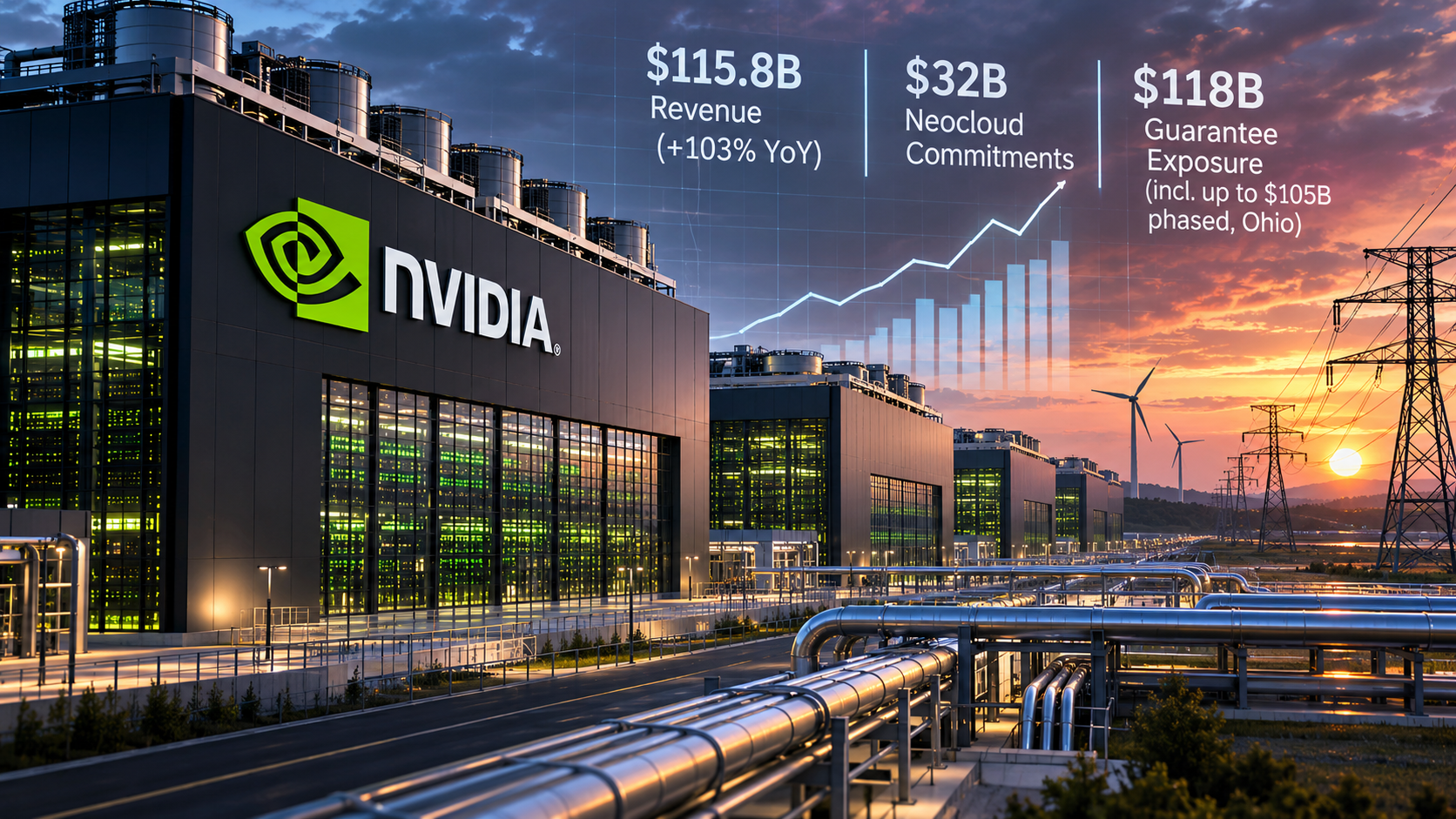
Nvidia reported revenue of $115.8 billion for its third quarter of fiscal 2027, an increase of 103% from a year earlier. Data center revenue reached $107.6 billion, while the company projected approximately $130 billion in revenue for the following quarter.
These numbers demonstrate the extraordinary scale of investment flowing into artificial intelligence infrastructure. Technology companies, cloud providers and specialized AI operators continue purchasing computing capacity at unprecedented levels.
For Nvidia, that translates into exceptional commercial performance. For the broader AI economy, however, the picture is more complicated.
Revenue generated by selling computing infrastructure is not the same as economic value generated by deploying it. Customers must eventually earn sufficient returns from AI services to justify their investments in processors, data centers, electricity and networking.
This distinction matters because the companies supplying AI infrastructure can generate substantial profits long before their customers establish sustainable business models.
The tension: Nvidia’s revenues demonstrate powerful demand for computing infrastructure, but not necessarily the profitability of the businesses purchasing it.
🟥 When does a technology supplier become part of the financing system?
Nvidia’s financial disclosures reveal a growing involvement in the capital structures supporting AI infrastructure development.
In its latest CFO Commentary, the company reported up to $32 billion in future commitments under agreements with neocloud providers. These commitments depend on financing, deployment and operational conditions being satisfied. Nvidia can generate revenue from infrastructure sales and, under specified circumstances, participate in revenue generated by its customers.
More significantly, Nvidia disclosed guarantees with a maximum gross exposure of $118 billion. This includes up to $105 billion in phased credit support connected to SB Energy’s PORTS-Pike Technology Campus in Ohio, where Nvidia infrastructure is intended to support OpenAI under long-term leases.
The distinction is important. The $105 billion represents a maximum potential exposure, not an immediately effective guarantee or an amount already paid. Individual guarantees become effective only as buildings are completed and ready for service, with the first expected in fiscal 2029.
Nvidia reports that no payments have been made under these guarantees.
Nevertheless, the strategic significance extends beyond accounting. Nvidia is increasingly helping create the financial and physical conditions under which its products can be purchased and deployed.
That can accelerate infrastructure development. It can also create relationships in which suppliers, customers and financiers become more economically dependent on one another.
The tension: Financial support can expand the market for AI infrastructure while simultaneously increasing the interdependence of those funding, supplying and operating it.
🟥 Who ultimately carries the financial risk?
The expansion of AI infrastructure requires far more than processors. It demands enormous investments in land, power generation, construction, cooling, networking and long-term computing capacity.
These investments involve participants with fundamentally different financial responsibilities.
Hyperscalers can finance infrastructure through operating cash flow and capital markets. Specialized neocloud providers may depend more heavily on external financing, long-term customer contracts and the collateral value of their computing assets.
Institutional investors, infrastructure funds and private credit providers increasingly form part of this financing landscape.
Nvidia’s arrangements introduce another dimension by adding supplier-backed guarantees and commitments to selected infrastructure projects.
The company itself acknowledges the underlying challenge. In its third-quarter CFO Commentary, Nvidia observes that some neocloud providers and frontier AI laboratories are growing faster than their balance sheets and long-term credit profiles can support.
That observation is particularly revealing.
The resulting financing system distributes exposure across multiple institutions, but does not necessarily eliminate the underlying economic risk. A deterioration in customer demand, reduced infrastructure utilization or disappointing returns could affect several interconnected participants.
The crucial distinction is between distributing financial exposure and genuinely transferring economic risk.
The tension: AI financing may become more diversified even as the underlying sources of repayment remain concentrated in expectations of future AI demand.
🟥 Can infrastructure investment continue to outpace commercial adoption?
AI infrastructure is being constructed in anticipation of future demand.
That is not inherently unusual. Telecommunications networks, electricity systems and transport infrastructure have frequently required substantial investment before their full economic potential could be realized.
Artificial intelligence introduces an additional complication: technological generations are developing rapidly, while the infrastructure supporting them is often financed over much longer periods.
A data center may operate for decades, but the processors installed inside it can face successive generations of increasingly capable and potentially more efficient equipment.
Nvidia’s latest disclosures illustrate this contrast. The company is securing long-term supply, energy and data center capacity while continually introducing new computing architectures.
For investors, the challenge is to distinguish durable infrastructure value from assets exposed to rapid technological replacement. Buildings, land, power connections and cooling systems may remain useful across successive hardware generations, while the economics of the computing equipment itself can change much faster.
Strong demand for today’s processors does not automatically establish the long-term economics of every project built around them.
The tension: The AI industry is financing infrastructure for the long term while operating in a technology market defined by rapid change.
🟥 Does Nvidia’s leadership transition change the financial equation?
The departure of Jensen Huang and the appointment of Colette Kress as interim CEO introduce another dimension to Nvidia’s transformation.
For decades, Huang combined technological leadership with an unusually influential role in shaping Nvidia’s relationships with customers, investors and policymakers.
The company now faces the challenge of demonstrating that its industrial and commercial momentum can continue independently of its founder’s personal leadership.
The quarterly results provide strong evidence of operational momentum. They do not, however, resolve every strategic question surrounding Nvidia’s increasingly extensive financial commitments.
As the company prepares for its next phase of leadership, an important question concerns how far it should continue supporting the expansion of the customer ecosystem on which its own growth depends.
Such arrangements may strengthen Nvidia’s competitive position and accelerate the development of AI infrastructure. They also require careful decisions about financial exposure, counterparties and the allocation of capital.
That is no longer solely a technological question. It is also a question of corporate governance and financial discipline.
The tension: Nvidia’s commercial success remains exceptional, but its expanding role in the AI financing system makes financial governance increasingly important.
The Signal
Nvidia’s record results confirm that the AI infrastructure boom remains powerful. They also reveal how closely technology development, financing and future demand are becoming interconnected.
The central question is not whether Nvidia can continue selling advanced processors. It is whether the expanding ecosystem purchasing those processors can generate sustainable returns without requiring ever-greater financial support.
The next phase of the AI economy may be determined less by computing power than by the financial structures supporting it.
Sources and reporting basis
- Nvidia — Third Quarter Fiscal 2027 Financial Results, November 17, 2026
- Nvidia — Q3 FY2027 CFO Commentary, November 17, 2026, filed with the SEC
- Nvidia — Supplemental Financial Information, November 17, 2026
- Nvidia — CEO Transition Announcement, November 12, 2026
Reporting note: Nvidia’s third-quarter Form 10-Q had not yet been filed at the time of this analysis. Financial commitments and guarantees are based on the company’s published CFO Commentary. Maximum exposures and conditional commitments should not be interpreted as realized losses or immediately payable obligations.
Altair Signal | United States | Capital & Growth
Image Credit
AI-generated editorial illustration | Altair Media
Caption
Nvidia’s expanding AI ecosystem connects data centers, energy infrastructure and financial commitments. As investment accelerates, questions grow over how financial risks are distributed across the industry.
