The Photonic Constraint
Why AI May Be Running Out of Electrons
For years, artificial intelligence was assumed to be a computational challenge defined by larger models, faster processors and ever greater amounts of compute capacity. Increasingly, however, the bottleneck is shifting. As algorithms evolve, moving information itself is becoming more difficult, more expensive and more energy-intensive than the act of calculation.
🟦 What if communication consumes more energy than computation?
Artificial intelligence depends entirely upon movement. Data travels continuously between GPUs, memory systems, accelerators and server racks. As clusters expand towards tens of thousands of processors, transporting this information becomes an increasingly significant source of energy consumption and heat generation.
For decades, faster silicon compensated for architectural inefficiencies. Today, the physics of information movement has itself become the problem.
Computers are no longer constrained by logic alone. They are increasingly constrained by distance.
🟦 Is AI becoming a transportation problem?
For more than half a century, computing advanced through transistor scaling. Moore’s Law rewarded isolated processing power.
Yet modern AI systems increasingly resemble communication networks rather than standalone computers. Thousands of processors exchange enormous volumes of data in real time.
At scale, processors spend growing amounts of time waiting for information to arrive. Bandwidth. Latency. Signal integrity. Distance.
The future bottleneck may no longer be processing capacity. It may be velocity across increasingly complex systems.
The future of computing may depend less on faster processors and more on faster pathways between them.
🟦 Could photonics redefine the limits of copper?
Copper built the digital age. It connected processors, linked servers and enabled the rise of hyperscale computing. Yet copper obeys unforgiving physical laws.
Higher frequencies over longer distances inevitably generate greater losses, increased heat production and higher power requirements.
Integrated photonics offers an alternative. Instead of transporting information through electrical interconnects, photonic systems encode data in light travelling through microscopic waveguides.
The ambition is not to replace electronics. It is to create a hybrid architecture.
Electrons compute.
Photons communicate.
Whether such systems can scale economically remains uncertain. Manufacturing remains difficult. Packaging remains complex. Commercial deployment remains limited. Yet the underlying challenge is becoming increasingly difficult to ignore.
The semiconductor industry spent decades shrinking transistors. It may spend the next decades learning how to guide light.
🟦 Can infrastructure evolve faster than AI?
Artificial intelligence scales exponentially. Infrastructure rarely does. Electricity grids require decades to adapt. Datacentres take years to build. Manufacturing ecosystems evolve slowly. Energy systems scale differently from software.
The fundamental challenge facing artificial intelligence may therefore be less computational than infrastructural. Not because light is inherently superior to electricity. But because modern computing may be approaching the practical limits of what electrons alone can sustain.
Friction
Artificial intelligence may not be running out of ideas. It may be running out of electrons.
For seventy years, computing advanced by making transistors smaller. The next era may be defined by making communication faster.
Photonics therefore represents more than an engineering shift. It represents an attempt to reconcile the ambitions of the digital economy with the physical realities of energy, heat and infrastructure.
The question is whether light can scale before electricity itself becomes the hard ceiling of the AI age.
Signify
Light After Electricity explores how integrated photonics, optical systems and energy-constrained computing may redefine the architecture of artificial intelligence, datacentres and digital infrastructure. From photonic integrated circuits and manufacturing challenges to geopolitics and energy systems, the series examines whether light can become the next foundational layer of computation.
Credit
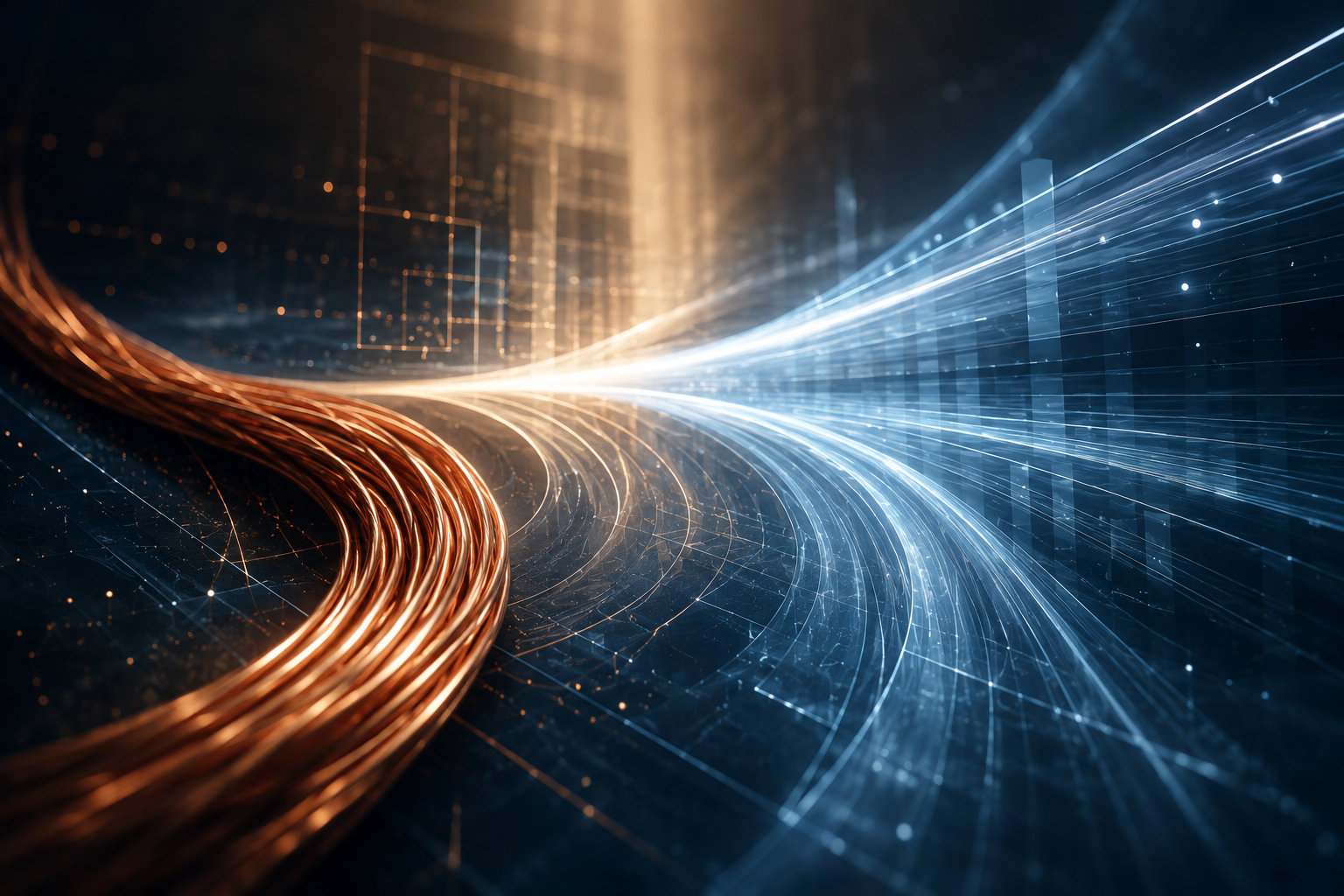
Illustration: Altair Media / AI-generated visualisation
Caption
Abstract visualisation of the transition from electrical to optical computing. Copper pathways converge with streams of light, symbolising the growing role of integrated photonics as digital infrastructure encounters the physical limits of energy, heat and data movement.
