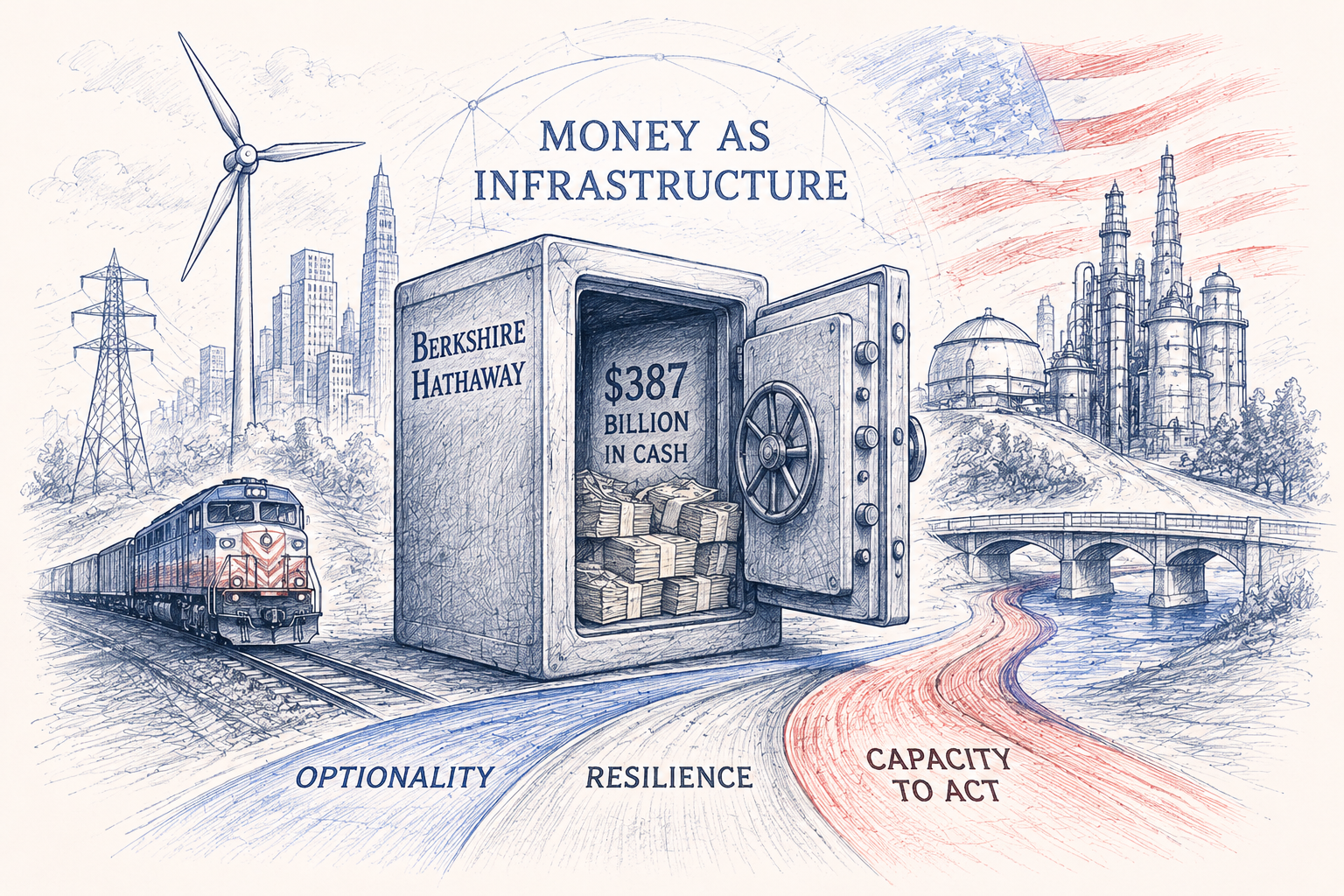
Berkshire Hathaway’s vast liquidity is often interpreted as caution. Yet in an age increasingly defined by uncertainty, cash may represent something more profound: reserve capacity, strategic optionality and the ability to act when resilience becomes more valuable than efficiency.
Infrastructure
Physical and digital networks shaping connectivity, productivity and the foundations of modern economic activity.

BT and Verizon’s proposed joint venture may signal more than consolidation. It suggests that telecommunications is evolving into a platform business where sovereignty, cloud connectivity and AI infrastructure increasingly converge into a new global enterprise layer.

Artificial intelligence is often described as a software revolution. Yet behind every AI model lies a growing demand for electricity. As data centres expand and computing capacity increases, energy is emerging as one of the most important foundations of the digital economy. The future of AI may depend not only on algorithms, but also on the systems that generate and deliver power.

Digital payments, subscriptions and embedded finance have made spending faster and increasingly invisible. As friction disappears from modern finance, societies may also be losing emotional awareness around value, debt and consumption — especially inside digital environments designed to bypass hesitation itself.

Europe’s new technology strategy is not about decoupling from the United States. It is about becoming indispensable within the infrastructures, supply chains and innovation ecosystems that underpin the digital economy, reshaping the future of transatlantic technological cooperation and resilience.

As robots become more capable, the most important questions may no longer be technological. This article explores how societies can balance automation, human responsibility and meaning in a future increasingly shaped by intelligent machines and autonomous systems.
